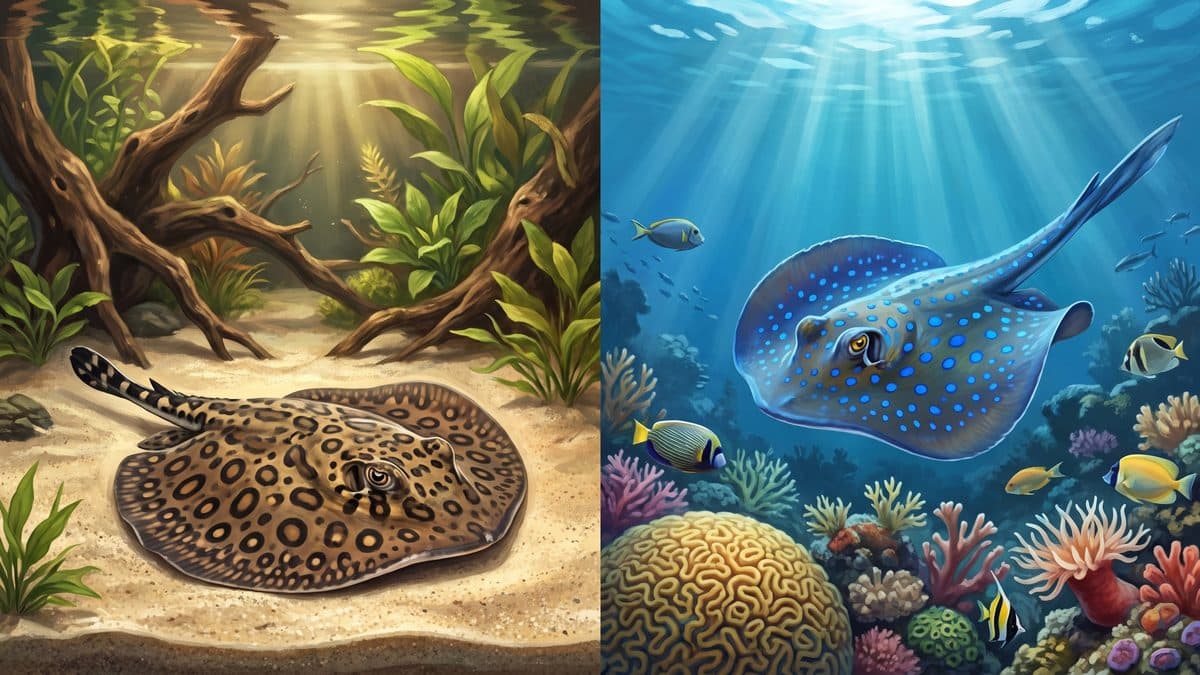
Freshwater vs Saltwater Stingray: Can You Keep Rays at Home?
Stingrays represent the ultimate aspiration for many fishkeepers — graceful, intelligent, and undeniably exotic. The flat, disc-shaped body, whip-like tail, and almost alien mode of locomotion make them unlike anything else in the aquarium hobby. But "stingray" encompasses a vast group of cartilaginous fish spanning freshwater rivers, brackish estuaries, and open oceans — and the difference between keeping a freshwater ray and a saltwater ray at home is enormous.
This guide explains why freshwater stingrays have become a viable — if demanding — home aquarium species, while saltwater stingrays remain almost exclusively the domain of public aquaria and advanced marine specialists.
Freshwater Stingray Overview
Freshwater stingrays belong to the family Potamotrygonidae, endemic to South American river systems — primarily the Amazon, Orinoco, Paraná, and their tributaries. The family contains roughly 40 described species across four genera (Potamotrygon, Paratrygon, Plesiotrygon, and Heliotrygon), with new species still being discovered. Unlike marine rays, Potamotrygonids are obligate freshwater fish — they have lost the ability to osmoregulate in saltwater.
The most popular aquarium species include:
- Motoro Ray (Potamotrygon motoro): The most commonly kept species. Olive to brown disc with prominent orange-yellow ocelli (eye spots). Disc width 35–50 cm in typical aquarium conditions, up to 60 cm in large setups. Hardy and relatively adaptable for a ray. Price: $100–$500.
- Black Diamond Ray (Potamotrygon leopoldi): Jet-black disc with bright white polka dots. One of the most visually striking freshwater fish in the world. Disc width 40–60 cm. More sensitive and expensive. Price: $500–$10,000+ for high-contrast specimens.
- Pearl Ray (Potamotrygon jabuti): Dark base with orange-gold pearl-like markings. Disc width 40–55 cm. Sought-after and expensive. Price: $1,000–$5,000.
- Hystrix Ray (Potamotrygon hystrix): Brown with a complex pattern of rosettes. Moderate size at 30–45 cm disc width. A good starter ray. Price: $150–$400.
Freshwater rays are intelligent — they learn to recognise their keepers, accept hand-feeding, and can be trained to approach a specific feeding spot. Their care demands are significant: enormous tanks, pristine water quality, and a high-protein diet. But they are among the most rewarding fish in the hobby for keepers willing to meet their needs.
Saltwater Stingray Overview
Marine (saltwater) stingrays encompass multiple families within the order Myliobatiformes, including Dasyatidae (whiptail stingrays), Myliobatidae (eagle rays), and Urolophidae (round stingrays). There are over 200 described species inhabiting tropical and temperate oceans worldwide. They range from the relatively small Yellow Stingray (Urobatis jamaicensis, 35 cm disc width) to the massive Short-tail Stingray (Bathytoshia brevicaudata, 2+ metres disc width).
Species occasionally seen in the marine aquarium trade include:
- Blue-spotted Ribbontail Ray (Taeniura lymma): Perhaps the most commonly attempted marine ray in home aquariums — a beautiful species with electric blue spots on an olive disc, reaching 30–35 cm disc width. Unfortunately, it has a poor survival record in captivity due to stress sensitivity, refusal to feed on prepared foods, and need for large sand flats.
- California Round Ray (Urobatis halleri): A small (20–30 cm), temperate species that adapts better to captivity than tropical marine rays. Requires cooler water (15–22 °C).
- Cortez Round Ray (Urobatis maculatus): Similar to the California Round Ray, with spotted patterning. Moderate adaptability to captive conditions.
The vast majority of saltwater stingrays are not suitable for home aquariums. Most species grow far too large, require specialised marine environments with deep sand beds, and have poor records of captive survival. Public aquaria maintain marine rays successfully because they can provide the thousands of gallons, professional water quality management, and veterinary care these animals require.
Key Differences
Captive Feasibility
This is the overriding distinction. Freshwater stingrays (Potamotrygonidae) have been successfully kept and bred in home aquariums for decades. A dedicated hobbyist with a 180–300+ gallon tank, heavy filtration, and consistent water-change discipline can maintain Motoro or Hystrix rays for their full 15–20 year lifespan. Saltwater stingrays, with very few exceptions, do not adapt well to captive conditions. Even the "beginner-friendly" Blue-spotted Ribbontail Ray has a high mortality rate in home aquariums, largely due to feeding difficulties and stress from inadequate space.
Water Chemistry
Freshwater rays require soft, acidic to neutral water (pH 6.0–7.0, TDS 50–200 ppm) at warm temperatures (26–30 °C). They are extremely sensitive to ammonia and nitrite — even trace levels cause disc curling, loss of appetite, and death. Nitrates should be kept below 20 ppm. This demands massive filtration, frequent large water changes (50 % weekly is common), and often RO/DI water systems.
Saltwater rays require full marine conditions: salinity 1.023–1.026 SG, pH 8.0–8.4, stable temperature, and all the complexity of marine water chemistry (alkalinity, calcium, magnesium management). A marine ray system is effectively a fish-only-with-live-rock (FOWLR) setup of enormous proportions — 300+ gallons minimum for even small species, with a massive sump, protein skimmer, and automated water-change system.
Venom
Both freshwater and saltwater stingrays are venomous — their tails are equipped with one or more serrated, venomous barbs (spines) capable of delivering excruciatingly painful stings. Freshwater ray stings are medically significant: the venom causes intense, radiating pain, tissue necrosis, and secondary infection. Hot water immersion (45 °C / 113 °F) denatures the protein-based venom and provides the most effective first aid. Stingray keepers must always exercise extreme caution during tank maintenance — never reach into a ray tank without knowing exactly where the ray is. Thick rubber gloves offer some protection but are not sting-proof.
Quick Comparison Table
| Factor | Freshwater Stingray (Potamotrygonidae) | Saltwater Stingray (various families) |
|---|---|---|
| Typical Disc Width (aquarium spp.) | 30–60 cm | 20–200+ cm |
| Lifespan | 15–20 years | 15–25+ years |
| Minimum Tank Size | 180 gal (small spp.); 300+ gal (large spp.) | 300+ gal (small spp.); public aquaria only (most) |
| Water Type | Soft, acidic freshwater (pH 6.0–7.0) | Full marine (SG 1.023–1.026, pH 8.0–8.4) |
| Temperature | 26–30 °C | 22–28 °C (species-dependent) |
| Captive Breeding | Regularly achieved by hobbyists | Rare; mostly in public aquaria |
| Availability | Good (specialist breeders and importers) | Poor (few species, poor survival rates) |
| Cost | $100–$10,000+ | $50–$500 (species that enter trade) |
| Venomous | Yes (tail barb) | Yes (tail barb) |
| Home Aquarium Suitability | Feasible for dedicated hobbyists | Not recommended for most hobbyists |
Tank Requirements Comparison
Freshwater stingray tank setup: A single small-to-medium freshwater ray (Motoro, Hystrix) needs a minimum of 180 gallons with a footprint of at least 72 × 24 inches — rays are bottom-dwellers that need floor space, not height. Larger species (Leopoldi, large Motoro) need 300+ gallons. The tank should have a fine sand substrate (2–3 cm depth) that allows the ray to bury itself — a natural stress-reduction behaviour. Bare-bottom is acceptable but less natural.
Filtration must be enormous: a sump with 50–100 gallons capacity, packed with biological media, with a turnover rate of 8–10 times tank volume per hour. A UV steriliser is recommended to reduce bacterial load. Water changes of 40–50 % weekly are standard for serious ray keepers — some do 25 % twice weekly. Temperature should be maintained at 27–29 °C with redundant heaters. Ammonia and nitrite must be undetectable at all times; nitrate below 20 ppm.
Tank mates must be chosen carefully: large, peaceful fish that stay off the substrate. Silver Dollars, large Tetras (Congo, Buenos Aires), Geophagus cichlids, and Arowanas (in tanks 300+ gallons) are compatible. Avoid bottom-dwellers (Plecos, Corydoras) that compete for substrate space and may be stung or eaten.
Saltwater stingray tank setup: The few marine ray species occasionally kept in home aquariums (Blue-spotted Ribbontail, California Round Ray) require a minimum of 300 gallons with an expansive sand flat — a deep sand bed of 10–15 cm fine aragonite sand across at least 60 % of the tank floor. The system needs a full marine setup: large protein skimmer, sump with biological filtration, return pump providing 6–8 times turnover, RO/DI water for top-off and water changes, and salt mixing equipment.
The fundamental challenge is that marine rays need space to swim and bury in sand, which means décor must be minimal and the tank footprint must be enormous. A 300-gallon marine system with adequate equipment costs $5,000–$15,000 to set up, and the high failure rate of captive marine rays makes this a poor investment for most hobbyists. Public aquaria succeed because they provide pools of 10,000+ gallons with professional life-support systems.
Which Should You Choose?
Choose a freshwater stingray if:
- You have 180+ gallons (footprint-oriented) with heavy-duty filtration
- You are an experienced fishkeeper comfortable with demanding water-quality requirements
- You understand and accept the venom risk and can maintain safe handling protocols
- You want one of the most interactive, intelligent bottom-dwelling fish available
- Stingray keeping is legal in your state/country (illegal in some US states and Australian states)
Choose a saltwater stingray if:
- You are an advanced marine aquarist with 300+ gallons and professional-grade equipment
- You have experience with challenging marine species and understand the high failure rate
- You are specifically interested in temperate species (California Round Ray) that adapt better than tropical species
- You are prepared for the possibility that the animal may not thrive despite your best efforts
Our recommendation: For home aquarists, freshwater stingrays are the only practical choice. The Motoro Ray (P. motoro) is the best starter species — relatively hardy, commonly captive-bred, reasonably priced, and stunningly beautiful. Saltwater stingrays belong in public aquaria where they can receive the space and professional care they require. If you are drawn to the idea of rays but cannot commit to 180+ gallons and intensive maintenance, consider starting with a freshwater stingray observation visit at your local public aquarium — and save ray keeping for when your fishroom can support it.