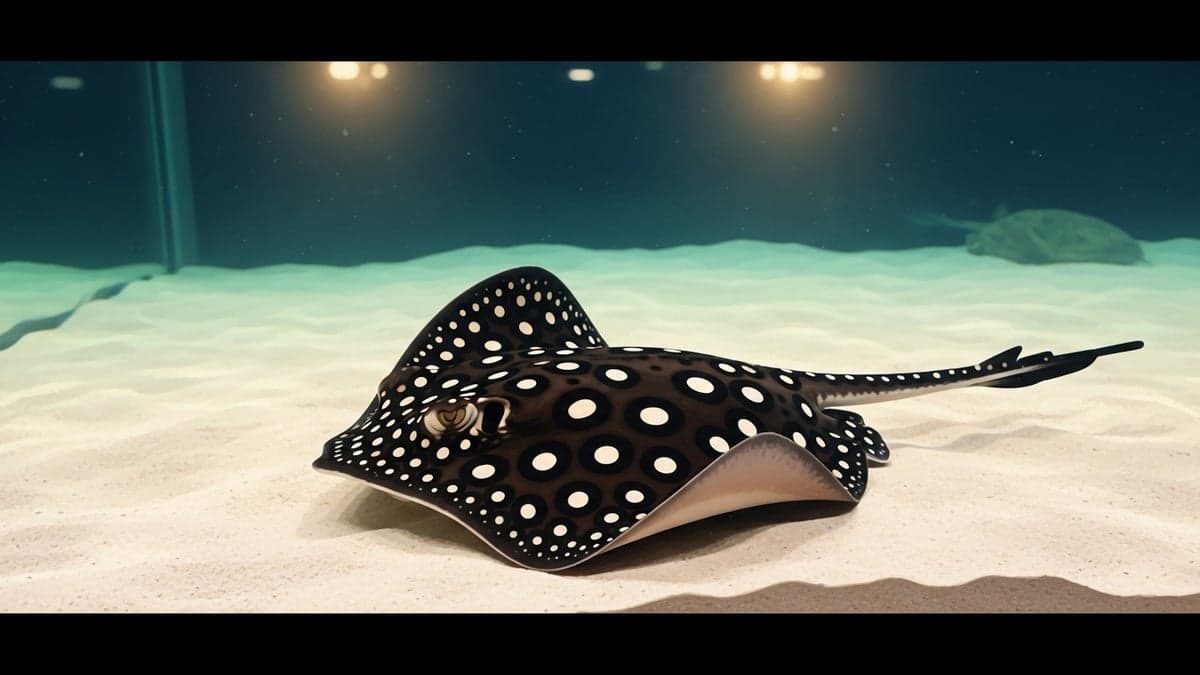
Introduction to Freshwater Stingrays
Freshwater stingrays of the family Potamotrygonidae are among the most impressive and demanding fish available to the home aquarist. Native to South American river systems — primarily the Amazon, Xingu, Tocantins, and Orinoco basins — they have adapted from marine ancestors to thrive in soft, acidic freshwater over millions of years. Their flat, disc-shaped bodies, graceful undulating locomotion, and often spectacular patterning make them centrepiece fish that draw attention in any room.
They are also among the most challenging species to keep. Stingrays are exquisitely sensitive to water quality, require enormous tank footprints, demand a high-protein diet fed almost daily, and carry a venomous caudal barb capable of inflicting excruciating injuries. This guide covers everything you need to know before committing to these extraordinary animals.
Popular Freshwater Stingray Species
Dozens of Potamotrygon species exist, but four dominate the US aquarium trade:
Motoro Stingray (Potamotrygon motoro)
The most commonly available and affordable freshwater stingray. Motoros display brown to olive discs with yellow-orange ocelli (eye-spots) arranged in concentric patterns. Adult disc width: 40–60 cm. Price: $150–$800 depending on size and pattern quality. Their relative hardiness and availability make them the recommended first stingray for intermediate to advanced keepers.
Black Diamond Polka Dot (Potamotrygon leopoldi)
The showpiece of the stingray world. Jet-black discs covered with bright white polka dots create one of the most striking patterns in the freshwater hobby. Native to Brazil's Xingu River, wild export is restricted, making captive-bred specimens the primary source. Adult disc width: 45–60 cm. Price: $1,500–$100,000+ depending on pattern quality and rarity of mutation. See our most expensive fish guide for premium specimen pricing.
Pearl Stingray (Potamotrygon sp. Pearl)
A relatively recent arrival in the trade, the Pearl Stingray displays a golden-brown disc with small, uniform pearl-like white spots. It is smaller than most Potamotrygon species (adult disc width 30–40 cm), making it more manageable in large home aquariums. Price: $300–$1,200.
Porcupine River Stingray (Potamotrygon hystrix)
Named for the rough, spine-like dermal denticles covering its disc, the Hystrix is a hardy species with muted brown coloration and subtle patterning. Adult disc width: 35–50 cm. Price: $200–$600. A solid choice for keepers who prioritise hardiness over visual flash.
Tank Requirements for Stingrays
Stingrays are bottom-dwellers that need floor space, not height. The critical measurement is the tank footprint — length × width — not volume.
- Minimum for a single juvenile: 180 gallons with a 6 × 2-foot footprint. This is temporary — juveniles outgrow this within 12–18 months.
- Minimum for a single adult: 300 gallons with an 8 × 4-foot footprint.
- For a breeding pair: 500+ gallons with a 10 × 4-foot footprint or larger.
- Tank height: 18–24 inches is sufficient. Taller tanks waste volume that does not benefit rays.
Substrate: Fine river sand (1–2 mm grain) is mandatory. Stingrays bury themselves in sand as a natural behaviour and to regulate their skin microbiome. Gravel, crushed coral, or bare bottoms cause ventral abrasion, bacterial infection, and chronic stress. Maintain sand depth at 3–5 cm. For detailed setup specifications, see our stingray tank setup guide.
Décor: Minimal. Large, smooth driftwood pieces positioned above the sand line are acceptable. Avoid sharp rocks, rough surfaces, or anything that reduces available floor space. Stingrays need unobstructed bottom area to move, feed, and bury.
Water Parameters
Stingrays are among the most water-quality-sensitive freshwater fish. Their large body surface area — essentially a wide, permeable disc — means they absorb toxins faster than torpedo-shaped fish of equivalent mass.
- Temperature: 26–28 °C (79–82 °F). Stability within ±1 °C is critical.
- pH: 5.5–6.8. Most Potamotrygon species prefer mildly acidic conditions. Avoid pH above 7.0 — alkaline water stresses their ion regulation systems.
- General Hardness: 1–6 dGH. Soft water mimics their natural blackwater habitat.
- Ammonia: 0 ppm — absolutely non-negotiable. Even 0.25 ppm ammonia can cause gill irritation and appetite loss in stingrays.
- Nitrite: 0 ppm.
- Nitrate: Below 10 ppm preferred; below 20 ppm maximum. Stingrays show stress behaviours (curling disc edges, reduced feeding) at nitrate levels that most fish tolerate comfortably.
Weekly water changes of 30–40 % are non-negotiable. Many serious stingray keepers perform 50 % changes twice weekly. Use dechlorinated, temperature-matched water — even small temperature differentials during water changes can trigger stress responses.
Filtration for Stingrays
Stingrays produce enormous bioload relative to their body mass. An adult Motoro stingray produces roughly the same waste as a 60 cm Arowana — but stingrays are less tolerant of the resulting water quality degradation.
Target turnover: 10–12× total system volume per hour. For a 300-gallon system, that means 3,000–3,600 GPH of filtration flow.
A sump-based system is the only practical approach for stingray tanks. Design the sump with oversized mechanical filtration (filter socks changed every 2–3 days), heavy biological media (15+ litres of sintered glass), and chemical polishing (activated carbon replaced bi-weekly). UV sterilisation (40+ watts) is strongly recommended — stingrays are susceptible to bacterial infections, and UV reduces waterborne pathogen load significantly.
Supplement the sump with a large canister filter (FX6 or equivalent) for redundancy. If the sump fails, the canister maintains biological filtration until you diagnose and repair the issue.
Feeding Freshwater Stingrays
Stingrays are carnivorous and require a high-protein diet to maintain their rapid metabolism. Feed juveniles daily; adults every other day.
Staple foods:
- Frozen raw shrimp (shell-on for calcium) — the backbone of most stingray diets.
- Frozen smelt or silversides — whole fish provide complete nutrition.
- Earthworms (nightcrawlers) — excellent protein source, readily accepted by all species.
- Live blackworms — ideal for juveniles and for stimulating feeding response in new arrivals.
- Frozen bloodworms — suitable for juveniles; too small as a staple for adults.
Supplementary foods:
- Mussels and clam meat — rich in trace minerals.
- Tilapia fillet — lean white fish, cut to appropriate size.
- High-quality sinking carnivore pellets (Hikari Massivore, Northfin Predator) — useful for nutrition rounding but should not exceed 30 % of the total diet.
Avoid feeder fish — they carry parasites, provide poor nutrition, and introduce disease risk into your system. Gut-loaded feeder shrimp are acceptable but should not be a staple.
Handling Safety and Venomous Barbs
Freshwater stingrays are venomous. Their caudal barb — a serrated spine located on the tail — delivers a protein-based venom that causes intense, immediate pain, tissue necrosis, and risk of secondary infection. Stingray envenomation is a medical emergency that often requires hospital treatment.
Safety protocols:
- Never reach into a stingray tank without visual confirmation of the ray's position. Rays bury in sand and are easy to step on or place your hand on accidentally.
- Use long-handled tools (18"+ aquascaping tools, feeding tongs) for all maintenance tasks.
- Wear puncture-resistant gloves (Kevlar-lined aquatic gloves) during water changes and tank maintenance.
- If stung: Immerse the wound in hot water (45 °C / 113 °F) immediately — heat denatures the protein-based venom and provides significant pain relief. Seek medical attention regardless of apparent severity.
- Do not attempt to trim or remove the barb. The ray regrows barbs after natural shedding, and improper removal causes severe stress and infection risk.
Common Health Issues
Stingrays are susceptible to several conditions that require prompt intervention:
- Death curl (curled disc edges): The most alarming symptom — indicates severe environmental stress, usually from high ammonia/nitrite, elevated nitrate, or pH crash. Perform an immediate 50 % water change with parameter-matched water and identify the root cause.
- Bacterial infections: Manifesting as white patches, ulcers, or cloudy eyes. Usually triggered by poor water quality or physical injury. Treat with broad-spectrum antibiotics (kanamycin + metronidazole) and improve water conditions.
- Parasites: Freshwater stingrays can harbour internal parasites (nematodes, trematodes), especially wild-caught specimens. Prophylactic deworming with praziquantel during quarantine is standard practice.
- Disc injuries: Abrasions from rough substrate or sharp décor can become infected rapidly. Fine sand substrate and smooth furnishings are preventive. Treat injuries with daily salt baths (1 tbsp per gallon for 10 minutes) and antibiotic food.
Tankmate Compatibility
Stingrays can coexist with carefully selected tankmates. The primary rules: nothing small enough to be eaten, nothing aggressive enough to bite the ray's disc, and nothing that competes for bottom space.
Good tankmates:
- Arowana — occupy the upper water column, minimal interaction with rays. The classic stingray companion.
- Large Bichirs (Polypterus endlicheri, P. ornatipinnis) — bottom dwellers but typically coexist peacefully with rays in large tanks.
- Datnoides (Tiger Fish) — mid-water predators, non-threatening to rays.
Avoid:
- Aggressive cichlids (Flowerhorn, large Oscars) — will bite ray disc edges.
- Plecos with sucker mouths — some species attach to stingray discs and damage the mucus coat, leading to infection.
- Small fish of any kind — stingrays eat anything they can pin to the substrate.
Browse The Fish Collection's stingray collection for available specimens, and consult our team for personalised compatibility advice.