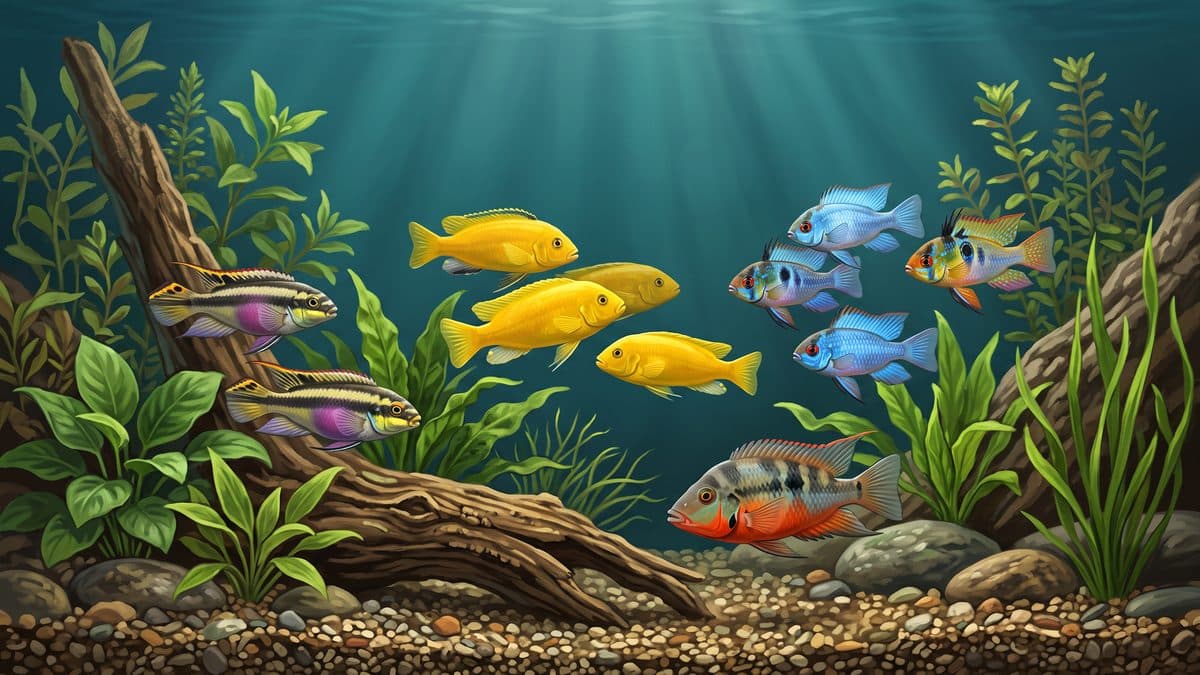
Why Cichlids Are Great for Beginners
Cichlids are one of the most diverse fish families on Earth, with over 1,500 described species spanning Africa, Central and South America, and parts of Asia. For beginners, this diversity is a double-edged sword: some cichlids are among the hardiest aquarium fish alive, while others demand expert-level care. The key is choosing the right species from the start.
What makes certain cichlids ideal for newcomers is a combination of disease resistance, tolerance of parameter swings, readily available food acceptance, and manageable adult size. Unlike many tropical fish that hide at the back of the tank, cichlids are front-and-centre personalities — they recognise their keepers, defend territories, and often breed readily in captivity, giving you a front-row seat to fascinating natural behaviours.
This guide focuses on seven species that combine beauty, personality, and genuine hardiness. Each has been selected because it thrives in a standard beginner setup without demanding precise water chemistry or specialised equipment.
Top 7 Cichlids for Beginners
1. Electric Yellow Lab (Labidochromis caeruleus)
The Electric Yellow Lab is widely considered the single best cichlid for beginners. Native to Lake Malawi's rocky littoral zone, this species reaches 10 cm (4 inches) and displays a vivid lemon-yellow body with bold black dorsal fin edging. Unlike many Mbuna (rock-dwelling) cichlids, Yellow Labs are among the least aggressive of the group, making them far more forgiving in community setups.
Keep a group of 6–8 in a 55-gallon tank with a sand substrate, plenty of rockwork for hiding spots, and hard, alkaline water (pH 7.8–8.6, GH 10–20). They accept flake, pellet, and frozen foods readily. Avoid housing them with highly aggressive Mbuna like Melanochromis auratus.
2. Convict Cichlid (Amatitlania nigrofasciata)
The Convict Cichlid is practically indestructible. These 12–15 cm Central American cichlids tolerate a remarkable range of water conditions (pH 6.5–8.0, temperature 20–28 °C) and will eat anything offered. Their black-and-white vertical barring gives them a distinctive look, and pink/leucistic morphs are widely available.
The trade-off is aggression — Convicts are territorial, especially when breeding (which they do constantly). A single Convict or a mated pair in a 40-gallon tank with robust filtration is the ideal beginner approach. Avoid mixing with slow, long-finned species.
3. Kribensis (Pelvicachromis pulcher)
The Kribensis, or "Krib," is a West African dwarf cichlid reaching 8–10 cm. Females are the showstoppers, displaying a brilliant cherry-red belly during breeding condition. Kribs are cave spawners that thrive in planted tanks — a rarity among cichlids, making them perfect for beginners who want cichlid personality in a community aquarium.
A pair does well in a 30-gallon planted tank with coconut caves or clay pots for spawning sites. They tolerate pH 6.0–7.5 and temperatures of 24–27 °C. Kribs coexist peacefully with tetras, Corydoras, and other non-bottom-dwelling community fish outside of breeding.
4. German Blue Ram (Mikrogeophagus ramirezi)
The German Blue Ram is arguably the most beautiful dwarf cichlid available. At 5–7 cm, it displays iridescent blue spangling, golden flanks, a red eye, and black vertical bars. Rams are peaceful enough for most community tanks but do need warmer water (26–30 °C) and slightly acidic to neutral pH (6.0–7.0).
The caveat for beginners: Rams are less tolerant of poor water quality than other species on this list. They need a fully cycled, well-maintained tank. A 20-gallon planted aquarium with soft substrate and gentle filtration is ideal. If you can maintain stable parameters, Rams reward you with stunning colour and engaging pair-bonding behaviour.
5. Firemouth Cichlid (Thorichthys meeki)
The Firemouth Cichlid is a Central American species reaching 15 cm, named for the fiery red-orange colouration on its throat and belly. When threatened, Firemouths flare their gill covers to display this colour — an impressive bluff that rarely escalates to actual combat. This makes them one of the more peaceful medium-sized cichlids.
House a pair or small group in a 55-gallon tank with sand substrate (they love to sift), driftwood, and moderate rockwork. Parameters are forgiving: pH 6.5–8.0, temperature 24–28 °C. Firemouths are excellent eaters and take pellets, flake, frozen bloodworms, and brine shrimp without fuss.
6. Bolivian Ram (Mikrogeophagus altispinosus)
The Bolivian Ram is the hardier, more forgiving cousin of the German Blue Ram. It reaches 8 cm and displays warm golden-tan colouration with red fin highlights and a distinctive black lateral spot. While less flashy than its German relative, the Bolivian Ram tolerates cooler water (22–26 °C), harder water, and minor parameter fluctuations — making it significantly more beginner-friendly.
A pair thrives in a 30-gallon planted community tank with Corydoras, tetras, and peaceful barbs. They sift through sand substrate searching for food, which is endlessly entertaining to watch. Feed a varied diet of high-quality pellets, frozen bloodworms, and occasional live foods.
7. Peacock Cichlid (Aulonocara spp.)
Peacock Cichlids are the "reef fish of freshwater" — males display extraordinary colours ranging from electric blue to ruby red to sunshine yellow, depending on the species. Native to Lake Malawi, Peacocks reach 12–15 cm and are significantly more peaceful than most Mbuna, making them excellent for beginners who want vivid colour without extreme aggression.
Keep a group of 6–8 (one male to several females per species) in a 55–75 gallon tank with sand substrate, rockwork, and hard alkaline water (pH 7.8–8.6). Peacocks are open-water sand sifters, so leave open areas between rock formations. They accept pellets, flake, and frozen foods readily.
What to Look For When Choosing a Beginner Cichlid
- Active swimming behaviour: Healthy cichlids are alert and responsive. Avoid fish that hover listlessly or gasp at the surface.
- Intact fins: Check for torn, clamped, or eroded fins — signs of aggression, poor water quality, or bacterial infection.
- Clear eyes: Cloudy or bulging eyes indicate infection or poor conditions.
- Vibrant colour: Completely washed-out fish may be chronically stressed or ill.
- No visible spots or patches: White spots (ich), cotton-like growths (fungus), or red streaks are red flags.
Common Mistakes with Beginner Cichlids
- Overstocking too early: Cichlids produce more waste than similarly sized community fish. Start with fewer fish and add slowly.
- Mixing incompatible species: Yellow Labs and Convicts have completely different water chemistry needs. Research compatibility before mixing.
- Ignoring territory: Insufficient hiding spots and sight breaks lead to relentless bullying. Provide more caves than you think necessary.
- Skipping the cycle: Fully cycle your tank before adding any cichlids — no exceptions.
- Underestimating adult size: That cute 3 cm juvenile Oscar is going to be a 35 cm beast. Always research adult size first.
Getting Started Equipment
- Tank: 55 gallons minimum for a small community. 75 gallons gives significantly more stocking flexibility.
- Filter: A canister filter (Fluval 307/407) or large HOB (AquaClear 70/110) rated for 1.5–2x your tank volume.
- Heater: Adjustable heater sized at 3–5 watts per gallon.
- Substrate: Pool filter sand or aragonite sand for African cichlids; fine gravel or sand for South/Central American species.
- Hardscape: Holey rock or stacked slate for Africans; driftwood and river rocks for South Americans.
- Lighting: Standard LED aquarium light.
- Test kit: API Freshwater Master Test Kit for monitoring ammonia, nitrite, nitrate, and pH.
- Water conditioner: Seachem Prime or equivalent dechlorinator.
Budget approximately $300–$500 for a complete 55-gallon cichlid setup. For a detailed equipment breakdown, see our aquarium equipment guide.