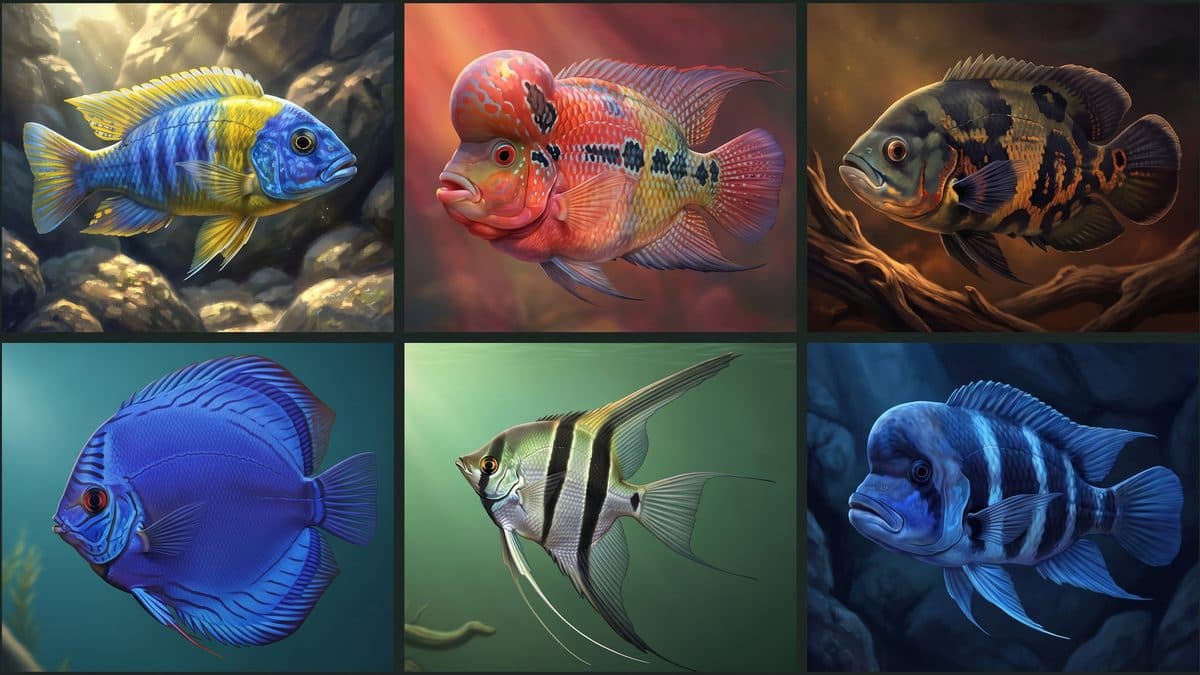
Why Cichlids Dominate the Aquarium Hobby
Family Cichlidae is one of the most species-rich vertebrate families on Earth, with conservative estimates placing the count above 2,000 described species — and hundreds more awaiting formal classification. Cichlids have radiated into nearly every freshwater niche in Africa, Central and South America, and parts of Asia, producing an astonishing diversity of form, colour, and behaviour that no other fish family can match in a home aquarium.
What sets cichlids apart from most tropical fish is personality. Cichlids recognise their keepers, defend territories with genuine strategic intelligence, court mates with elaborate displays, and — in many species — provide extended parental care to their fry. For aquarists who want a fish that interacts with them rather than simply swimming past, cichlids are the answer.
This guide covers every major group of cichlid available in the aquarium trade, from the explosive colour of African Rift Lake species to the predatory heft of Central American giants and the refined elegance of Discus. Browse The Fish Collection's full cichlid collection to see what is currently available.
African Rift Lake Cichlids
The cichlids of East Africa's Great Rift Valley — particularly Lakes Malawi, Tanganyika, and Victoria — represent one of the most spectacular examples of adaptive radiation in biology. Hundreds of species have evolved within each lake, filling ecological niches from algae scraper to open-water predator, and producing colour intensity that rivals marine fish. For aquarists, African Rift Lake cichlids offer vibrant colour, fascinating behaviour, and relative hardiness in hard, alkaline water (pH 7.8–8.6, GH 10–20 dGH).
Mbuna: The Rock-Dwellers of Lake Malawi
Mbuna (pronounced "mm-BOO-nah") is a Tonga word meaning "rockfish," and it perfectly describes these cichlids' lifestyle: they live among and between the rocky shorelines of Lake Malawi, grazing aufwuchs (the biofilm of algae, microorganisms, and detritus coating rock surfaces) and fiercely defending small territories.
Popular Mbuna genera include Pseudotropheus (Demasoni, Saulosi), Labidochromis (the iconic Electric Yellow, L. caeruleus), Melanochromis (Auratus), and Metriaclima (Estherae, commonly sold as Red Zebra). Most Mbuna reach 10–15 cm and are best kept in heavily stocked tanks of 55 gallons or more — overstocking spreads aggression across many targets and prevents any single fish from being fatally bullied.
Water parameters should mirror Lake Malawi: temperature 24–28 °C, pH 7.8–8.6, and hard alkaline water. A rockwork-heavy aquascape with numerous caves and line-of-sight breaks is essential. Feed a primarily herbivorous diet — spirulina flakes, algae wafers, and blanched vegetables. High-protein foods can cause the lethal bloating condition known as Malawi Bloat.
Mbuna are mouthbrooders: the female holds fertilised eggs in her buccal cavity for 18–28 days until the fry are free-swimming. Even a basic setup will produce fry, making Mbuna an excellent entry point into cichlid breeding.
Peacock Cichlids (Aulonocara)
If Mbuna are the feisty rock-dwellers, Peacock Cichlids are the show dogs of Lake Malawi. The genus Aulonocara contains over 20 recognised species, and males display some of the most vivid colouration in freshwater fishkeeping — electric blues, sunburst yellows, deep reds, and metallic orange, often within a single species depending on collection locality.
Peacocks are calmer than Mbuna and inhabit the sandy transitional zones between rocky and open-water habitats. They use specialised sensory pores on the lower jaw to detect invertebrate prey buried in sand — a behaviour fascinating to observe in the aquarium. A 75-gallon minimum with a sandy substrate, scattered rockwork, and open swimming areas suits them perfectly.
Water parameters match the standard Rift Lake profile: pH 7.8–8.6, temperature 24–28 °C, GH 10–20 dGH. Peacocks are mouthbrooders and relatively easy to breed. Avoid housing them with aggressive Mbuna species, which will outcompete them for food and territory — a mixed Peacock/Haplochromis tank is a better combination.
Haplochromis and Predatory Haps
The "Haps" — a catch-all trade name for non-Mbuna, non-Aulonocara Lake Malawi cichlids — include some of the lake's most impressive predatory species. The Electric Blue Ahli (Sciaenochromis fryeri), Venustus (Nimbochromis venustus), and Livingstonii (Nimbochromis livingstonii, famous for playing dead to ambush prey) are among the most popular.
Haps are generally larger than Mbuna and Peacocks (15–30 cm adult size) and require more swimming space: 125 gallons minimum for most species, 180+ for larger predatory Haps. They are best combined with Peacocks and other similarly sized Haps in a well-filtered system with strong water movement. Diet is more piscivorous than Mbuna — feed a mix of high-quality pellets, frozen krill, and occasional whole silversides.
Frontosa: The Emperor of Tanganyika
The Frontosa (Cyphotilapia frontosa) is arguably the most regal cichlid in the hobby. Adults reach 30–35 cm, develop a prominent nuchal hump (particularly in males), and display bold black-and-white or black-and-blue banding depending on geographic variant. The Burundi and Mpimbwe "Blue" variants are especially prized by collectors.
Frontosa are deep-water predators in Lake Tanganyika, which translates to an aquarium requirement of 180+ gallons with dim lighting, ample cave structures, and a slow-moving, methodical pace of life that contrasts sharply with frenetic Mbuna tanks. They are best kept in species-only groups of six or more, with one male to multiple females.
Water parameters: pH 8.0–9.0, temperature 24–27 °C, GH 12–20 dGH. Frontosa are mouthbrooders with exceptionally long holding periods (up to 40 days). They are slow growers — reaching full adult size takes 4–5 years — but the result is a fish with commanding presence and a lifespan exceeding 25 years.
South American Cichlids
South America's river systems — particularly the Amazon, Orinoco, and their countless tributaries — host an extraordinary diversity of cichlids adapted to soft, acidic water (pH 5.5–7.0, GH 2–10 dGH). The contrast with African Rift Lake species is stark: where African cichlids thrive in liquid rock, South Americans demand tannin-stained blackwater or gentle, mineral-poor conditions. This fundamental water-chemistry difference means the two groups should never be mixed in the same system.
Oscar Cichlid
The Oscar (Astronotus ocellatus) is arguably the most popular large cichlid in the hobby — and one of the most frequently underestimated. Sold as charming 5 cm juveniles, Oscars grow rapidly to 30–40 cm and require a minimum 75-gallon tank for a single fish, with 125+ gallons for a pair. They are intelligent, interactive fish that learn to recognise their keeper, accept hand-feeding, and even perform rudimentary tricks — behaviours that have earned them the nickname "river dogs."
Colour varieties include Tiger (the wild-type pattern of black with orange-red markings), Red, Albino, and Lemon Oscar. All colour forms share the same care requirements: temperature 24–28 °C, pH 6.0–7.5, and powerful filtration to handle their prodigious waste output. Feed a varied diet of high-quality cichlid pellets, frozen krill, earthworms, and occasional whole fish. Avoid feeder goldfish — they are nutritionally poor and frequently carry parasites.
Discus: The King of the Aquarium
Discus (Symphysodon spp.) represent the pinnacle of freshwater fishkeeping for many aquarists. Their laterally compressed, disc-shaped bodies and extraordinary colour varieties — Pigeon Blood, Cobalt Blue, Marlboro Red, Snakeskin, and dozens more — make them living works of art. But that beauty comes with a care commitment that separates casual hobbyists from dedicated keepers.
Discus demand pristine water quality: temperature 28–30 °C (higher than most tropical community fish), pH 6.0–7.0, and near-zero nitrates maintained through 25–50 % water changes twice weekly. A minimum 55-gallon tank for a group of six is the starting point, with 75+ gallons preferred. They are schooling fish that become stressed and withdrawn when kept singly or in pairs.
For a detailed dive into Discus keeping, see our complete Discus beginners' guide. Browse The Fish Collection's cichlid collection for available Discus varieties.
Freshwater Angelfish
The Freshwater Angelfish (Pterophyllum scalare) is one of the most iconic aquarium fish and many people's first introduction to the cichlid family. Their tall, laterally compressed bodies with elongated dorsal and anal fins create an elegant silhouette that no other community fish replicates. Colour varieties range from the classic Silver to Koi, Marble, Black, Platinum, and Blue Pinoy.
Despite their graceful appearance, Angelfish are cichlids through and through — territorial during breeding, capable of eating small tank mates (neon tetras are a favourite snack), and assertive in establishing a hierarchy. A 55-gallon tall tank with a minimum height of 18 inches accommodates their vertical body shape. Temperature 24–28 °C, pH 6.5–7.5. Keep in groups of four or more to spread aggression, or as a bonded pair in a breeding setup.
Geophagus: The Eartheaters
The Eartheaters (Geophagus, Satanoperca, Gymnogeophagus, and related genera) are among the most behaviourally fascinating South American cichlids. Their feeding method — scooping mouthfuls of substrate, sifting it through their gills for micro-invertebrates, and expelling clean sand — is endlessly captivating to watch and serves a practical function by turning over and aerating the substrate.
Popular species include the Red Head Tapajos (Geophagus sp. "Red Head Tapajos"), Altifrons (Geophagus altifrons), and Surinamensis (Geophagus surinamensis). Most reach 15–25 cm and do best in groups of five or more in 100+ gallon tanks with fine sand substrate (mandatory for their sifting behaviour), moderate current, and temperatures of 26–30 °C. pH 5.5–7.0 suits most species.
Central American Cichlids
Central American cichlids are the heavyweights of the cichlid world — literally and figuratively. Originating from the rivers and lakes of Mexico, Guatemala, Honduras, Nicaragua, and Costa Rica, these fish tend toward larger adult sizes, higher aggression levels, and bolder personalities than their South American cousins. They thrive in moderately hard, neutral to slightly alkaline water (pH 7.0–8.0, GH 8–15 dGH, temperature 24–28 °C).
Jack Dempsey Cichlid
Named after the 1920s boxing champion for its pugnacious temperament, the Jack Dempsey (Rocio octofasciata) is a robust, 20–25 cm cichlid with iridescent blue-green spangles covering a dark base coloration. The Electric Blue Jack Dempsey — a selectively bred morph with vivid, all-over metallic blue — has become one of the most popular cichlids in the trade, though it is generally smaller (15–20 cm) and somewhat less aggressive than the wild type.
A 55-gallon minimum is suitable for a single Jack Dempsey, with 75+ gallons for a pair. They are territorial but manageable alongside similarly sized, assertive tank mates: Firemouths, Convicts, and medium-sized catfish work well. Temperature 22–28 °C, pH 7.0–8.0.
Convict Cichlid
The Convict Cichlid (Amatitlania nigrofasciata) is arguably the easiest cichlid to breed — place a male and female together, provide a cave or flat stone, and you will have fry within weeks. Their black-and-white vertical barring (hence "convict") is attractive but understated; it is the species' bulletproof hardiness and prolific breeding that make it a staple. Adults reach 10–15 cm and can be housed in a 30-gallon tank for a pair, though breeding Convicts become extraordinarily aggressive defenders of their territory.
Pink and "Polar Blue" colour morphs are increasingly popular, offering visual variety while retaining the same care requirements. Temperature 22–28 °C, pH 6.5–8.0. An excellent beginner cichlid for anyone who wants to experience cichlid breeding behaviour without investing in expensive stock.
Dovii (Wolf Cichlid)
The Dovii (Parachromis dovii) is the apex predator of the Central American cichlid world — a 50–70 cm powerhouse of muscle, teeth, and attitude that demands respect. Wild-type males develop a golden-yellow base with iridescent green-blue flecking and a massive underbite; females display vivid yellow with black blotching. This is not a community fish. A breeding pair of Dovii will systematically destroy any tank mate, and even pairs must be monitored for spousal aggression.
Minimum tank size: 180 gallons for a single fish, 300+ gallons for a pair with a divider available for separation. Filtration should be industrial-grade: sump systems rated for 10× turnover. Temperature 24–28 °C, pH 7.0–8.0. Dovii are arguably the most interactive freshwater fish available — they bond intensely with their keeper and display remarkable problem-solving intelligence. For experienced keepers who want a genuine "pet fish," the Dovii is unmatched.
Jaguar Cichlid
The Jaguar Cichlid (Parachromis managuensis) is a close relative of the Dovii with a distinctive spotted pattern that intensifies with age — juveniles are silvery with faint bars, while adults develop bold black spots on a gold or silver base, resembling the big cat they are named for. Adults reach 40–55 cm and share the Dovii's predatory temperament, requiring 125+ gallons for a single specimen and 200+ gallons for a pair.
Jaguar Cichlids are more widely available and slightly less expensive than Dovii, making them a popular entry point into Central American predator keeping. They will eat anything that fits in their considerable mouths — tank mates must be of similar size and assertiveness. Temperature 24–28 °C, pH 7.0–8.5.
Dwarf Cichlids
At the opposite end of the size spectrum, dwarf cichlids offer all the personality, colour, and breeding behaviour of their larger relatives in a package that fits comfortably in 20–30-gallon aquariums. They are the ideal choice for aquarists who want cichlid intelligence without the space demands or aggression of larger species.
Apistogramma
Apistogramma is a genus of roughly 100 described species (with many more undescribed forms) from South American blackwater streams. Males are extravagantly coloured — electric blues, sunset oranges, and intricate finnage — while females are typically smaller and yellow-bodied, especially when guarding fry. Popular species include A. cacatuoides (Cockatoo Dwarf), A. borellii (Umbrella Dwarf), and A. macmasteri.
A single male with 2–3 females thrives in a 20-gallon tank with sand substrate, leaf litter, driftwood caves, and soft, acidic water (pH 5.0–6.5, temperature 24–28 °C). Apistogramma are cavity spawners: the female lays eggs in a cave and guards them aggressively, often turning bright yellow as a warning display. They are compatible with small tetras, Corydoras, and Otocinclus.
German Blue Ram and Bolivian Ram
The German Blue Ram (Mikrogeophagus ramirezi) is one of the most colourful small cichlids available — electric blue flanks, a red-orange belly, black markings, and iridescent spangles across the body. Selectively bred variants include Electric Blue Ram, Gold Ram, and Balloon Ram. Adults reach only 5–7 cm, making them suitable for tanks as small as 20 gallons.
However, German Blue Rams are notably sensitive to water quality. They demand temperatures of 27–30 °C (they do poorly below 26 °C), pH 5.5–7.0, very soft water (GH 2–6 dGH), and impeccable nitrate control. Many commercially bred specimens are weakened by hormonal colour enhancement and antibiotics at the farm level, so sourcing from reputable breeders is critical.
The Bolivian Ram (Mikrogeophagus altispinosus) is the hardier alternative: slightly larger (7–8 cm), less colourful but still attractive, and tolerant of a broader parameter range (temperature 22–26 °C, pH 6.0–7.5). For beginners who want a dwarf cichlid, the Bolivian Ram is the safer choice.
Hybrid Cichlids
Hybrid cichlids occupy a controversial but commercially dominant position in the hobby. Created by crossing species that would never meet in the wild, these fish are bred for extreme colour, unusual body shapes, or exaggerated features. They cannot be assigned a scientific name — they are human inventions. Love them or loathe them, their popularity is undeniable.
Flowerhorn Cichlid
The Flowerhorn is a man-made hybrid developed in Malaysia in the late 1990s by crossing various Central and South American cichlid species (the exact lineage varies by strain and is often a closely guarded trade secret). They are bred for their massive nuchal hump (kok), intense red-and-blue colouration, metallic "pearling" scales, and bold, interactive personality.
Adult Flowerhorns reach 25–35 cm and require a minimum 75-gallon tank — almost always kept alone, as their aggression is extreme and indiscriminate. Competition-grade specimens with exceptional koks and pearling can sell for $5,000–$60,000. Water parameters: temperature 28–31 °C, pH 7.0–8.0, moderate hardness.
For a deep dive into strains, kok development, and competition grading, see our complete Flowerhorn guide. Browse The Fish Collection's cichlid collection for available Flowerhorn specimens.
Blood Parrot Cichlid
The Blood Parrot Cichlid is a hybrid between the Midas Cichlid (Amphilophus citrinellus) and the Redhead Cichlid (Paraneetroplus synspilus) — though, like the Flowerhorn, exact parentage varies between breeders. Their rounded body, beak-like mouth (which cannot fully close, limiting feeding efficiency), and vivid orange-red colouration make them instantly recognisable.
Blood Parrots reach 20–25 cm and need a minimum 55-gallon tank. Despite their somewhat comical appearance, they are moderately aggressive cichlids that will hold territories and bully smaller tank mates. They do well with similarly sized, robust fish: Severums, medium-sized catfish, and larger barbs. Temperature 24–28 °C, pH 6.5–7.5.
A note on ethics: Blood Parrots' deformed mouths make feeding less efficient — offer sinking pellets small enough for them to manage. Dyed Blood Parrots (injected with artificial colour to produce purple, blue, or green specimens) are widely condemned by the hobby community and should be avoided. Purchase only naturally coloured fish from responsible breeders.
Choosing the Right Cichlid for Your Aquarium
Cichlids encompass such an enormous range of size, temperament, and environmental needs that choosing the right species is critical. Here is a framework based on tank size and experience level:
- Nano and small tanks (20–30 gallons): Apistogramma, German Blue Ram, Bolivian Ram, Shell-Dwellers (Neolamprologus multifasciatus). These dwarf cichlids deliver full cichlid behaviour in a compact footprint.
- Standard community tanks (55–75 gallons): Angelfish, Convict Cichlid, Electric Yellow Lab (Mbuna), Jack Dempsey, Blood Parrot. This range opens up a wide variety of species while remaining manageable for intermediate keepers.
- Large display tanks (100–180 gallons): Oscar, Peacock Cichlid community, mixed Mbuna tank, Frontosa group, Geophagus group. Serious cichlid keeping begins here — with the space for natural behaviours and proper stocking.
- Monster-fish systems (200+ gallons): Dovii, Jaguar Cichlid, large Haplochromis predators, Flowerhorn (75 gal solo but 200+ for a mixed predator community). These apex cichlids demand dedicated infrastructure and experienced hands.
The single most important rule: research aggression levels before mixing species. A Discus and a Dovii both belong to family Cichlidae, but housing them together would be a death sentence for the Discus. African Rift Lake cichlids and South American cichlids require fundamentally different water chemistry and should never share a system. Match species by geography, temperament, and water parameters — not just by size.
Ready to explore the world of cichlids? Browse The Fish Collection's curated cichlid collection — from rare Apistogramma to competition-grade Flowerhorns, every specimen ships with a live-arrival guarantee, tracked delivery, and full care documentation.