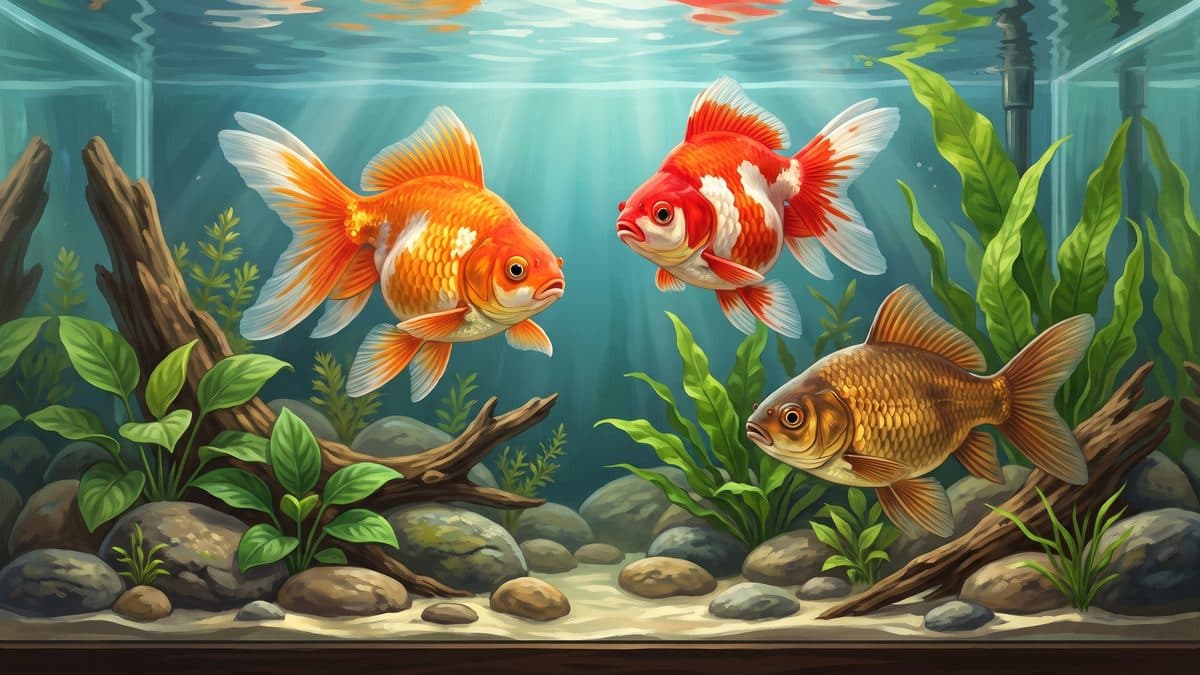
Why Goldfish Are More Than a Starter Fish
Goldfish (Carassius auratus) are the oldest domesticated ornamental fish, bred in China for over 1,000 years. They are far more complex — and more rewarding — than their "cheap pet store fish" reputation suggests. Healthy goldfish live 10–15 years (Commons can exceed 20 years), grow to 15–35 cm depending on variety, and display genuine personality and intelligence.
The biggest misconception is that goldfish belong in bowls. They do not. Goldfish are heavy waste producers that need large, well-filtered aquariums or ponds. The difference between a goldfish surviving in a bowl and thriving in a proper setup is the difference between a cramped cell and a comfortable home. Get the setup right, and goldfish reward you with decades of companionship.
The critical distinction for beginners is between single-tailed (Common, Comet, Shubunkin) and fancy/double-tailed (Fantail, Ryukin, Black Moor, Ranchu) varieties. Single-tailed goldfish grow large and fast, needing ponds or 75+ gallon tanks. Fancy goldfish stay smaller and work in large aquariums. Never mix single-tailed and fancy varieties — the fast single-tails outcompete slow fancies for food.
Top 7 Goldfish Varieties for Beginners
1. Common Goldfish
The original goldfish — and still the hardiest. Common Goldfish reach 25–35 cm and live 15–20+ years. They are the standard feeder fish sold in pet stores, but given proper space, they develop deep orange-gold colouration and impressive size. Commons are nearly indestructible, tolerating temperatures from 2–30 °C and pH from 6.5–8.5.
The catch: Commons need a pond or a 75+ gallon tank. They are fast swimmers that produce enormous waste relative to their body size. A pair of Commons in a well-filtered 75-gallon tank or a small outdoor pond is one of the simplest, most rewarding setups in the hobby. Price: $0.30–$5.
2. Comet Goldfish
The Comet is the American-developed cousin of the Common Goldfish, distinguished by its deeply forked, flowing tail fin that can be as long as its body. Comets are slightly smaller (20–30 cm) and even faster swimmers than Commons. They come in orange, white, red-and-white (sarasa pattern), and yellow varieties.
Comets need the same space as Commons: a pond or 75+ gallon tank. They are equally hardy and long-lived. Sarasa Comets (red and white) are particularly popular for ponds because their colours are visible from above. An excellent choice for beginners building an outdoor pond alongside Koi. Price: $0.50–$8.
3. Shubunkin Goldfish
Shubunkin are calico-patterned goldfish — a mottled mix of blue, red, orange, white, and black on a single fish. The blue base colour is the most prized, as it is the hardest to breed reliably. Shubunkin reach 20–30 cm and have the same care requirements as Commons and Comets.
There are three Shubunkin types: London (short-finned like a Common), Bristol (broad, heart-shaped tail), and American (long, flowing tail like a Comet). All are extremely hardy. Shubunkin add visual variety to ponds and large tanks. Their calico pattern means every fish is unique. Price: $3–$15.
4. Fantail Goldfish
The Fantail is the best fancy goldfish for beginners. It has an egg-shaped body, a split (double) caudal fin held high, and a moderately arched back. At 15–20 cm, Fantails are the hardiest fancy variety — they tolerate cooler temperatures (15–24 °C) better than most fancies and can even overwinter outdoors in mild climates.
Fantails do well in a 30+ gallon tank (add 10 gallons per additional fish). They are slower swimmers than single-tailed varieties, so use gentle filtration and avoid strong currents. Available in orange, red, calico, red-and-white, and black. The Fantail is the ideal stepping stone from single-tailed to fancy goldfish keeping. Price: $3–$15.
5. Ryukin Goldfish
The Ryukin is a Japanese-bred fancy goldfish with a distinctive high-arched back (dorsal hump), deep body, and flowing fins. It is more compact and round-bodied than the Fantail, creating a dramatic, almost spherical silhouette. Ryukin come in red, orange, calico, red-and-white, and chocolate varieties.
Ryukin are moderately hardy for a fancy goldfish and adapt well to aquarium life. They reach 15–20 cm and need a 30+ gallon tank with gentle filtration. Their deep bodies make them slightly more prone to swim bladder issues than Fantails — avoid overfeeding and offer sinking pellets rather than floating flakes. Price: $5–$25.
6. Black Moor Goldfish
The Black Moor is a telescope-eyed fancy goldfish with a velvety jet-black body and protruding eyes. It is one of the most recognisable and popular fancy varieties. Black Moors reach 15–18 cm and are hardier than most telescope-eyed goldfish, tolerating temperatures as low as 15 °C.
The protruding eyes are the key care consideration: Black Moors have poor eyesight and should not be kept with fast-swimming fish that outcompete them for food. Avoid sharp decorations that could damage their eyes. Keep in a 20+ gallon tank with other slow-moving fancies (Fantails, Ranchu, other Moors). Feed sinking pellets they can find by smell. Price: $5–$15.
7. Ranchu Goldfish
The Ranchu is the "king of goldfish" in Japan — a compact, egg-shaped fancy variety with no dorsal fin and a prominent head growth (wen) that develops with age. Ranchu have a unique waddle-like swimming style that is endearing to watch. They reach 12–18 cm and are available in red, orange, red-and-white, and calico.
Ranchu are slightly more delicate than Fantails but still beginner-appropriate if you maintain clean water and stable temperatures (18–24 °C). Their lack of a dorsal fin means they are less stable swimmers — use gentle filtration and provide smooth decorations. A 20+ gallon tank with other fancy varieties is ideal. Price: $10–$50 for pet-quality; $100–$5,000+ for show-grade Japanese imports.
What to Look For When Buying Goldfish
- Active, alert swimming: Healthy goldfish swim smoothly and respond to movement. Avoid fish that float at the surface, sit on the bottom, or swim erratically.
- Symmetrical body: Both sides of the fish should look identical. Bent spines, lopsided tails, or asymmetrical eyes indicate genetic or health issues.
- Clean fins: No red streaks (bacterial infection), white spots (ich), or frayed edges (fin rot). Fins should be held erect, not clamped against the body.
- Clear eyes: Especially important for telescope-eyed varieties. Eyes should be clear, equal-sized, and undamaged.
- Observe the tank: If any fish in the store tank appear sick (spots, fungus, lethargy), avoid buying from that tank entirely — disease spreads quickly among goldfish.
Common Mistakes with Beginner Goldfish
- Goldfish bowls: Bowls are too small, unfiltered, unheated, and low in oxygen. Goldfish need 20+ gallons (fancies) or 75+ gallons (single-tailed varieties) with filtration.
- Mixing single-tailed and fancy: Commons and Comets are aggressive, fast feeders that outcompete slow fancies for food. Keep these groups separately.
- Tropical tank mates: Goldfish are cold-water fish (15–24 °C). They should not be kept with tropical species that need 25–28 °C. Compatible mates include White Cloud Mountain Minnows, Dojo Loaches, and other goldfish.
- Overfeeding: Goldfish are perpetually hungry and will eat until they are sick. Feed small amounts 2–3 times daily — only what they consume in 2 minutes. Excess food rots and crashes water quality.
- Inadequate filtration: Goldfish produce 2–3x more waste than tropical fish of the same size. Your filter should be rated for at least 2x your tank volume. Double filtration (two filters) is common practice among goldfish keepers.
Getting Started Equipment
- Tank: 20–30 gallons for 1–2 fancy goldfish; 75+ gallons for single-tailed. Add 10–20 gallons per additional fish. Long, wide tanks are better than tall tanks for oxygen exchange.
- Filter: HOB filter or canister rated for 2x your tank volume. Dual filtration is recommended. Sponge pre-filters protect fancy goldfish from intake suction.
- No heater needed: Goldfish thrive at room temperature (15–24 °C). Only add a heater if your home drops below 15 °C regularly.
- Substrate: Bare bottom (easiest to clean), fine sand, or large river rocks. Avoid small gravel that goldfish can swallow and choke on.
- Air pump: Goldfish benefit from additional aeration, especially in warmer months. A simple air pump with an airstone is sufficient.
- Food: Sinking pellets (Hikari Oranda Gold, Repashy Soilent Green gel food) for fancies; floating pellets for single-tailed. Supplement with blanched peas (digestive aid), frozen bloodworms, and duckweed.
- Test kit: API Freshwater Master Test Kit. Monitor ammonia closely — goldfish waste is substantial.
Budget $150–$350 for a complete 30-gallon fancy goldfish setup. See our equipment guide.