Why Acclimation Matters
Acclimation is the process of gradually adjusting a new fish to the water chemistry and temperature of its destination tank. Fish are sensitive to rapid changes in pH, temperature, salinity, and dissolved mineral content — parameters that almost always differ between the store's water and your aquarium. Sudden exposure to different conditions causes osmotic shock (cell damage from water chemistry differences) and temperature shock (metabolic disruption from temperature changes), both of which can be immediately fatal or cause delayed death 24–72 hours later.
The difference between the store's water and yours may seem small — a pH of 7.0 versus your 7.4, for example — but remember that pH is logarithmic: that 0.4 difference represents a 2.5-fold change in hydrogen ion concentration. For a fish's gill membranes, that is a significant chemical shift. Proper acclimation introduces these changes gradually, giving the fish's physiology time to adjust.
The Float Method
The float method addresses temperature only. It is the minimum acceptable acclimation for hardy species:
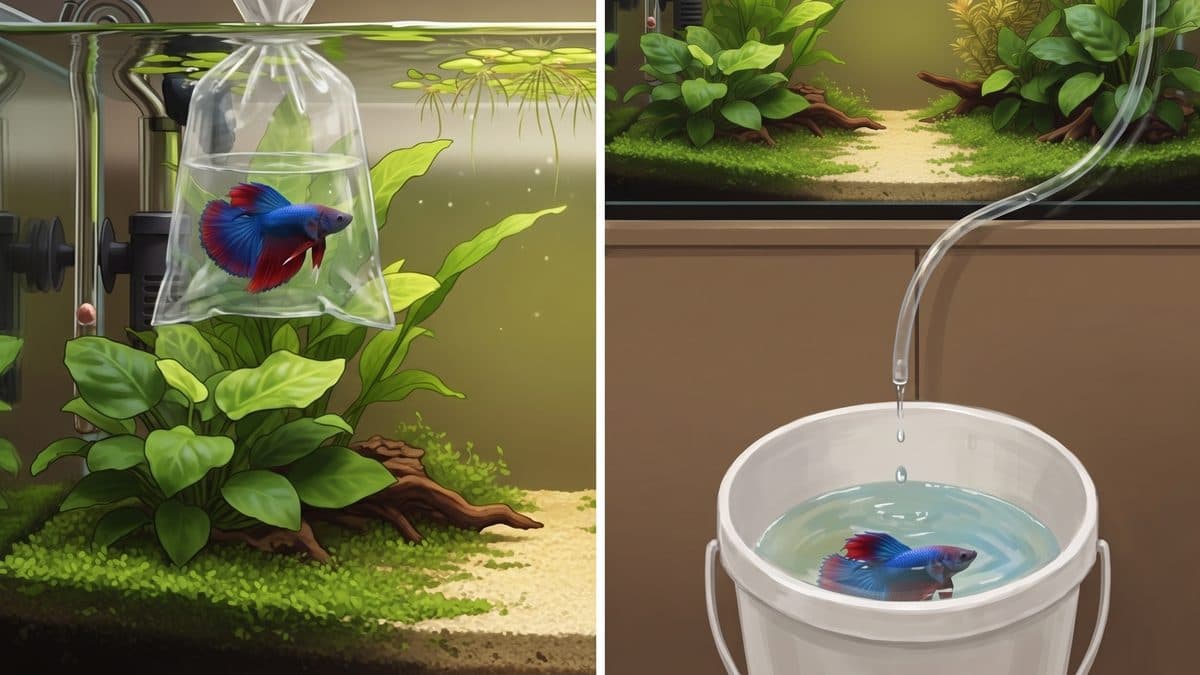
- Float the sealed transport bag in the destination tank for 15–20 minutes. The water inside the bag gradually equalises with the tank temperature.
- Open the bag and add a small cup (100–150 mL) of tank water every 5 minutes for 20–30 minutes.
- Net the fish out of the bag and place it in the tank. Never pour the bag water into your tank — it contains ammonia from the fish's waste during transport, and may contain pathogens, medication residues, or copper from the store's systems.
Limitation: The float method does not gradually adjust water chemistry (pH, hardness). If the chemistry difference between the bag water and your tank is significant, the fish experiences a sudden chemical shift when transferred. For this reason, the drip method is preferred for most species.
The Drip Method
The drip method is the gold standard for acclimation, gradually equalising both temperature and water chemistry:
Step-by-Step Drip Protocol
- Float the sealed bag in the destination tank for 15 minutes to equalise temperature.
- Pour the fish and bag water into a clean bucket or container. The container should be large enough to hold at least 3× the bag water volume.
- Set up a drip line: Use a length of airline tubing. Start a siphon from the tank into the bucket by sucking on the tubing (or using a siphon starter). Tie a loose knot in the tubing to restrict flow to 2–4 drops per second. Alternatively, use an airline valve for precise flow control.
- Drip for 45–60 minutes until the water volume in the bucket has at least doubled. This gradually blends tank water with bag water, exposing the fish to a slow, steady change in chemistry.
- Net the fish from the bucket into the tank. Do not pour the bucket water into the tank — discard it.
- Dim the tank lights for 2–4 hours after introduction to reduce stress.
The drip method is especially important when the bag water chemistry differs significantly from your tank — for example, when your tank has soft, acidic water (pH 6.5, GH 4) but the store uses hard, alkaline water (pH 7.8, GH 12). The gradual blend prevents the shock that a sudden transfer would cause.
The Plop-and-Drop Method
The plop-and-drop method skips water chemistry matching entirely: float for temperature, then net the fish directly into the tank. This is acceptable only when:
- The fish is extremely hardy (most livebearers, goldfish, common tetras).
- The bag water chemistry is close to your tank (same water source, for example).
- The fish has been in the bag for a long time (8+ hours) and the bag water is severely degraded — in this case, prolonged acclimation in ammonia-laden bag water causes more harm than a quick transfer.
The logic behind plop-and-drop in long-transit scenarios: as CO₂ builds up in the sealed bag, pH drops, which converts toxic ammonia (NH₃) into less toxic ammonium (NH₄⁺). When you open the bag, CO₂ escapes, pH rises rapidly, and the ammonia reverts to its toxic free form — potentially spiking to lethal levels. In these cases, getting the fish into clean water quickly is more important than gradual acclimation. Add Seachem Prime to the bag immediately upon opening to detoxify ammonia during any extended acclimation.
Species-Specific Protocols
Sensitive Species
- Discus: Drip acclimate for 90–120 minutes. Discus are extremely sensitive to pH and temperature changes. Match temperature precisely (±0.5 °F). If the pH difference between bag and tank exceeds 0.5 units, extend the drip duration.
- Freshwater stingrays: Drip for 120+ minutes. Stingrays are osmoregulatory-sensitive — rapid chemistry changes cause immediate stress. Some breeders recommend dripping for 2–4 hours for wild-caught specimens.
- Arowana: Drip for 60–90 minutes. Arowana are large fish with significant metabolic sensitivity. Add Seachem Prime to the bag water upon opening to detoxify accumulated ammonia. Browse our Arowana collection — all specimens ship with detailed acclimation instructions.
- Crystal shrimp (Caridina): Drip for 120+ minutes at 1–2 drops per second. Shrimp are far more sensitive to chemistry changes than fish. Any TDS shift greater than 10–20 ppm per hour risks osmotic shock.
Hardy Species
- Guppies, Mollies, Platies: Float + brief drip (20–30 minutes) or plop-and-drop. Livebearers are among the hardiest aquarium fish and tolerate parameter changes readily.
- Goldfish: Float + brief drip. Goldfish are cold-water fish that tolerate wide parameter ranges.
- Most tetras, barbs, Corydoras: Standard drip method (45–60 minutes) is appropriate and sufficient.
Common Acclimation Mistakes
- Pouring bag water into the tank: The most common mistake. Bag water contains ammonia, possibly medications, potentially pathogens. Always discard bag water and net the fish into the tank.
- Acclimating too quickly: Rushing the process (15-minute float only) exposes the fish to sudden chemistry changes. Take the full 45–60 minutes (or longer for sensitive species).
- Acclimating too slowly in degraded bag water: For fish that have been in a bag for 8+ hours, the bag water is toxic with ammonia and low in oxygen. Extended acclimation in this water does more harm than good. Add Prime, brief temperature match, and transfer quickly.
- Leaving lights on during introduction: Bright lighting stresses newly introduced fish. Dim lights for 2–4 hours after acclimation.
- Feeding immediately after introduction: Do not feed new fish for 12–24 hours after acclimation. The stress of transport and introduction suppresses appetite and digestion. Offer food the next day.
- Skipping quarantine: Acclimation into the display tank directly, bypassing quarantine, risks introducing disease. Acclimate into a quarantine tank instead.
Post-Acclimation Care
- Dim lights for 2–4 hours. Reduces stress and allows the fish to explore its new environment without feeling exposed.
- Do not feed for 12–24 hours. The fish's digestive system is stressed from transport; feeding immediately can cause regurgitation and water quality issues.
- Monitor behaviour closely for 48 hours. Watch for gasping, listing (swimming at an angle), clamped fins, loss of colour, or refusal to eat after 24 hours. These signs indicate acclimation stress or a pre-existing condition.
- Test water parameters 24 hours after introduction to verify the additional bioload has not spiked ammonia (particularly in smaller tanks or recently cycled systems).
- Do not add more fish for at least 2 weeks to allow the biological filter to adjust to the increased bioload and to observe the new fish for any emerging health issues.
Proper acclimation takes less than an hour and dramatically reduces the risk of new fish losses. The investment in time pays for itself with every successful introduction. For water chemistry background, see our water chemistry guide. For quarantine protocols, see the quarantine guide.