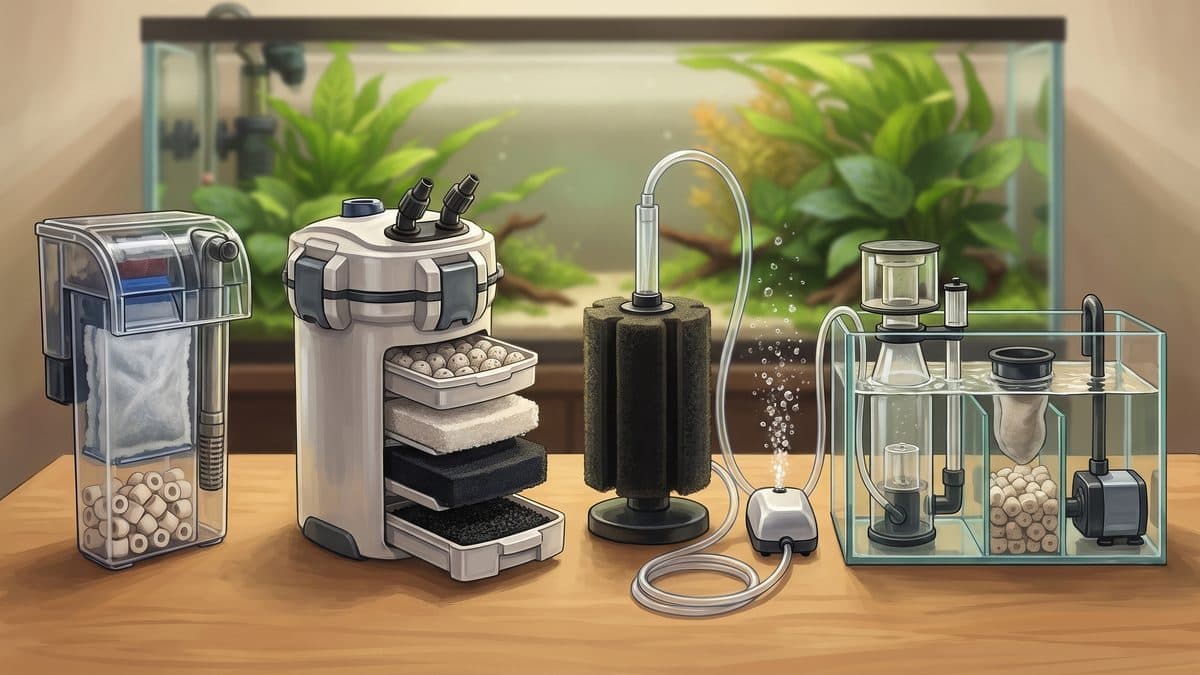
Why Filtration Matters
Filtration is the life support system of an aquarium. Without it, ammonia from fish waste accumulates within hours to levels that burn gills, suppress immune function, and kill fish within days. A properly sized, well-maintained filter processes waste biologically (converting ammonia to nitrite to nitrate via beneficial bacteria), removes particulate matter mechanically (keeping water clear), and can optionally remove dissolved contaminants chemically (activated carbon, resins).
The filter is the single most important piece of equipment in your aquarium — more important than the heater, the light, or the tank itself. Invest in a quality filter that exceeds your minimum requirements, and maintain it religiously. A good filter, properly maintained, runs for decades.
The Three Stages of Filtration
Mechanical Filtration
Mechanical filtration removes solid particles (fish waste, uneaten food, plant debris, dust) from the water column by trapping them in a physical medium. Common mechanical media include:
- Filter floss/polyester batting: Fine mechanical filtration that polishes water to crystal clarity. Traps very small particles. Inexpensive and disposable — replace every 1–2 weeks when it becomes clogged.
- Coarse sponge: Traps larger particles while allowing water to flow through easily. Long-lasting — rinse in used tank water monthly. The sponge also serves as biological media (bacteria colonise its surface).
- Filter pads (various densities): Layered from coarse to fine, these provide progressive mechanical filtration. Water passes through coarse media first (catching large debris), then finer media (catching smaller particles).
Mechanical media must be cleaned or replaced regularly. Clogged mechanical media reduces flow rate, which reduces both mechanical and biological filtration effectiveness. Always place mechanical media before biological media in the flow path — catch the particles before they reach the bacteria.
Biological Filtration
Biological filtration is the conversion of ammonia to nitrite to nitrate by nitrifying bacteria. This is the most critical function of any filter — a filter with zero mechanical capacity but excellent biological capacity will keep fish alive; the reverse will not. See our nitrogen cycle guide for complete details.
Biological media provides maximum surface area for bacterial colonisation:
- Ceramic rings/cylinders (Eheim Substrat Pro, Seachem Matrix): Highly porous ceramic with enormous internal surface area. The gold standard for biological media. Lasts indefinitely — never replace, only rinse gently in used tank water annually.
- Bio-balls: Plastic balls with ridged surfaces. Good surface area, primarily used in wet/dry sumps where water trickles over them with maximum air exposure.
- Sponge media: Every sponge in your filter doubles as biological media. This is why sponge filters work despite having no dedicated bio-media — the sponge itself hosts the bacteria.
- Lava rock: Inexpensive, porous, and effective. Can be used as a budget alternative to ceramic media in canister filters and sumps.
Critical rule: Never replace all biological media at once. Never rinse biological media in tap water (chlorine kills the bacteria). Always clean in used tank water, and stagger any replacements by 4+ weeks to maintain the bacterial colony.
Chemical Filtration
Chemical filtration removes dissolved substances through adsorption or ion exchange:
- Activated carbon: Adsorbs dissolved organic compounds, tannins, odours, and medication residues. Useful for water polishing and removing discolouration. Replace every 3–4 weeks as the adsorption capacity is exhausted. Remove carbon during medication — it adsorbs the medication before it can treat the fish.
- Purigen (Seachem): A synthetic adsorption resin that removes nitrogenous organic waste at the molecular level. More effective per gram than activated carbon and rechargeable with a bleach soak. Excellent for maintaining water clarity in planted tanks.
- Phosphate removers (GFO — granular ferric oxide): Adsorbs phosphate, reducing algae growth. Useful in tanks with persistent algae problems despite good husbandry.
Chemical filtration is optional for most setups. Mechanical + biological filtration handles the essential life support functions. Chemical media is an enhancement, not a requirement.
Sponge Filters
Sponge filters are the simplest and most reliable filtration method. A porous sponge sits in the tank, connected via airline tubing to an air pump. Rising air bubbles create a current that draws water through the sponge, which provides both mechanical and biological filtration.
Best for: Betta tanks (gentle flow), fry tanks (no intake to trap babies), quarantine tanks (easy to sterilise and redeploy), shrimp tanks (no risk of shrimp being sucked in), and as backup filtration in any tank.
Advantages: Extremely reliable (no moving parts to fail), inexpensive ($5–15), silent biological filtration, gentle current, safe for fry and shrimp, easy to pre-cycle in an existing tank.
Limitations: Limited mechanical filtration (will not polish water to crystal clarity), requires an air pump (additional equipment), aesthetically unappealing in display tanks, insufficient as sole filtration for heavily stocked tanks above 40 gallons.
Sizing: Choose a sponge filter rated for your tank size or one size larger. For Betta tanks (5–10 gallons), a single small sponge is sufficient. For quarantine (10–20 gallons), use a medium sponge. Dual-sponge models allow you to clean one sponge at a time while the other maintains the bacterial colony.
Hang-On-Back (HOB) Filters
HOB filters hang on the back rim of the tank, drawing water up through an intake tube, passing it through a media chamber, and returning it via a waterfall-style spillway. They are the most popular filter type for tanks between 10 and 55 gallons.
Best for: Community tanks 10–55 gallons, beginner setups, and tanks where sump installation is not practical.
Recommended models:
- AquaClear (Fluval): The gold standard HOB. Uses loose media (sponge, carbon, bio-rings) rather than proprietary cartridges, allowing full customisation. AquaClear 30 for 10–30 gallons, AquaClear 50 for 20–50 gallons, AquaClear 70 for 40–70 gallons.
- Seachem Tidal: Surface skimmer intake, self-priming, adjustable flow. Media basket design allows complete customisation. Tidal 55 for up to 55 gallons, Tidal 75 for up to 75 gallons.
Avoid HOB filters with proprietary cartridges (e.g., most Marineland, Tetra Whisper models). These cartridges combine mechanical and biological media into a single disposable unit — when you replace the clogged cartridge, you discard the bacterial colony and crash the cycle. Always choose HOBs that allow separate media placement.
HOB tip for Bettas: Baffle the output with a pre-filter sponge or a cut water bottle to reduce the waterfall current. Bettas are poor swimmers and the unmodified output of a HOB can exhaust them.
Canister Filters
Canister filters are sealed canisters that sit below or beside the tank, connected by intake and output hoses. Water is pumped through stacked media baskets inside the canister, providing the most versatile and powerful external filtration available for tanks under 150 gallons.
Best for: Planted tanks (pressurised output allows inline CO₂ and heater integration), medium to large tanks (40–150 gallons), and aquascapes where visible equipment must be minimised.
Recommended models:
- Fluval FX4 / FX6: The workhorses. FX4 handles up to 250 gallons, FX6 up to 400 gallons. Self-priming, enormous media capacity, reliable. The FX6 is the go-to filter for large predator tanks (Arowana, Oscars, large cichlids).
- Eheim Classic (2213, 2215, 2217): German engineering, legendary reliability, whisper-quiet. The 2217 handles up to 160 gallons. Eheim Classics have been in production largely unchanged since the 1970s — proven technology.
- Oase BioMaster: Integrated heater option, pre-filter chamber for easy maintenance, excellent flow rates. BioMaster 350 for up to 90 gallons, BioMaster 600 for up to 160 gallons.
Media loading order (bottom to top, following water flow): coarse sponge → filter floss → ceramic bio-media → optional chemical media (carbon, Purigen). This ensures large particles are caught before reaching the bio-media, extending cleaning intervals.
Sump Systems
A sump is a separate tank (typically placed inside the aquarium stand) connected to the display tank via an overflow and return pump. Water flows from the display into the sump by gravity, passes through filtration chambers, and is pumped back to the display. Sumps are the professional-grade filtration solution for tanks above 100 gallons.
Advantages: Massive media capacity (entire chambers dedicated to each filtration stage), hides all equipment (heater, probes, reactors inside the sump), increases total system water volume (adding stability), and allows easy maintenance without disturbing the display.
Sump chamber layout (typical):
- Overflow chamber: Water enters from the display via a weir or overflow box. Filter sock or sponge catches large debris.
- Biological chamber: Filled with ceramic media, bio-balls, or lava rock. The largest chamber in the sump.
- Refugium/plant chamber (optional): A lit chamber growing fast-growing plants (Pothos, Peace Lily, or aquatic plants) that absorb nitrate directly.
- Return chamber: Houses the return pump, heater, and any probes or dosing equipment. Water is pumped back to the display.
Sumps require a drilled tank (preferred) or an overflow box to move water from the display to the sump. DIY sumps can be built from standard aquariums with glass baffles. For large predator fish (Arowana, stingrays, large cichlids), a sump is the recommended filtration method.
Sizing Your Filter
- Community tanks (tetras, Corydoras, small cichlids): 4–6× tank volume turnover per hour. A 50-gallon tank needs a filter rated for 200–300 GPH.
- Planted tanks: 4–6× turnover. Higher flow improves CO₂ and nutrient distribution. Use a spray bar or lily pipe to distribute flow evenly.
- Predator tanks (Arowana, Oscars, large cichlids): 8–10× turnover. These fish produce heavy waste loads. A 125-gallon Oscar tank needs 1,000–1,250 GPH of filtration — typically achieved with dual canisters or a sump.
- Betta and shrimp tanks: 2–4× turnover with gentle output. A sponge filter alone is usually sufficient for 5–10 gallon tanks.
Always oversize your filter. A filter rated for "up to 75 gallons" running on a 50-gallon tank provides better biological capacity, cleaner water, and more forgiveness for missed maintenance. There is no downside to oversizing filtration — only undersizing creates problems.
Filter Maintenance Schedule
- Weekly: Check filter flow rate. Reduced flow indicates clogged mechanical media. Visually inspect intake for blockages.
- Monthly: Rinse mechanical media (sponges, filter floss) in used tank water during a water change. Replace filter floss if using it. Never rinse in tap water.
- Every 3–4 months: Open canister filters for a full inspection. Rinse all sponges, check impeller for debris, clean tubing with a flexible brush. Replace activated carbon if using it.
- Annually: Replace impeller and O-rings on canister filters (preventive maintenance). Gently rinse bio-media in used tank water — do not scrub or replace.
- Never: Replace all media at once. Replace bio-media. Rinse anything in tap water. Run the filter without media after cleaning (re-assemble before plugging in).
A well-maintained filter is the foundation of a healthy aquarium. Choose the right type for your setup, size it generously, maintain it consistently, and it will keep your fish healthy for years. For guidance on the nitrogen cycle that powers biological filtration, see our nitrogen cycle guide.