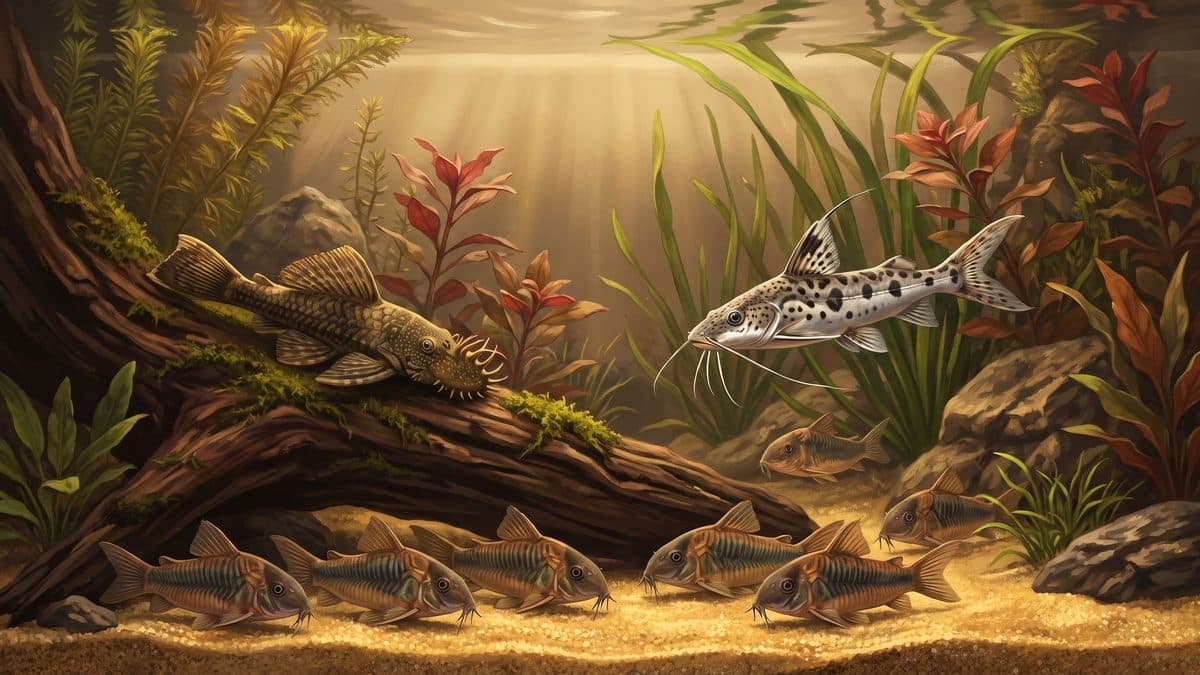
Why Catfish Are Essential for Beginner Aquariums
Catfish occupy a unique ecological niche in the aquarium: they are the clean-up crew. While no fish truly "cleans" a tank (you still need filtration and water changes), catfish consume uneaten food that sinks to the substrate, graze on algae films, and scavenge organic debris that would otherwise decompose and pollute your water.
Beyond their practical utility, catfish display some of the most interesting behaviours in the hobby. Corydoras school in tight groups and perform synchronised surface dashes to gulp air. Plecos rasp algae off wood with specialised teeth. Upside-Down Catfish swim inverted under surfaces, defying expectations. For beginners, catfish offer an engaging, low-maintenance addition to virtually any community tank.
The seven species below were chosen for their proven hardiness, wide availability, reasonable adult size, and peaceful temperament.
Top 7 Catfish for Beginners
1. Bronze Corydoras (Corydoras aeneus)
The Bronze Corydoras is the quintessential beginner catfish. These 6–7 cm South American catfish are virtually indestructible, tolerating temperatures from 20–28 °C and pH from 6.0–8.0. They are obligate shoalers and must be kept in groups of 6 or more.
Bronze Corydoras spend their days shuffling across the substrate, using sensitive barbels to locate food particles buried in the sand. They accept sinking pellets, wafers, frozen bloodworms, and will enthusiastically devour any food that other fish miss. A group of 8 in a 20-gallon tank with fine sand substrate is the perfect community foundation.
2. Peppered Corydoras (Corydoras paleatus)
The Peppered Corydoras is equally hardy as the Bronze but tolerates even cooler water — down to 18 °C — making it suitable for unheated tanks in temperate climates. At 5–7 cm, it displays attractive dark speckled patterning on a silvery body.
Peppered Corydoras are one of the easiest catfish to breed in captivity. Females scatter adhesive eggs on glass and plants after a temperature drop simulating the rainy season, making them an excellent first breeding project. Keep on fine sand in a 20+ gallon tank.
3. Bristlenose Pleco (Ancistrus spp.)
The Bristlenose Pleco is the algae-eating workhorse of the freshwater hobby. At 12–15 cm adult size, it stays manageably small compared to the Common Pleco (which reaches 45+ cm). Males develop distinctive fleshy "bristle" tentacles on the snout.
Bristlenose Plecos graze on algae, biofilm, and decomposing plant matter throughout the night. They require driftwood in their tank — the wood fibres are essential for their digestion. Supplement with algae wafers, blanched zucchini, and cucumber. One per 30+ gallon tank; pH 6.0–7.5, temperature 22–28 °C.
4. Otocinclus (Otocinclus vittatus)
Otocinclus — universally called "Otos" — are tiny (3–4 cm) algae grazers that are the gold standard for planted tank maintenance. They specialise in eating soft green and brown algae films without damaging live plants, making them indispensable for aquascapers.
The caveat: Otos are sensitive to water quality and must be added to fully cycled, mature tanks with established algae growth. They starve easily in pristine tanks. Supplement with blanched vegetables and Repashy algae gel food. Keep in groups of 6+ in a 20+ gallon planted tank at pH 6.0–7.5 and 22–26 °C.
5. Banjo Catfish (Bunocephalus coracoideus)
The Banjo Catfish is one of the most unusual and low-maintenance catfish available. Shaped like a banjo (flat, broad head tapering to a narrow tail), this 15 cm species spends the vast majority of its time buried in sand substrate, emerging only at night to feed.
Banjo Catfish are completely peaceful, ignore all tank mates, and tolerate a wide range of conditions (pH 6.0–8.0, temperature 22–28 °C). Feed sinking pellets or frozen bloodworms at lights-out. The only requirement is soft sand substrate deep enough for burying — 5–8 cm of pool filter sand is ideal.
6. Upside-Down Catfish (Synodontis nigriventris)
The Upside-Down Catfish habitually swims belly-up under surfaces. This 8–10 cm African species from the Congo Basin has evolved reversed counter-shading (darker belly, lighter back) to camouflage itself while inverted under floating leaves and driftwood.
Keep a group of 3–5 in a 30+ gallon tank with plenty of driftwood, caves, and floating plants. They are peaceful, nocturnal, and omnivorous — sinking pellets, flake food, and frozen foods are all accepted. Parameters: pH 6.0–7.5, temperature 24–28 °C.
7. Pictus Catfish (Pimelodus pictus)
The Pictus Catfish is strikingly beautiful — silver body covered in bold black polka dots with long, elegant barbels. At 12–15 cm, this active South American catfish constantly patrols the tank at all hours.
Pictus Catfish are peaceful toward similar-sized fish but will eat anything that fits in their mouth — avoid tiny tank mates like Neon Tetras. They do best in groups of 3+ in a 55+ gallon long tank with open swimming space and moderate current. Parameters: pH 6.0–7.5, temperature 22–26 °C.
What to Look For When Choosing a Beginner Catfish
- Full, undamaged barbels: Eroded or missing barbels indicate sharp gravel or poor water quality. Choose fish with long, intact barbels.
- Rounded belly: Sunken bellies indicate starvation or internal parasites — common in wild-caught Otocinclus.
- Active foraging: Healthy catfish should be actively exploring. Motionless fish in corners are often stressed or ill.
- Clear skin: White spots, fuzzy patches, or reddened areas indicate infection. Catfish are particularly vulnerable to skin infections.
- Proper group size: Reputable stores keep Corydoras in groups, which reflects proper husbandry.
Common Mistakes with Beginner Catfish
- Using sharp gravel: Corydoras have soft barbels that erode on rough substrates. Always use fine sand for bottom-dwelling catfish.
- Not feeding specifically: "They eat leftovers" is a myth. Catfish need targeted feeding with sinking pellets, wafers, or frozen foods.
- Keeping Corydoras alone: These are obligate shoaling fish that need groups of 6+ to feel secure and display natural behaviour.
- Buying a Common Pleco: They reach 45–60 cm and need 125+ gallons. Choose a Bristlenose Pleco instead for tanks under 75 gallons.
- Ignoring nocturnal feeding: Drop sinking food 30 minutes after lights-out so catfish get their share.
Getting Started Equipment
- Tank: 20 gallons for Corydoras; 30+ for Bristlenose Plecos; 55+ for Pictus Catfish.
- Substrate: Fine sand is non-negotiable for Corydoras and Banjo Catfish. Pool filter sand is the most cost-effective choice.
- Filter: HOB filter (AquaClear 50/70) or canister filter with moderate flow.
- Heater: Adjustable heater at 3–5 watts per gallon. Peppered Corydoras can skip the heater in rooms above 20 °C.
- Driftwood: Essential for Bristlenose Plecos and beneficial for all catfish as hiding spots.
- Caves: Coconut caves, clay pots, and PVC pipe sections for secure daytime resting spots.
- Sinking food: Hikari Sinking Wafers, Repashy Bottom Scratcher, and frozen bloodworms.
- Test kit: API Freshwater Master Test Kit for monitoring parameters.
Budget approximately $200–$400 for a complete 30-gallon catfish community setup. See our aquarium equipment guide for details.