Why Lighting Matters
Aquarium lighting serves three functions: it allows you to see and enjoy your fish, it drives photosynthesis in live plants, and it establishes a day/night cycle (photoperiod) that regulates fish behaviour, feeding patterns, and stress levels. Poor lighting choices cause algae blooms, stunted plant growth, washed-out fish colour, and disrupted circadian rhythms.
The modern aquarium hobby has been transformed by LED technology. LEDs are energy-efficient, long-lasting (50,000+ hours), produce minimal heat, and offer adjustable spectrum and intensity — features that make them the default choice for every application from a 5-gallon Betta tank to a professional aquascape.
LED vs. Fluorescent
LEDs have comprehensively replaced fluorescent lighting in the aquarium hobby:
- LED advantages: 50,000+ hour lifespan (vs. 6–12 months for fluorescent tubes before spectrum degradation), adjustable intensity and colour, programmable sunrise/sunset ramps, lower heat output, lower electricity cost, and slimmer profiles.
- Fluorescent (T5HO, T8): Still available and effective, particularly T5HO fixtures for high-light planted tanks. However, tubes must be replaced every 6–12 months as the phosphor coating degrades — the tube still appears bright to the eye but loses the specific wavelengths plants need. The ongoing tube replacement cost eliminates any initial price advantage over LED.
For new setups, LED is the clear choice. For existing fluorescent setups, continue using them (they still work) but plan a transition to LED when tubes need replacement.
Understanding Light Spectrum
Colour Temperature (Kelvin)
Colour temperature describes the visual warmth or coolness of light, measured in Kelvin (K):
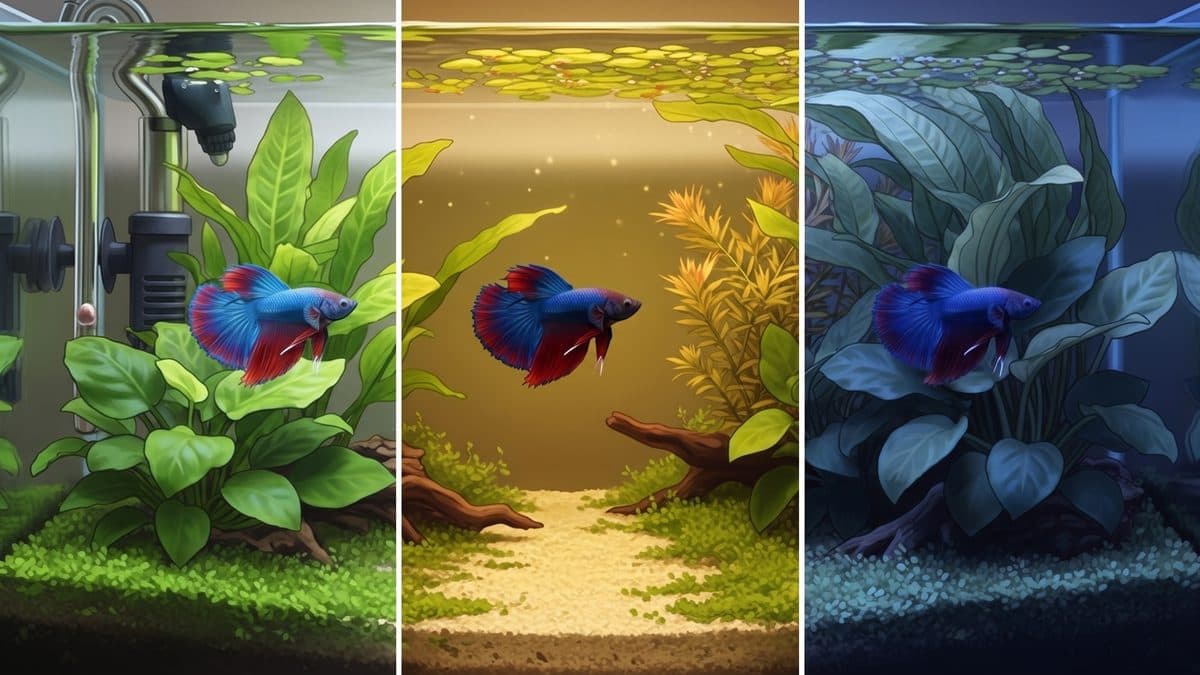
- 3,000–5,000 K: Warm, yellowish light. Mimics early morning or late afternoon sun. Makes red and orange fish colours pop but can make plants appear yellowish.
- 6,500 K: Neutral daylight. The standard for planted aquariums — it closely replicates midday tropical sunlight and supports photosynthesis across all wavelengths. Plants appear natural green, and fish colours are rendered accurately.
- 8,000–10,000 K: Cool, bluish-white light. Simulates deeper water conditions. Enhances blue fish colours and creates a crisp, modern aesthetic. Common in marine and African cichlid setups.
- 10,000–20,000 K (actinic blue): Deep blue light primarily for marine reef aquariums. Not recommended as sole lighting for freshwater — fish appear washed out and plants do not receive adequate photosynthetically active radiation.
For freshwater aquariums, 6,500–8,000 K provides the best balance of natural appearance, plant growth, and fish colour rendering. Many modern LED fixtures allow you to blend warm and cool LEDs to achieve any colour temperature, adjustable to your preference.
PAR Values for Planted Tanks
PAR (Photosynthetically Active Radiation) measures the amount of light in the 400–700 nm wavelength range that plants can use for photosynthesis. PAR is measured in micromoles per square metre per second (µmol/m²/s) using a PAR meter. It is the most accurate way to determine whether your light can grow the plants you want:
- Low-light plants (20–40 PAR at substrate): Java Fern, Anubias, Java Moss, Cryptocoryne, Vallisneria. These plants thrive under modest lighting and are ideal for beginners and fish-focused tanks.
- Medium-light plants (40–80 PAR at substrate): Amazon Sword, Hygrophila, Rotala rotundifolia, Ludwigia, Staurogyne repens. Require a capable planted-tank LED light and benefit from liquid fertiliser supplementation.
- High-light plants (80–150+ PAR at substrate): Glossostigma, Hemianthus callitrichoides (HC "Cuba"), Rotala macrandra, red-coloured plants requiring intense light for pigment development. Require premium LED fixtures, CO₂ injection, and comprehensive fertilisation.
PAR decreases with depth — a light that provides 80 PAR at 12 inches may only deliver 40 PAR at 24 inches. Deep tanks (24+ inches) require significantly more powerful lights to achieve adequate PAR at the substrate.
Lighting for Fish-Only Tanks
Fish-only tanks (no live plants) have simple lighting requirements:
- Any LED light in the 6,500–10,000 K range for natural colour rendering.
- 8–10 hours daily on a timer. Consistency matters — an automatic timer eliminates the variability of manual on/off.
- Avoid excessively bright lighting — many fish (Bettas, most catfish, predators) prefer dim environments and become stressed under intense light.
- For species that prefer dim conditions (Betta, Wolf Fish, nocturnal catfish), use a low-intensity setting or floating plants (Amazon Frogbit, Salvinia) to diffuse the light.
Lighting for Planted Tanks
Planted tank lighting must balance three factors: sufficient PAR for plant growth, appropriate spectrum for photosynthesis, and controlled intensity to prevent algae.
- Low-tech planted tanks (no CO₂, liquid fertiliser only): A moderate LED providing 20–40 PAR at substrate is sufficient. Plants like Java Fern, Anubias, Cryptocoryne, and Vallisneria thrive under this light level. Run 8 hours daily.
- Medium-tech planted tanks (no CO₂, comprehensive fertilisation): 40–80 PAR at substrate. A quality planted-tank LED (Fluval Plant 3.0, Chihiros WRGB II) at moderate intensity. 7–8 hours daily to balance growth and algae control.
- High-tech planted tanks (pressurised CO₂, full fertilisation): 80–150+ PAR at substrate. Premium LED at full intensity (Chihiros WRGB II, Twinstar 900SP, ONF Flat Nano). CO₂ injection is mandatory at this light level — without CO₂, high PAR drives explosive algae growth rather than plant growth. 6–8 hours daily.
The relationship between light, CO₂, and fertiliser is a triangle: increasing one without proportionally increasing the others creates imbalance — and imbalance grows algae. Start with lower light and increase gradually as you master fertilisation and CO₂ management.
Photoperiod Management
Photoperiod — the daily duration of light — affects fish behaviour, plant growth, and algae development:
- 8–10 hours is the standard photoperiod for freshwater aquariums. This provides adequate light for plant photosynthesis while limiting the total daily light exposure that fuels algae.
- Use a timer. Manual on/off creates inconsistent photoperiods that stress fish (disrupted circadian rhythm) and promote algae (irregular light availability). A $5 mechanical timer or a smart plug provides reliable automation.
- Sunrise/sunset ramp: Programmable LEDs (Fluval Plant 3.0, Chihiros) allow gradual ramp-up from darkness to full intensity over 30–60 minutes, simulating natural dawn and dusk. This reduces the startling effect of sudden on/off lighting and is less stressful for fish.
- Midday siesta (optional): Some aquarists split the photoperiod — 4 hours on, 2 hours off, 4 hours on. The siesta reduces total light exposure (helping control algae) while maintaining the same visual enjoyment period. Plants tolerate the break without issue. The evidence for siesta effectiveness in algae control is anecdotal but widely reported as beneficial.
Algae Control Through Lighting
Excessive or poorly managed lighting is the primary driver of algae outbreaks:
- Reduce photoperiod: If experiencing algae, reduce lighting to 6 hours daily for 2–3 weeks. This starves algae while established plants, with their stored energy reserves, continue growing (albeit more slowly).
- Reduce intensity: Turn the LED down to 50–70 % power. High intensity without corresponding CO₂ and fertilisation drives algae, not plants.
- Avoid direct sunlight: Never place an aquarium where it receives direct sunlight. Even 1–2 hours of direct sun provides more PAR than most LED fixtures at full power, creating an uncontrollable algae trigger.
- Blackout treatment: For severe algae outbreaks (green water, cyanobacteria), a complete 3–5 day blackout (lights off, tank covered) kills the algae while plants survive on stored energy. Resume with a reduced photoperiod (6 hours) and gradually increase.
- Balance the triangle: Light + CO₂ + fertiliser must be balanced. Increasing light without increasing CO₂ and nutrients gives the extra light energy to algae (which have lower nutrient requirements than plants). If you add more light, add more CO₂ and fertiliser proportionally.
Equipment Recommendations
- Budget fish-only / low-tech planted: Nicrew ClassicLED Plus ($20–40). Adequate for low-light plants, good colour rendering, built-in timer on some models. Available for 12–72 inch tanks.
- Mid-range planted: Fluval Plant 3.0 ($80–150). Full spectrum, Bluetooth app control, programmable sunrise/sunset, and proven PAR output for medium-light plants. The most recommended planted-tank light in the hobby.
- High-end planted / aquascaping: Chihiros WRGB II ($150–250). Professional-grade PAR output, individual RGBW channel control, and Bluetooth app with community-shared presets. Drives high-light carpet plants with CO₂.
- Nano tanks (5–15 gallons): ONF Flat Nano ($70). Compact, powerful, adjustable. Perfect for small planted tanks and Betta setups.
- Large tanks (48–72 inches): Twinstar 900SP or Fluval Plant 3.0 in the appropriate size. For very large tanks, multiple fixtures mounted side by side provide even coverage.
Lighting is the most visible piece of aquarium equipment — it determines how your tank looks every day. Choose a light that matches your goals (fish viewing, plant growth, or both), set it on a timer, and resist the urge to run it at maximum intensity unless your CO₂ and fertilisation programme supports it. For complete equipment guidance, see our filter guide and heater guide.