Overview
The Snowflake Moray Eel has earned its reputation as the most beginner-friendly moray species through a combination of favourable traits: it stays relatively small (most captive specimens top out at 60 cm / 24 in), has blunt, molar-like teeth designed for crushing crustacean shells (rather than the sharp, recurved teeth of fish-eating morays), tolerates a wide range of marine water conditions, and adapts readily to frozen food. These characteristics make it accessible to marine aquarists who might be intimidated by larger, more aggressive moray species.
In the wild, Echidna nebulosa inhabits shallow reef flats, tide pools, and rocky intertidal zones throughout the Indo-Pacific — from the Red Sea and East Africa to Hawaii and French Polynesia. This broad distribution across variable environments has produced a naturally hardy, adaptable species.
Appearance
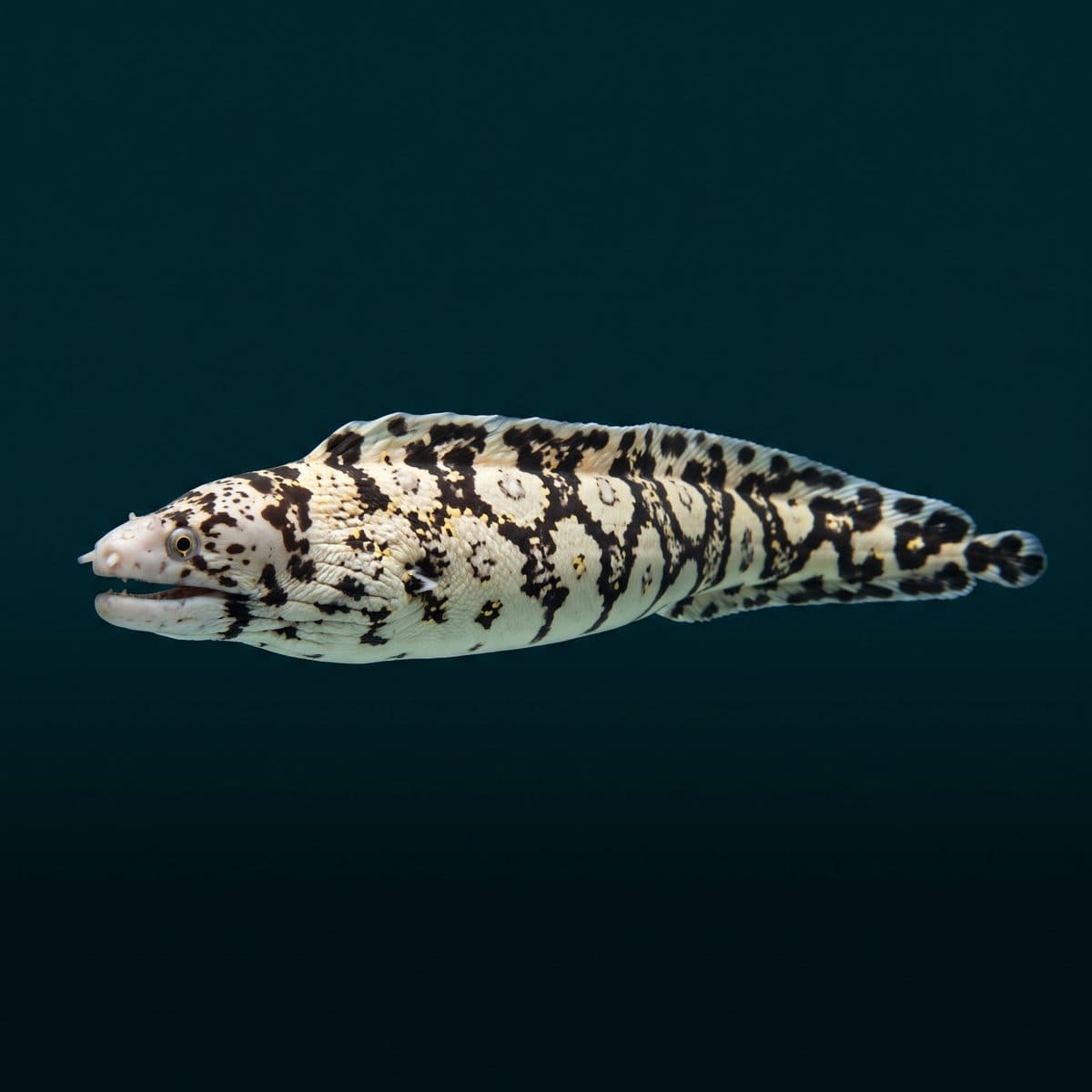
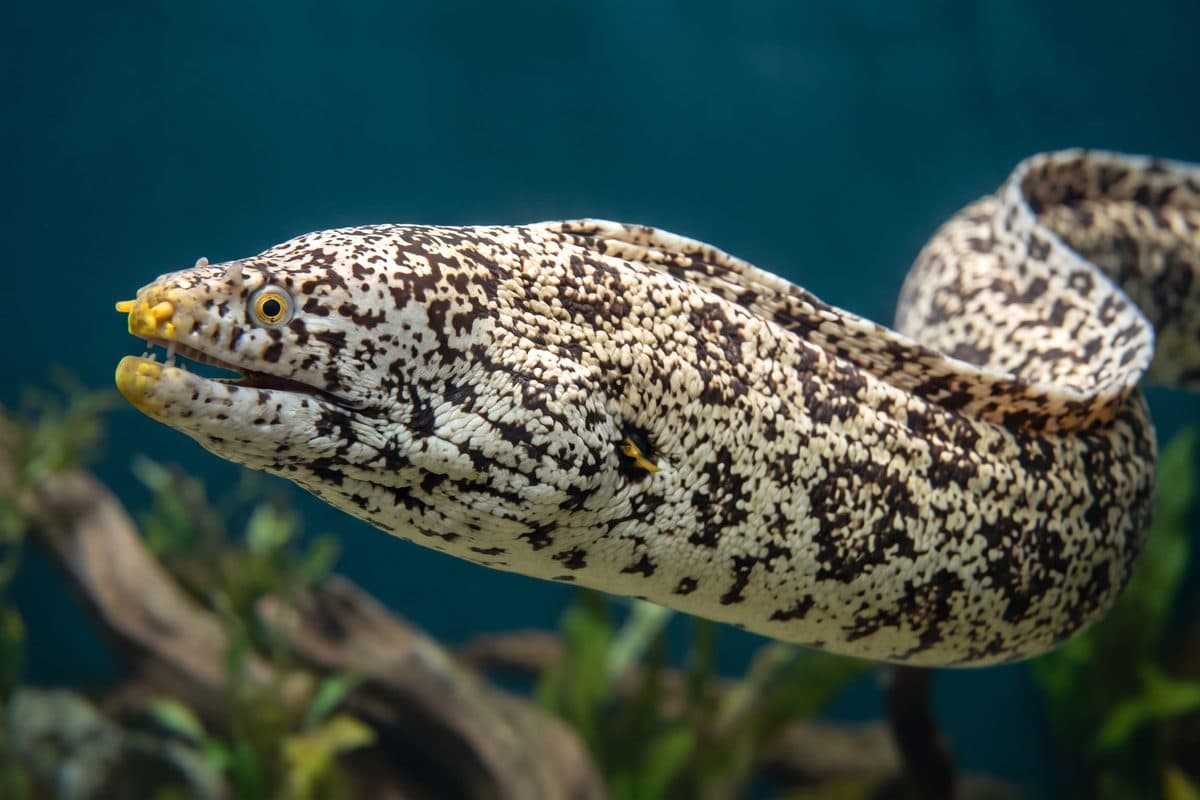
The Snowflake Moray's common name derives from its colour pattern: a white or cream base covered with a complex pattern of black, brown, and yellow markings that resemble snowflakes or frost patterns. Key features:
- Body colour: White to cream base with bold black or dark brown reticulated markings.
- Yellow accents: Many specimens display yellow-golden highlights within the dark markings and around the face, particularly around the nostrils.
- Eyes: Small, with a distinctive yellowish ring.
- Body shape: Typical moray morphology — elongated, muscular, serpentine body with no pectoral or ventral fins. Dorsal and anal fins are reduced to a continuous fin fold along the back and underside.
- Teeth: Blunt, pebble-like — visible when the eel gapes (which is respiratory behaviour, not aggression). The dental structure is adapted for crushing hard-shelled prey.
Tank Requirements
- Tank size: 75 gallons (284 L) minimum. While Snowflake Morays spend most time hiding in rockwork, they need adequate space to extend and move when active (typically at dawn, dusk, and night).
- Rockwork: Extensive — the eel needs multiple caves, crevices, and hiding spots. PVC pipe sections hidden within the rockwork provide additional retreats. The eel will choose a "home cave" and return to it consistently.
- Substrate: Fine sand or crushed coral. Morays sometimes burrow partially into substrate.
- Filtration: Standard marine filtration with protein skimmer. Morays produce significant waste during and after feeding, so slightly over-specifying filtration is wise.
Escape Prevention
This deserves its own section because moray eels are notorious escape artists. Snowflake Morays are particularly determined:
- Lid: Completely sealed. Every gap, cable hole, overflow opening, and filter intake must be covered. Use egg crate, mesh, or foam to block gaps around plumbing and equipment.
- Overflow guards: If using a sump system, cover the overflow with mesh fine enough that the eel cannot enter.
- Vigilance: Check lid security regularly. Morays are strong and can push lightweight lids aside.
A Snowflake Moray that escapes the tank can survive for hours out of water (their skin produces a protective mucus coating, and they can breathe through their skin to some extent). If you find your eel on the floor, return it to the tank immediately — many survive if found within a few hours.
Water Parameters
- Temperature: 75–82 °F (24–28 °C).
- pH: 8.1–8.4.
- Salinity: 1.024–1.026 SG.
- Ammonia/Nitrite: 0 ppm.
- Nitrate: Below 20 ppm.
Snowflake Morays are more tolerant of suboptimal water conditions than many marine fish, but this should not be used as an excuse for poor maintenance. Clean water extends lifespan and reduces disease risk.
Diet & Feeding
Snowflake Morays are carnivores with a crustacean-heavy natural diet. In captivity:
- Staple foods: Frozen shrimp (whole, shell-on — the shell provides roughage and calcium), frozen squid, frozen krill, and frozen silversides.
- Feeding method: Use long feeding tongs or a feeding stick to present food near the eel's cave entrance. Morays have excellent sense of smell but poor vision — waving the food slowly near their cave triggers the feeding response.
- Frequency: 2–3 times per week for adults. Morays have slow metabolisms and overfeeding leads to poor water quality.
- Vitamin supplementation: Soak frozen food in a vitamin supplement (Selcon, Vitachem) before offering to prevent nutritional deficiencies.
Behaviour & Tank Mates
Snowflake Morays are primarily nocturnal but adapt to daytime feeding schedules in captivity. During the day, they rest in caves with their head protruding — the classic moray "guard" posture. The rhythmic opening and closing of the mouth is respiratory (forcing water over the gills) and is not a threat display.
Despite their dramatic appearance, Snowflake Morays are among the more peaceful moray species. Their blunt teeth are designed for crustaceans, not fish, so they are less likely to prey on tank mates than sharp-toothed species. However, they will eat any crustacean in the tank (shrimp, crabs, lobsters, hermit crabs) and may attempt to eat very small fish.
Suitable tank mates include:
- Medium to large robust marine fish: tangs, large wrasses, triggerfish, lionfish, pufferfish
- Avoid: small fish (chromis, gobies, blennies), all crustaceans (will be eaten), other moray species (in tanks under 125 gallons)
Natural Habitat & Range
The Snowflake Moray has one of the widest distributions of any moray, ranging right across the Indo-Pacific from the Red Sea and the east coast of Africa through Indonesia and the Philippines to Hawaii, French Polynesia, and the eastern Pacific coast of Central America. That enormous range tells you a lot: Echidna nebulosa is a generalist that thrives in variable conditions, which is exactly why it adapts so well to aquarium life.
Unlike the deep-reef morays, this species lives in the shallows — reef flats, tide pools, surge zones, and rocky intertidal areas rarely deeper than 30 metres, and often in water barely a metre deep. It spends the day wedged into rock and coral crevices with just its head showing, and hunts crabs, shrimp, and other crustaceans at dusk and after dark, crushing shells with those distinctive blunt, pebble-like teeth.
Recreating a slice of that habitat is the key to a happy eel. Plenty of interlocking live rock with tunnels and caves, a length or two of PVC hidden in the aquascape, and sand it can nose through will make it feel secure — and a secure moray is one that comes out to greet you rather than hiding permanently. The shallow, high-energy origin also explains its tolerance for the fluctuating conditions of a home tank.
Health & Common Problems
Snowflake Morays are hardy, but they have some quirks worth knowing before something goes wrong:
- Going off food: A healthy moray can voluntarily fast for a week or two, especially after a big meal or a move, and this is usually nothing to worry about. A fish that refuses food for several weeks, or that looks thin behind the head, needs investigating — check water quality first.
- Overfeeding and fatty liver: Far more eels are killed by kindness than by starvation. Feeding rich, oily foods too often leads to obesity and fatty degeneration of the liver. Two or three modest feedings a week is plenty for an adult.
- Bacterial infections and skin lesions: Scrapes from rockwork or a rough net can become infected in poor water. Morays are scaleless, so cuts and cloudy patches need clean water and, if they progress, a marine antibacterial in a hospital tank.
- Parasites: Marine ich and flukes affect morays less than most fish thanks to their thick mucus coat, but heavy infestations still happen. Their copper sensitivity means treatment is safest done cautiously in quarantine, not with reef-level copper doses.
Two habits prevent nearly every problem: quarantine new tank mates so you're not introducing disease to the eel, and don't overfeed. A Snowflake Moray kept in clean, stable water on a sensible feeding schedule routinely lives well past a decade.
Acclimation & Handling
Getting a moray home safely is mostly about respecting two things: their sensitivity to sudden change and their extraordinary strength. Drip-acclimate a new Snowflake over an hour, matching salinity and temperature carefully, and release it into a dimly lit tank with a ready-made cave. Expect it to vanish into the rockwork for a day or several — that's a healthy response, not a problem. Offer the first meal on feeding tongs near its hiding spot after lights-out.
Handling is where keepers get hurt. Never grab a moray or try to move it by hand — even a blunt-toothed Snowflake can deliver a painful, bruising bite, and their skin is easily damaged by dry hands or a rough net. To move one, coax it into a rigid container or a length of PVC pipe it's already using as a home and lift the whole thing. Soft nets are worse than useless here; the teeth and jaw tangle in the mesh and the eel can injure itself thrashing.
The same strength drives their legendary escaping. Everything about handling and housing comes back to the sealed lid covered in the escape-prevention section above — a moray you can't keep in the tank is a moray you'll eventually find dried out on the floor. Treat every open gap, cable port, and overflow as a door it will test.
Breeding
Snowflake Morays are effectively impossible to breed at home, and it's worth understanding why so you're not chasing an impractical goal. Morays are broadcast spawners that release eggs and sperm into open water; the fertilised eggs develop into a bizarre, leaf-shaped larval stage called a leptocephalus that drifts in the plankton for months before settling. No home aquarium, and very few public ones, can support that pelagic larval phase.
There's also the matter of sexing them. Snowflake Morays show no reliable external differences between males and females, and some morays are hermaphroditic or change sex, which further complicates any pairing attempt. As a result, essentially every Snowflake Moray in the trade is wild-collected as a juvenile or sub-adult from shallow reefs across its vast range.
Because collection is straightforward and the species is abundant and widespread, this isn't a conservation concern the way deep-reef or endangered species are. Your role as a keeper is simply to give a wild-caught animal a long, well-fed, low-stress life in captivity — which, for a hardy species like this, is very achievable.
Is a Snowflake Moray Right for You?
The Snowflake Moray is the moray most people should start with, but "beginner-friendly" is relative — it's still a large, predatory, escape-prone marine fish. Here's how to tell if it suits you.
It's a great fit if you:
- Can run a 75+ gallon marine tank with a genuinely sealed lid.
- Want an interactive, long-lived, hardy fish that learns to feed from tongs and recognise you.
- Are happy to keep a fish-only or FOWLR system rather than a shrimp-and-crab reef.
- Don't mind a nocturnal animal that hides during the day, especially at first.
Reconsider if you:
- Keep small fish or prize your cleanup-crew invertebrates — both are food.
- Can't or won't fully seal every opening in the lid and plumbing.
- Want a fish that's always on show; morays are ambush-hiders by nature.
Meet those conditions and a Snowflake Moray is one of the most rewarding marine fish you can own — genuinely personable, tough, and long-lived. The two ways people fail with them are letting them escape and overfeeding them, and both are entirely within your control.