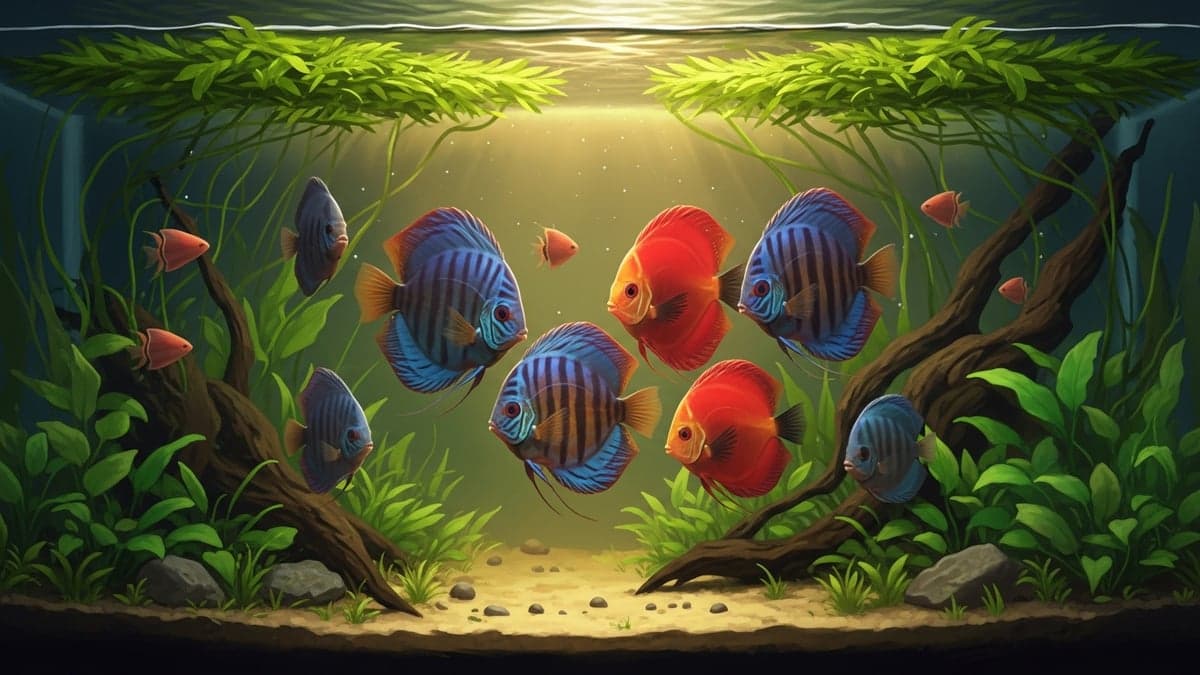
What Makes Discus Special
Discus (Symphysodon spp.) are often called the "king of the aquarium," and for good reason. Their laterally compressed, disc-shaped bodies, vivid colour patterns, and remarkably intelligent behaviour set them apart from virtually every other freshwater species. A mature Discus will recognise its keeper, respond to feeding cues, and display complex social hierarchies within the group — behaviour more commonly associated with cichlids twice their size.
What makes Discus challenging is not complexity — it is consistency. They demand stable, warm, soft water with minimal dissolved waste. Miss a water change, let the temperature swing 2 °C overnight, or introduce a stressed specimen without quarantine, and problems cascade quickly. The reward for meeting their needs is a centrepiece display that stops every visitor in their tracks.
For keepers ready to invest the effort, Discus are deeply rewarding. This guide covers everything you need to set up your first Discus aquarium and avoid the pitfalls that catch most beginners. You can also explore our Discus species profiles for detailed information on individual varieties.
Discus Species and Varieties
Three species comprise the genus Symphysodon: S. aequifasciatus (green Discus), S. discus (Heckel Discus), and S. tarzoo (blue/brown Discus). In practice, nearly all aquarium Discus are captive-bred hybrids derived from decades of selective breeding. The result is a staggering palette of colour forms.
Popular varieties for beginners include:
- Pigeon Blood — cream to orange body with red speckles, hardy and widely available.
- Blue Diamond — solid electric-blue body, one of the most striking solid-colour strains.
- Red Melon — warm orange-red body with minimal patterning, excellent colour saturation.
- Turquoise — classic strain with turquoise stripes over a reddish-brown base; closest to wild-type patterning.
- Snow White — pure white leucistic strain, demanding in terms of water quality but visually stunning.
For your first Discus tank, choose captive-bred strains from a domestic breeder. Wild-caught Discus are significantly more demanding regarding water chemistry and should be reserved for experienced keepers.
Tank Requirements for Discus
Tank Size and Dimensions
A 55-gallon (210-litre) aquarium is the absolute minimum for a small group of Discus, but a 75-gallon (285-litre) tank is strongly recommended. Discus are social fish that must be kept in groups of six or more to distribute aggression and allow natural hierarchical behaviour. For a group of six adults, budget 10 gallons per fish minimum — making a 75-gallon tank the practical starting point.
Height matters for Discus more than for most species. Their tall body profile means they utilise vertical space. A tank at least 45 cm (18 inches) tall is necessary; 50–60 cm (20–24 inches) is ideal. Standard 75-gallon tanks (48 × 18 × 21 inches) meet this requirement.
For a deep-dive on tank sizing, see our Discus fish tank size guide.
Substrate and Décor
Two schools of thought dominate Discus substrate choices:
- Bare bottom: Easiest to keep clean, ideal for grow-out tanks and breeding pairs. Uneaten food and waste are immediately visible and siphoned during water changes. The aesthetic trade-off is obvious.
- Fine sand: Pool filter sand or fine aquarium sand (1–2 mm grain) provides a natural look without trapping waste in the way gravel does. Keep the bed thin — 2–3 cm maximum.
For décor, driftwood is the centrepiece of most Discus tanks. Malaysian driftwood and mopani wood release tannins that naturally lower pH and tint the water amber — conditions Discus thrive in. Add Anubias, Java Fern, and Vallisneria as hardy plants that tolerate the warm temperatures Discus require. Avoid sharp rocks and rough surfaces that can damage fins.
Water Parameters
Temperature Stability
Discus require warmer water than almost any other common freshwater species: 28–30 °C (82–86 °F). This is non-negotiable. Below 27 °C, Discus become lethargic, refuse food, and become susceptible to intestinal parasites and bacterial infections. Temperature stability matters as much as the absolute number — invest in a quality heater with an external controller and avoid placing the tank near windows or exterior walls where ambient temperature fluctuates.
Use two heaters for tanks above 55 gallons. If one fails, the second maintains temperature until you notice. A $30 backup heater is cheap insurance for $500+ worth of livestock.
pH and Hardness
Target pH of 6.0–7.0 and general hardness of 1–8 dGH. Captive-bred Discus are more tolerant of moderate hardness than wild-caught fish, but soft, slightly acidic water consistently produces the best colour and behaviour. If your tap water is hard and alkaline, an RO/DI unit blended with tap water is the most reliable solution.
More important than hitting a specific pH number is stability. A stable pH of 7.2 is less stressful than pH oscillating between 6.0 and 6.8. Ensure your KH buffer (2–4 dKH) is sufficient to prevent pH crashes between water changes. For more details, consult our Discus water parameters guide.
Feeding Discus
Discus are carnivore-leaning omnivores that need frequent, high-protein meals:
- Staple diet: High-quality Discus pellets or granules (45 %+ protein). Brands like Hikari Discus Bio-Gold and Sera Discus Granules are well-proven.
- Frozen foods: Bloodworm, brine shrimp, mysis shrimp, and beefheart mix. Feed frozen foods 2–3 times per week for variety and colour enhancement.
- Live foods: Blackworms, daphnia, and brine shrimp are excellent conditioning foods, especially before breeding. Source from reputable suppliers to avoid introducing parasites.
Feeding frequency: Juveniles (under 10 cm) need 3–5 small meals daily to support rapid growth. Adults can be fed 2–3 times daily. Remove uneaten food within 5 minutes to prevent water quality degradation. See our Discus feeding guide for detailed protocols.
Compatible Tank Mates
Discus are peaceful but slow-moving, and their high temperature requirement limits compatible species. The best tank mates share three traits: tolerance of 28–30 °C, peaceful temperament, and inability to outcompete Discus at feeding time.
Recommended tank mates:
- Cardinal Tetras — the classic Discus companion; native to the same waters, thrives at 28 °C.
- Rummy-nose Tetras — schooling behaviour complements Discus, excellent water-quality indicator.
- Corydoras sterbai — one of the few Corydoras species comfortable above 27 °C.
- German Blue Rams — share identical temperature and pH requirements.
- Bristlenose Plecos — useful algae control; avoid common plecos that grow too large and may rasp Discus slime coat.
Avoid: Tiger Barbs (fin nippers), most African Cichlids (wrong water chemistry and temperament), and any fast-moving fish that will steal food before Discus can eat. For the full breakdown, see our Discus tank mates guide.
Breeding Basics
Discus are biparental substrate spawners with one of the most remarkable parental behaviours in freshwater fish: fry feed on a mucus secretion produced by the parents' skin for their first 10–14 days. This means removing eggs to hatch artificially — while possible — produces weaker fry than parent-raised offspring.
To breed Discus, start with a group of six or more juveniles and allow them to pair naturally. Forced pairing rarely succeeds. Once a pair forms (identified by mutual cleaning of a flat surface and aggressive defence of territory), move them to a dedicated 40–55 gallon breeding tank with bare bottom, a spawning cone or vertical slate, temperature raised to 30–31 °C, and pH lowered to 5.5–6.5.
Eggs hatch in 50–60 hours. Fry become free-swimming at day 3–4 and immediately attach to the parents' flanks to feed on mucus. Begin supplementing with newly hatched brine shrimp at day 7–10. For the full protocol, see our Discus breeding guide.
Common Diseases and Prevention
Discus are susceptible to several conditions that rarely affect hardier species:
- Hexamita / Hole-in-the-head: Caused by the flagellate protozoan Hexamita, presenting as pitting lesions around the head and lateral line. Triggered by poor water quality and nutritional deficiency. Treat with metronidazole and address underlying husbandry issues.
- Discus plague: A highly contagious condition (likely viral) causing darkening, excess mucus production, and rapid death. Quarantine new arrivals for 4–6 weeks to prevent introduction.
- Intestinal parasites: Common in imported Discus. Symptoms include white, stringy faeces, loss of appetite, and emaciation. Prophylactic deworming with praziquantel or levamisole is standard practice for new fish.
- Gill flukes: Caused by Dactylogyrus spp. Symptoms include rapid gill movement, flashing, and lethargy. Treat with praziquantel.
Prevention is always preferable to treatment. Maintain pristine water quality, quarantine every new fish, and source from breeders with transparent health protocols.
Top Beginner Mistakes to Avoid
- Keeping fewer than six. Small groups develop severe bullying hierarchies. One dominant fish terrorises the rest, causing chronic stress, colour loss, and disease susceptibility. Six is the minimum; eight or more is better.
- Skipping water changes. Discus produce significant bioload relative to their size. Twice-weekly water changes of 25–50 % are the baseline, not a suggestion. Nitrate must stay below 20 ppm — ideally below 10 ppm.
- Temperature too low. Keeping Discus at 25–26 °C (a common tropical community temperature) is a slow death sentence. They need 28–30 °C consistently.
- Mixing wild-caught with captive-bred. Wild and domestic Discus carry different disease profiles. Mixing without extended quarantine frequently results in devastating losses.
- Impulse buying from pet shops. Big-box pet stores rarely maintain Discus properly. Buy from specialist Discus breeders or reputable dealers like The Fish Collection who quarantine and condition fish before sale.
Discus keeping is not as difficult as its reputation suggests — it simply requires discipline. Commit to the water change schedule, maintain stable parameters, feed quality food, and your Discus will thrive for 10–15 years.