Axolotl vs Mudpuppy: Neotenic Salamanders Compared
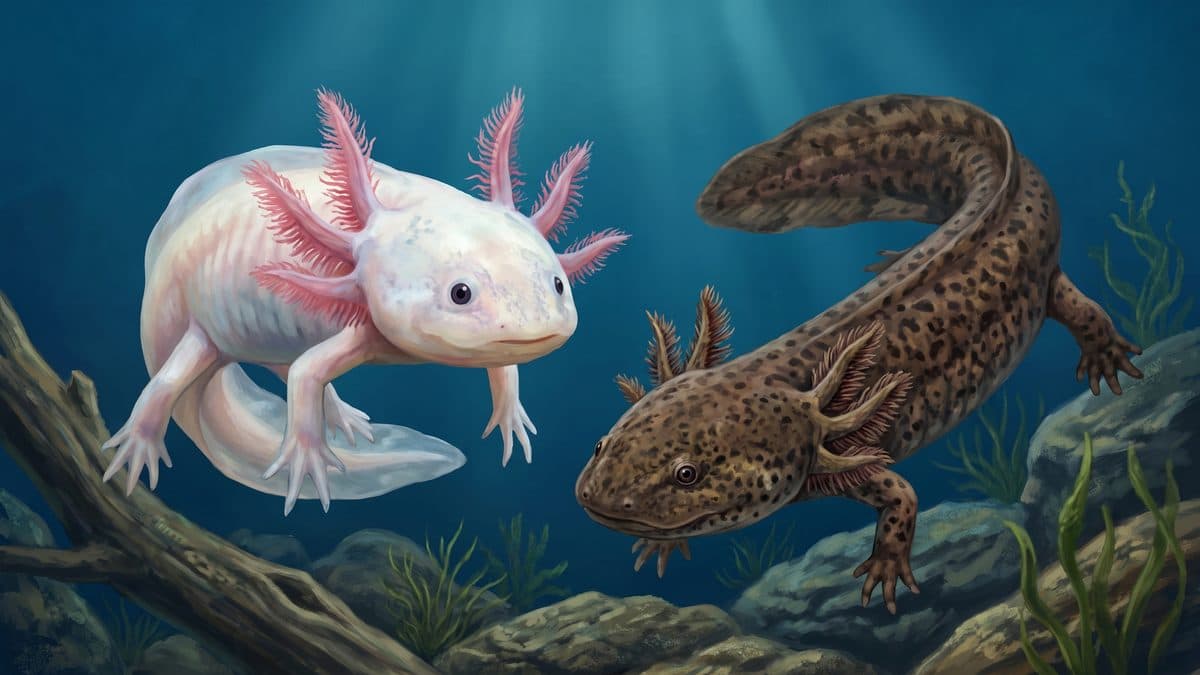
The Axolotl and the Mudpuppy are the two most commonly encountered neotenic salamanders in the aquarium and exotic pet hobby. Neoteny — the retention of larval characteristics (external gills, aquatic lifestyle, larval body plan) into sexual maturity — gives both species their distinctive feathery gills and permanently aquatic nature. To the untrained eye, they can look similar, leading to frequent confusion among new hobbyists.
However, these animals are not closely related. They belong to different families, inhabit different continents, and have fundamentally different care requirements and availability. This guide clarifies every important distinction.
Axolotl Overview
The Axolotl (Ambystoma mexicanum) is a member of the mole salamander family (Ambystomatidae) endemic to Lake Xochimilco in the Valley of Mexico. In the wild, the species is critically endangered — the remaining wild population is estimated at fewer than 1,000 individuals in the degraded canal systems of Xochimilco. Pollution, invasive tilapia and carp, and urbanisation have devastated their habitat.
Captive Axolotls, however, are abundant. They have been bred in captivity since the 1860s (originally for scientific research on regeneration) and are now produced commercially by hobbyist breeders worldwide. Adults reach 23–30 cm (9–12 inches), with exceptional individuals reaching 35 cm. They have a wide, flat head, small lidless eyes, and prominent feathery external gills (rami) that function as the primary respiratory organ.
Colour morphs: Wild-type (dark brown-grey with gold speckling), Leucistic (pale pink body with dark eyes — the most popular pet morph), Albino (golden-yellow with red gills), Melanoid (solid black, no iridophores), GFP (Green Fluorescent Protein — glow green under UV light, created for research), Copper, Lavender, and Piebald. New morphs continue to emerge through selective breeding. Axolotls are famous for their regenerative ability — they can regrow limbs, spinal cord tissue, heart tissue, and parts of their brain, making them invaluable to medical research.
Mudpuppy Overview
The Common Mudpuppy (Necturus maculosus) belongs to the family Proteidae and is found across eastern North America — from southern Canada through the Great Lakes region, down the Mississippi River drainage to Georgia and Louisiana. Unlike the Axolotl, the Mudpuppy is not endangered; it is widespread and locally common in clean rivers, streams, and lakes with rocky or debris-covered bottoms.
Adults reach 20–33 cm (8–13 inches), with records of 48 cm in the subspecies N. m. maculosus. They have a flattened head, small eyes, and bushy red external gills. Body colour is rusty brown to grey-brown with dark spots or blotches — there is essentially no colour variation, as Mudpuppies are not selectively bred. They are nocturnal and secretive, spending daylight hours hiding under rocks and logs.
Mudpuppies are not commonly bred in captivity. Most specimens in the pet trade are wild-caught, which raises sustainability and parasite concerns. They are cold-water animals adapted to temperate streams — a critical difference from the relatively warm-water Axolotl. In some regions, Mudpuppies are mistakenly killed by fishermen who believe (incorrectly) that they are venomous or harmful to game fish populations.
Key Differences
Taxonomy
Despite superficial similarity, Axolotls and Mudpuppies are taxonomically distant. Axolotls belong to the family Ambystomatidae (mole salamanders), which includes the Tiger Salamander and Spotted Salamander. Mudpuppies belong to the family Proteidae, which includes only Necturus (North American) and Proteus (the European Olm). The two families diverged over 150 million years ago — they are about as related as a cat is to a seal.
Temperature Requirements
This is the most critical practical difference. Axolotls are cool-water animals that thrive at 16–20 °C (60–68 °F) and suffer heat stress above 23 °C. Mudpuppies are genuinely cold-water — they inhabit streams at 4–18 °C (39–64 °F) year-round and are stressed by temperatures above 20 °C. Mudpuppies essentially require a chiller in most home environments, which significantly increases setup cost and complexity.
Availability and Legality
Axolotls are commercially bred and available from hundreds of breeders worldwide, typically costing $30–$100 per animal (rare morphs like GFP or Piebald may cost $100–$300). However, they are illegal to own in California, New Jersey, Maine, Virginia, and Washington, D.C. (USA), and in some other jurisdictions. Mudpuppies are rarely captive-bred and are mostly wild-caught, making them harder to source and potentially carrying parasites. Regulations on Mudpuppy collection vary by state.
Behaviour
Axolotls are relatively active and visible — they walk along the substrate, hover in mid-water, and often approach the front glass (especially at feeding time). They are crepuscular, most active at dawn and dusk. Mudpuppies are nocturnal and secretive — they spend most of their time hidden under rocks or logs and are rarely seen during the day. As pets, Mudpuppies are far less interactive and visible than Axolotls.
Quick Comparison Table
| Factor | Axolotl (Ambystoma mexicanum) | Mudpuppy (Necturus maculosus) |
|---|---|---|
| Family | Ambystomatidae | Proteidae |
| Origin | Lake Xochimilco, Mexico | Eastern North America |
| Adult Size | 23–30 cm (9–12 in) | 20–33 cm (8–13 in) |
| Lifespan | 10–15 years | 11–20+ years |
| Temperature | 16–20 °C (60–68 °F) | 4–18 °C (39–64 °F) |
| Colour Morphs | 10+ (leucistic, albino, GFP, etc.) | None (wild colouration only) |
| Availability | Widely captive-bred | Mostly wild-caught, uncommon |
| Activity Level | Moderate (crepuscular) | Low (nocturnal, secretive) |
| Regeneration | Exceptional (limbs, organs, CNS) | Limited (tail and some tissue) |
| Cost | $30–$300 | $20–$50 (wild-caught) |
| Conservation Status | Critically Endangered (wild) | Least Concern |
Tank Requirements Comparison
Axolotl tank setup: A single adult Axolotl needs a minimum of 20 gallons (long format preferred), with 10 additional gallons per extra Axolotl. The tank should have a fine sand substrate (bare bottom is acceptable but sand allows natural foraging behaviour) or no substrate at all — gravel is dangerous as Axolotls ingest substrate while feeding and can suffer fatal impaction from gravel pieces.
Filtration should be gentle — Axolotls are stressed by strong currents. A sponge filter or a canister/HOB filter with reduced flow output is ideal. The critical factor is temperature control: Axolotls need water at 16–20 °C. In warm climates or rooms, a chiller or aquarium fan is essential. Above 23 °C, Axolotls develop heat stress — reduced appetite, floating, fungal infections, and eventually death. Lighting should be dim; Axolotls have no eyelids and are uncomfortable under bright lights.
Mudpuppy tank setup: A single Mudpuppy needs a minimum of 20 gallons with excellent oxygenation. The tank should replicate a temperate stream environment: clean, well-oxygenated water at 4–18 °C (a chiller is almost always required), a sand or fine gravel substrate, and numerous hiding spots (flat rocks, PVC pipes, driftwood). Mudpuppies need more dissolved oxygen than Axolotls — an air pump with a long airstone is recommended in addition to the filter.
Current should be moderate — Mudpuppies are stream-dwellers accustomed to gentle flow. A canister filter with a spray bar provides both filtration and appropriate current. Lighting should be minimal; Mudpuppies are strictly nocturnal and will hide constantly under bright lights. Red or blue night-viewing lights allow observation without disturbing the animal.
Which Should You Choose?
Choose an Axolotl if:
- You want a visible, interactive, and photogenic pet salamander
- You prefer variety in colour morphs
- You want an animal that is captive-bred, widely available, and well-documented in care literature
- You can maintain water at 16–20 °C (achievable with fans or modest chillers in most climates)
- Axolotl ownership is legal in your jurisdiction
Choose a Mudpuppy if:
- You are an experienced keeper interested in native North American amphibians
- You can provide genuinely cold water (4–18 °C) year-round with a chiller
- You appreciate a more natural, wild-type animal over selectively bred morphs
- You do not mind a nocturnal, secretive pet that is rarely visible during the day
- You can source a healthy, legally collected specimen
Our recommendation: For the vast majority of hobbyists, the Axolotl is the clearly superior pet. It is captive-bred (no wild-collection concerns), available in beautiful colour morphs, more active and visible, better documented in care guides, and easier to maintain temperature-wise. Mudpuppies are fascinating animals that deserve more attention in the herp hobby, but their cold-water requirements, nocturnal nature, and wild-caught sourcing make them a specialist choice. Start with an Axolotl; graduate to Mudpuppies when you have cold-water experience.