Betta Community Principles
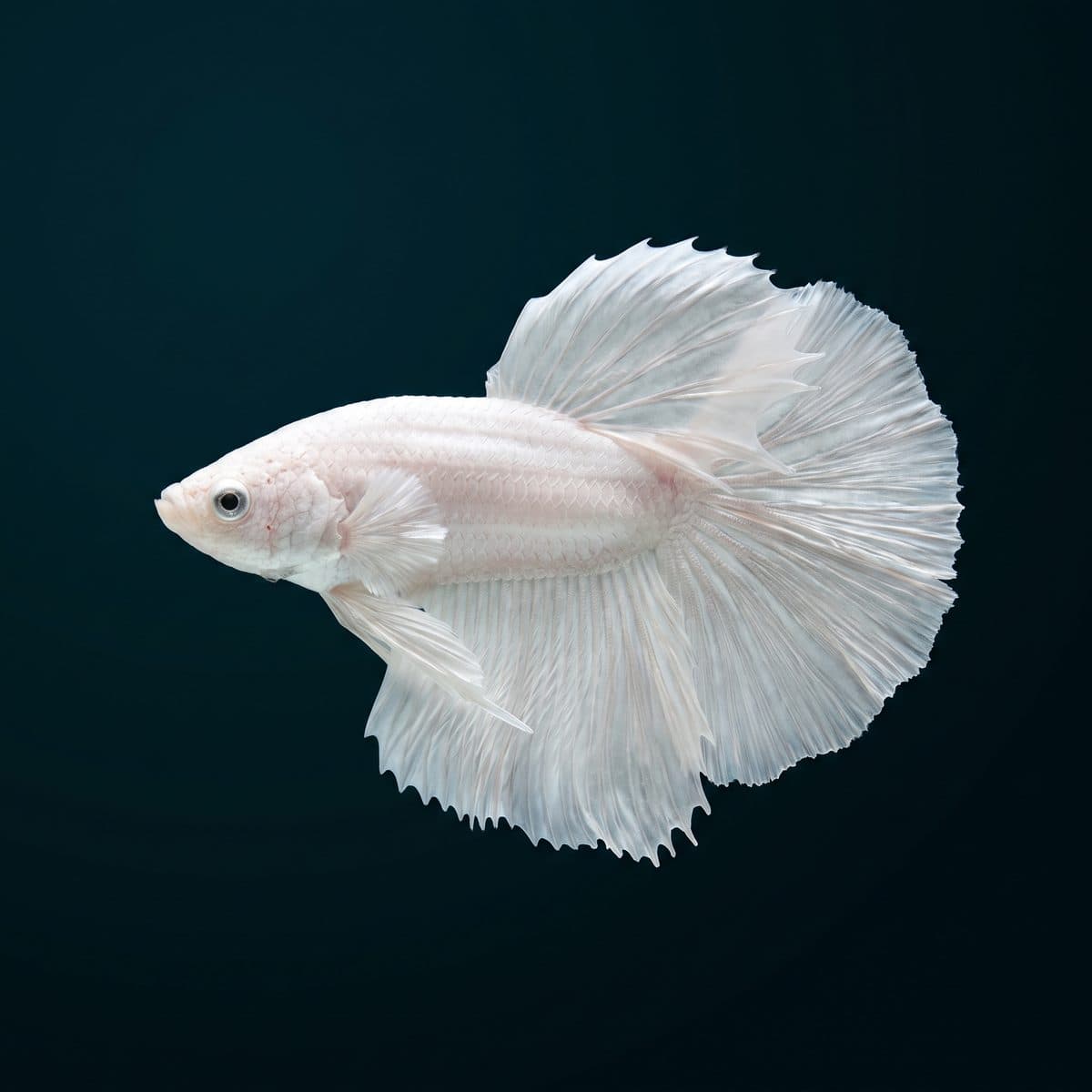
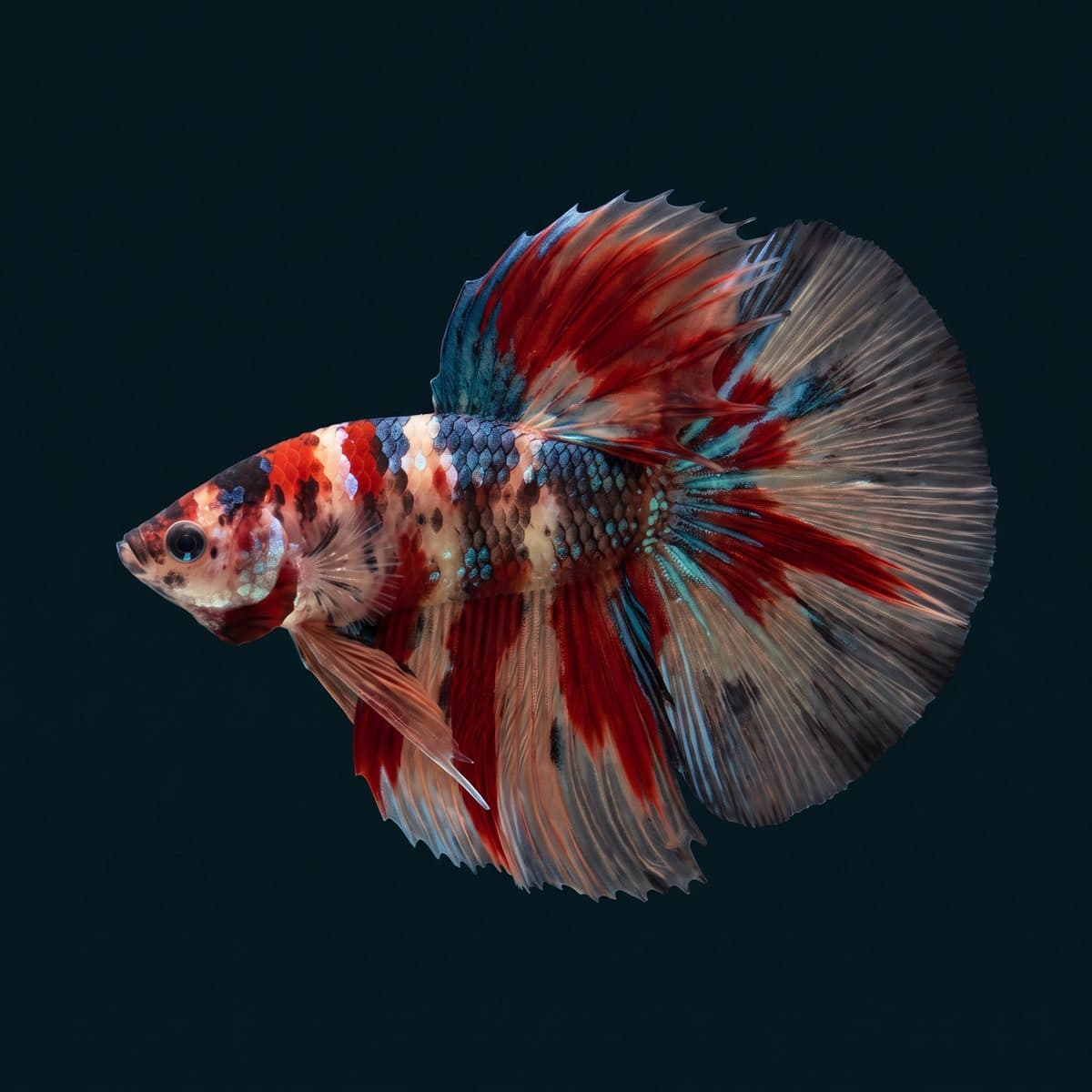
Betta splendens has a reputation as a solitary, aggressive fish that cannot live with anything. This is an oversimplification. While male Bettas are territorial toward other male Bettas and fish that resemble them (bright colours, flowing fins), many individual Bettas coexist peacefully with carefully chosen companions in properly set up tanks.
The three rules of Betta compatibility:
- No look-alikes: Avoid fish with bright colours or long fins that the Betta may perceive as a rival male. Guppies, Gouramis, and Endlers are excluded by this rule.
- No fin-nippers: Betta fins are slow-moving targets. Any species known to nip fins (Tiger Barbs, Serpae Tetras, some Danios) will destroy a Betta's finnage.
- Different zones: Choose species that primarily occupy the bottom or mid-water column, reducing territorial overlap with the surface-oriented Betta.
Minimum Tank Size for Community
A Betta community requires a minimum of 20 gallons (75 litres). This is non-negotiable — smaller tanks do not provide enough territory for the Betta to establish a home range while leaving sufficient space for companions. In tanks under 20 gallons, the Betta perceives the entire space as its territory and attacks anything that enters.
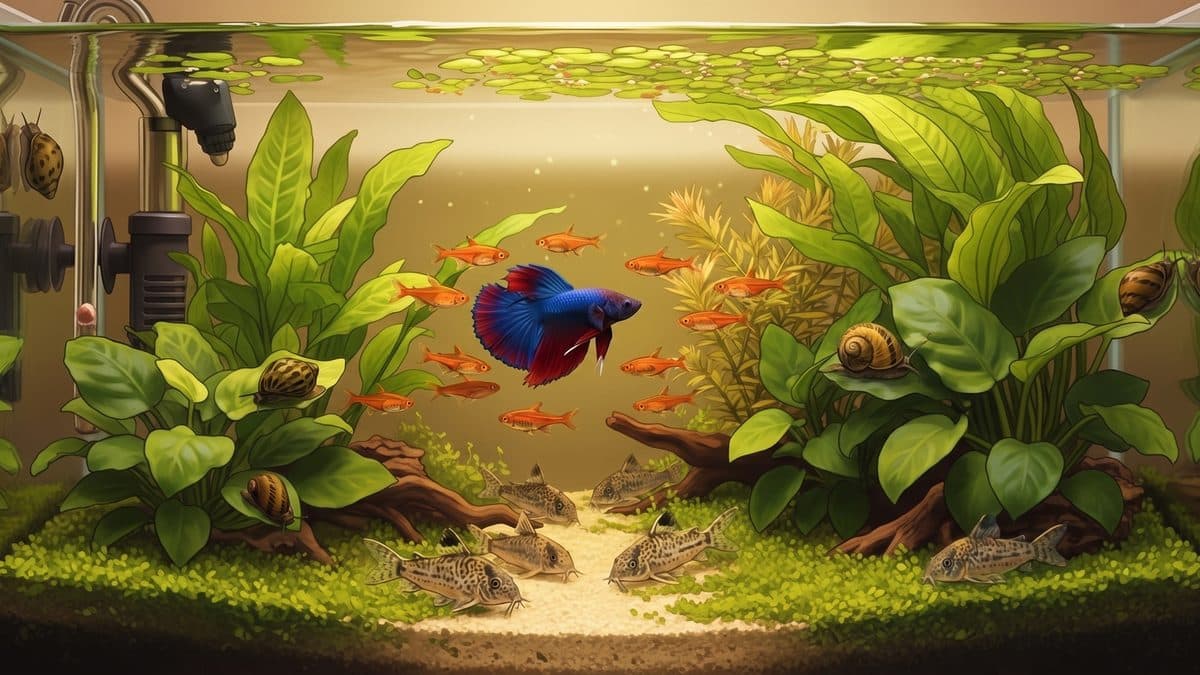
A 20-gallon long (30 × 12 × 12 inches) is ideal — the extended footprint provides more horizontal territory than a tall 20-gallon. Plant heavily with live plants (Java Fern, Anubias, Amazon Sword, Cryptocoryne) to create sight-line breaks and hiding spots. Dense planting is the single most important factor in Betta community success.
Invertebrate Companions
Snails
Snails are the safest Betta companions — virtually every Betta ignores them:
- Nerite Snails: The gold standard. 2–3 cm, excellent algae eaters, and completely peaceful. Cannot reproduce in freshwater (eggs need brackish water to hatch), so population control is not an issue. Choose Tiger Nerite or Zebra Nerite for visual appeal.
- Mystery Snails (Pomacea bridgesii): Larger (5–6 cm), peaceful, and visually interesting with long tentacles. Some curious Bettas nip at the tentacles occasionally, but serious aggression is rare. Available in gold, blue, ivory, and purple colour varieties.
- Malaysian Trumpet Snails: Burrowing snails that aerate the substrate and consume detritus. Nocturnal and mostly invisible. Reproduce prolifically — population can be controlled by not overfeeding.
Shrimp
- Amano Shrimp (Caridina multidentata): At 4–5 cm, they are large enough that most Bettas do not view them as food. Outstanding algae eaters and scavengers. Keep 3–5 in a 20-gallon Betta community. Always provide plenty of hiding spots (moss, driftwood, plant cover) for the shrimp to retreat to.
- Cherry Shrimp (Neocaridina davidi): Risky. At 2–3 cm, many Bettas view cherry shrimp as food. Success depends entirely on individual Betta temperament. In heavily planted tanks with ample hiding spots, breeding colonies can sometimes sustain themselves despite occasional predation — the shrimp reproduce faster than the Betta eats them. But some Bettas will hunt them to extinction.
- Ghost Shrimp: Inexpensive, 3–4 cm, transparent. A good test species — introduce 5–6 ghost shrimp first to gauge your Betta's reaction before investing in more expensive Amano or Cherry shrimp.
Compatible Fish Species
Bottom Dwellers
- Pygmy Corydoras (Corydoras pygmaeus): 2.5 cm, peaceful, schooling bottom-dwellers. Keep in groups of 8+ in a 20-gallon tank. Their small size and bottom-dwelling habit keeps them well below the Betta's radar.
- Corydoras habrosus: Similar to pygmy Corydoras but slightly larger (3 cm). Equally compatible. Groups of 6+.
- Kuhli Loaches (Pangio kuhlii): Nocturnal, eel-like bottom-dwellers (8–10 cm). Virtually invisible during the day — they hide in plant roots, driftwood crevices, and substrate. Groups of 6+ on sand substrate. One of the most reliable Betta tank mates.
- Otocinclus: Tiny (3–4 cm) algae eaters. Peaceful and surface-clinging. Keep in groups of 6+. Sensitive to water quality — only add to established, stable tanks.
Schooling Fish
- Ember Tetras (Hyphessobrycon amandae): At 2 cm, they are tiny, fast, and subdued in colour (soft orange, not bright red). Their small size and quick movement usually keeps them below the Betta's aggression threshold. School of 8–12 in a 20-gallon tank.
- Harlequin Rasboras (Trigonostigma heteromorpha): 4 cm, peaceful, muted orange-copper colour. School of 8+. Occupy mid-water. A proven Betta community species in 20+ gallon tanks.
- Chili Rasboras (Boraras brigittae): Tiny (1.5–2 cm), subdued red colouration, extremely peaceful. School of 10+. Their miniature size makes them almost invisible to the Betta.
- Lambchop Rasboras (Trigonostigma espei): Similar to Harlequins but slightly smaller. School of 8+.
Species to Avoid
- Other male Bettas: Two males in the same tank will fight to the death. No exceptions, no tank is large enough.
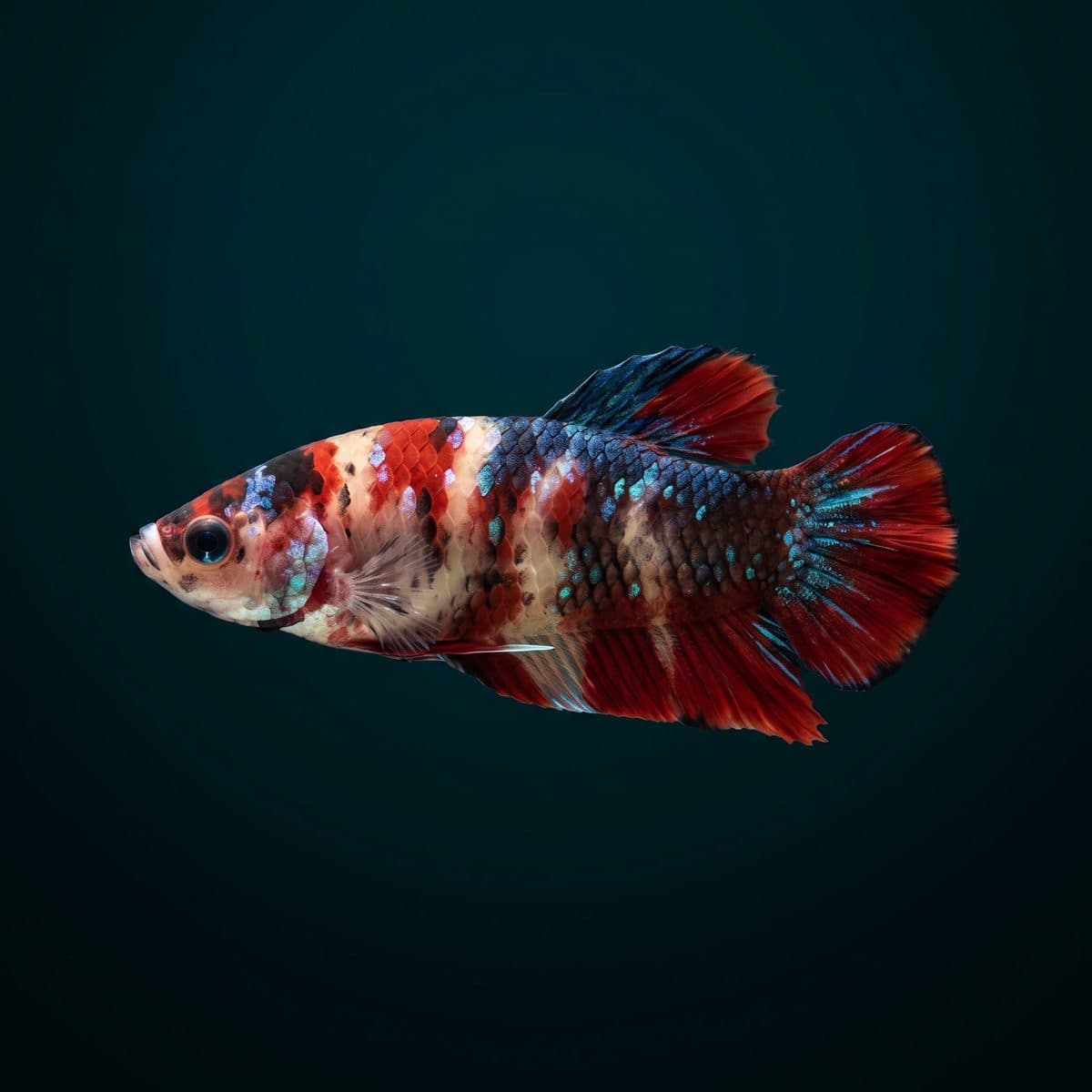
- Female Bettas (in male community tanks): Males will harass females relentlessly unless in a controlled breeding setup. Do not add a female "to keep him company."
- Guppies and Endlers: Flowing tails and bright colours trigger territorial aggression.
- Gouramis: Close relatives that Bettas recognise as competitors. Mutual aggression is guaranteed.
- Tiger Barbs, Serpae Tetras, Buenos Aires Tetras: Notorious fin-nippers that will shred Betta fins.
- Angelfish: Too large, too territorial, and their trailing fins can trigger Betta aggression (or vice versa).
- Any cichlid: Even "peaceful" cichlids (Rams, Apistogramma) can be risky with Bettas due to territorial overlap. The combination sometimes works in 30+ gallon tanks but is not recommended for beginners.
- Chinese Algae Eaters: Become aggressive as adults and will latch onto the Betta to rasp mucus.
Managing Betta Temperament
Individual Betta temperament varies enormously. Some Bettas tolerate tank mates readily from day one; others attack anything that moves. This unpredictability means you must always have a backup plan:
- Keep a spare 5-gallon tank or tank divider ready before introducing tank mates.
- Add the Betta last, after all other species are established and comfortable. This prevents the Betta from establishing the entire tank as its territory before companions arrive.
- Monitor closely for the first 72 hours. Mild curiosity (following, occasional flaring) is normal and usually subsides. Persistent chasing, biting, or clamped fins in tank mates indicates the community is not working.
- Rearrange decorations and plants when introducing the Betta — this resets territorial markers and reduces aggression.
- Feed the Betta first before feeding companions to reduce food-related aggression.
If your Betta proves incompatible with community life, there is no shame in maintaining it as a solo fish in a well-planted 5–10 gallon tank with snails. Some Bettas are simply too aggressive for companions, and forcing the issue harms everyone involved.
Female Betta Sororities
Female Betta sororities — groups of 5+ female Bettas in a single tank — are popular but controversial. They can work under specific conditions:
- Minimum 20-gallon long tank, heavily planted with dense cover and multiple line-of-sight breaks.
- 5–7 females minimum. Fewer creates a dominant-subordinate dynamic with too much pressure on the lowest-ranking fish.
- Introduce all females simultaneously. Adding new females to an established sorority almost always triggers aggression.
- Have individual tanks ready for each female in case the sorority collapses.
Even well-established sororities can collapse suddenly — a change in hierarchy, a hormonal shift, or a minor stressor can trigger aggression that escalates to injuries and death. Sororities are not recommended for beginners. For a detailed Betta care overview, see our Betta complete care guide.