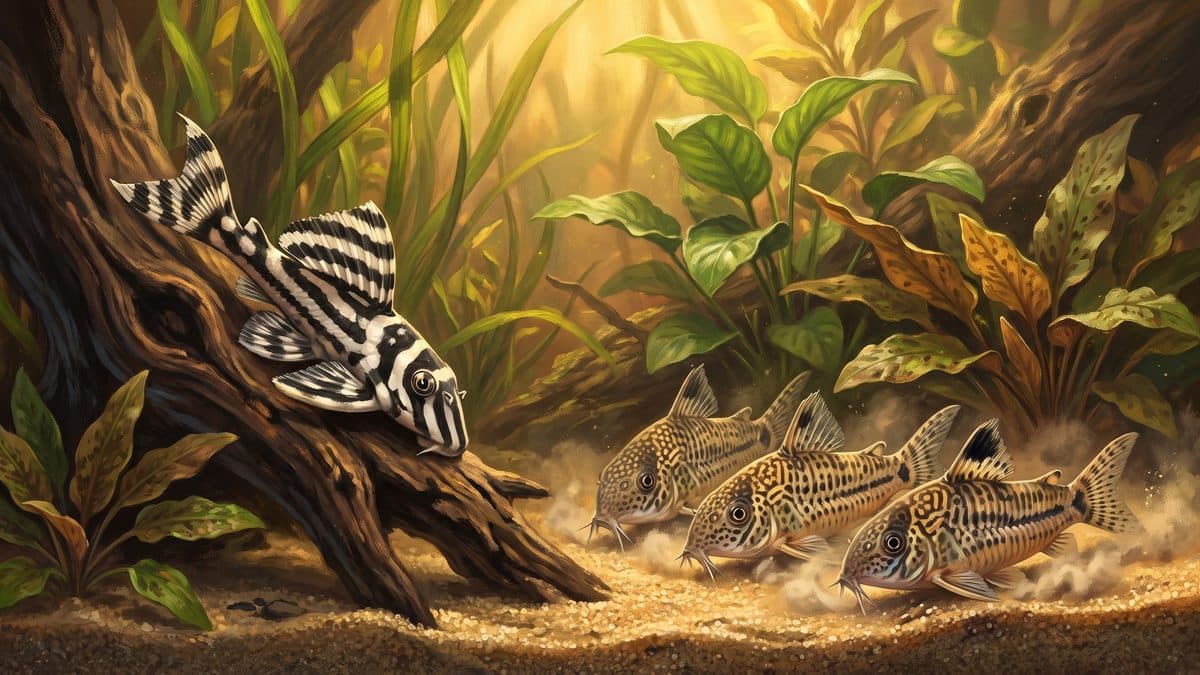
Pleco vs Corydoras: Bottom-Dweller Showdown
When hobbyists set up a community aquarium, the bottom-dweller slot is often the first to be filled — and the choice almost always comes down to Plecos or Corydoras. Both are South American catfish with armoured bodies, peaceful temperaments, and enormous popularity. Yet they fill fundamentally different ecological niches and offer different benefits to a community tank.
Understanding these differences is critical to stocking your tank effectively. This guide compares the two families across every factor that matters for community aquarium success.
Pleco Overview
Plecos belong to the family Loricariidae — the largest catfish family, with over 900 described species and hundreds more awaiting formal description (assigned L-numbers by the aquarium community, such as L046 Zebra Pleco, L333 King Tiger Pleco). They are characterised by a flattened ventral profile, a suckermouth adapted for rasping algae and biofilm from surfaces, and bony plate armour covering the head and body.
The most popular aquarium species is the Bristlenose Pleco (Ancistrus spp.) — a 12–15 cm species with characteristic tentacle-like growths (bristles) on the snout of males. Bristlenose Plecos are effective algae eaters, hardy, and suitable for tanks as small as 20 gallons. They are the go-to recommendation for biological algae control in community tanks.
Other popular species include the Clown Pleco (Panaqolus maccus, 8–10 cm, wood-eating), Rubber Lip Pleco (Chaetostoma spp., 10–12 cm, excellent algae eater), the spectacular Zebra Pleco (Hypancistrus zebra, 8–10 cm, carnivorous — does not eat algae), and the Common Pleco (Pterygoplichthys pardalis, which reaches 40–60 cm and is wildly inappropriate for most home aquariums despite being sold as a small juvenile).
Critical warning: The "Common Pleco" or "Sailfin Pleco" sold in most pet stores for $3–$5 grows to 40–60 cm and needs a 125+ gallon tank. This is the single most frequently re-homed fish in the hobby. Always research the species — choose a Bristlenose, Clown, or Rubber Lip for standard community tanks.
Corydoras Overview
Corydoras catfish belong to the family Callichthyidae and the genus Corydoras, which contains over 170 described species. They are small (2.5–7.5 cm depending on species), armoured catfish with a downturned mouth adapted for sifting through substrate for food particles, insect larvae, and worms. Corydoras are obligate social fish — they must be kept in groups of 6 or more of the same species to display natural behaviour and reduce stress.
Popular species include: Bronze Corydoras (C. aeneus), the hardiest and most widely available at 5–7 cm; Peppered Corydoras (C. paleatus), similarly hardy at 5–6 cm; Sterbai Corydoras (C. sterbai), a beautiful spotted species that tolerates higher temperatures (up to 28 °C, making it suitable for Discus tanks); Pygmy Corydoras (C. pygmaeus), a tiny 2.5–3 cm species that schools in mid-water; and Panda Corydoras (C. panda), a striking black-and-white species at 4–5 cm.
Corydoras are among the most peaceful fish in the freshwater hobby. They are non-territorial, non-aggressive, and coexist with virtually any community fish that will not eat them. Their social schooling behaviour — groups moving in synchronised formation across the substrate — is one of the most entertaining displays in a community aquarium. They also exhibit a charming "winking" behaviour (rapidly rotating their eyes) and regularly dash to the surface to gulp atmospheric air, supplementing gill respiration via their hindgut.
Key Differences
Algae Eating
This is the most common misconception: Corydoras do not eat algae. They are omnivorous substrate sifters that eat sinking pellets, frozen bloodworms, brine shrimp, and organic detritus — but they ignore algae completely. If your primary goal is algae control, only Plecos (specifically herbivorous species like Bristlenose, Rubber Lip, and young Common Plecos) will help. Not all Plecos eat algae either — the Zebra Pleco and Royal Pleco are carnivorous or wood-eating, respectively.
Social Behaviour
Corydoras are social schooling fish that must be kept in groups of 6+ (same species). A solo Corydoras is a stressed, unhappy fish that will hide and refuse to display natural behaviour. Plecos are predominantly solitary — most species are territorial and best kept as single specimens (especially Bristlenose males, which claim caves and defend them). Some smaller Pleco species tolerate groups in large tanks with ample hiding spots, but social interaction is not a meaningful part of their behaviour.
Size Range
Corydoras are consistently small — 2.5–7.5 cm across all common species. This predictability makes them easy to stock. Plecos range from 5 cm (Otocinclus-allied species) to 60+ cm (Common Pleco, Royal Pleco). The size range within Loricariidae is enormous, and hobbyists must research specific species carefully. An "algae eater" impulse purchase from a pet store could result in a 50 cm fish that outgrows a 75-gallon tank.
Quick Comparison Table
| Factor | Pleco (Bristlenose recommended) | Corydoras |
|---|---|---|
| Family | Loricariidae | Callichthyidae |
| Adult Size (common spp.) | 12–15 cm (Bristlenose); 40–60 cm (Common) | 3–7 cm (species-dependent) |
| Lifespan | 10–15 years (Bristlenose); 20+ years (large spp.) | 5–10 years |
| Social Needs | Solitary (1 per tank typical) | Group of 6+ (same species) |
| Algae Eating | Yes (herbivorous species) | No |
| Substrate Cleaning | Minimal (suction-based feeding) | Yes (sifts and stirs substrate) |
| Temperature | 22–28 °C (most species) | 22–26 °C (Sterbai: up to 28 °C) |
| pH | 6.0–7.5 | 6.0–7.5 |
| Minimum Tank Size | 20 gal (Bristlenose); 10 gal (Clown) | 15 gal (group of 6 small spp.); 20+ gal (larger spp.) |
| Activity Level | Low (nocturnal, hides during day) | High (active during daytime, schooling) |
| Cost | $5–$20 (Bristlenose); $200–$800 (Zebra) | $3–$10 (common); $15–$40 (rare spp.) |
Tank Requirements Comparison
Pleco tank setup: A Bristlenose Pleco needs a minimum of 20 gallons with driftwood (essential — they rasp wood for dietary fibre), hiding caves (coconut shells, clay caves, PVC pipes), and moderate filtration. They produce significant waste relative to their size, so filtration should be rated for 1.5 times tank volume. Sand or smooth gravel substrate is suitable. Low to moderate lighting encourages algae growth on surfaces, providing a natural food source.
Bristlenose males are cave-dependent — they need at least one cave they can claim as territory, and in breeding setups, multiple caves are required. Plants are safe with Bristlenose Plecos (they do not eat healthy plant tissue), making them ideal for planted tanks. Driftwood is not optional — it provides essential dietary fibre and is a primary grazing surface.
Corydoras tank setup: A group of 6 small Corydoras (Pygmy, Habrosus) needs a minimum of 15 gallons; a group of 6 larger species (Bronze, Sterbai) needs 20+ gallons. The most critical requirement is substrate: Corydoras must have fine sand or very smooth, rounded gravel. Sharp gravel damages their barbels — the sensory whiskers around their mouth that they use to find food. Damaged barbels become infected, erode, and the fish loses its primary feeding ability. Fine sand (pool filter sand, play sand, or aquarium-specific sand) is the gold standard.
Filtration should be moderate — Corydoras dislike strong currents at substrate level. A sponge filter or canister filter with a spray bar directed at the surface works well. Open substrate area is important — avoid cramming the bottom with décor. Corydoras need clear "runways" along the substrate for their schooling behaviour. They appreciate some shade (floating plants, overhanging décor) but spend most of their time on the substrate rather than hiding in caves.
Which Should You Choose?
Choose a Pleco (Bristlenose) if:
- Your primary need is algae control
- You want a single, self-sufficient bottom-dweller
- You have driftwood in your tank (or are willing to add some)
- You appreciate unusual morphology — the Bristlenose's alien appearance is fascinating
- You want a long-lived fish (10–15 years) with minimal social demands
Choose Corydoras if:
- You want active, visible, daytime schooling behaviour on the substrate
- You enjoy watching social fish interact as a group
- You have fine sand substrate (or are willing to switch)
- You want the charm and personality that only a Corydoras school provides
- You need a bottom-dweller that cleans up uneaten sinking food
Our recommendation: Keep both. A Bristlenose Pleco and a school of 6+ Corydoras is one of the most effective and enjoyable bottom-dweller combinations in the hobby. The Pleco handles algae; the Corydoras handle substrate cleaning and provide social dynamism. They occupy slightly different niches and coexist peacefully. In a 30+ gallon planted community with tetras or rasboras up top, a Bristlenose and a Corydoras school on the bottom, you have a complete, balanced ecosystem.