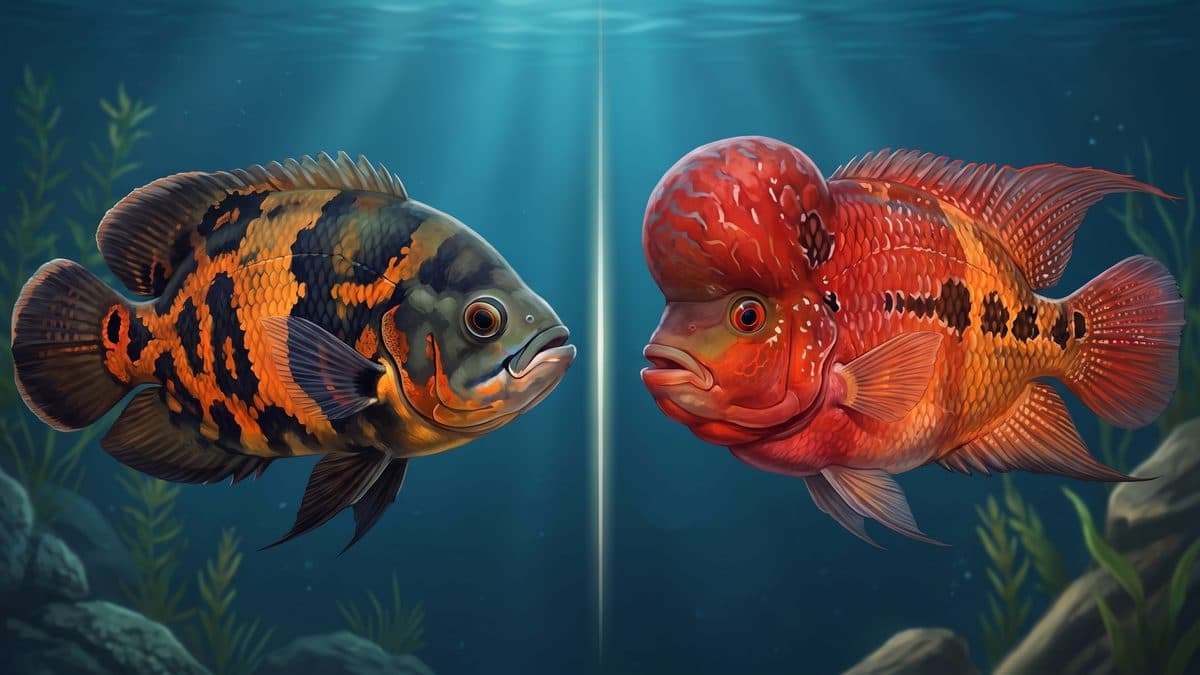
Oscar vs Flowerhorn: The Two Giants of Cichlid Keeping
The Oscar and the Flowerhorn are arguably the two most popular large cichlids in the freshwater aquarium hobby — and they appeal to overlapping but distinct audiences. Both are intelligent, interactive, and visually striking. Both demand large tanks and serious filtration. But the similarities end there: the Oscar is a naturally occurring South American species with a 100+ year history in the hobby, while the Flowerhorn is a man-made hybrid barely 25 years old, bred for extreme aesthetics and personality.
This comparison covers every factor that matters when choosing between them — from tank size and water parameters to long-term cost and community potential. If you are deciding between these two iconic cichlids, this guide will give you a clear answer.
Oscar Cichlid Overview
The Oscar (Astronotus ocellatus) is a South American cichlid native to the Amazon, Orinoco, and Paraná river basins. It has been a staple of the aquarium trade since the early 1900s and remains one of the most widely kept large freshwater fish worldwide. Adults reach 30–40 cm (12–16 inches) and can live 15–20 years in captivity.
Oscars are celebrated for their intelligence and personality. They recognise their keepers, can be hand-fed, learn to perform simple behaviours for food, and display a range of emotional responses — sulking after a tank rearrangement, begging at the front glass when hungry, and playing with tank décor. This interactivity has earned them the nickname "river dogs" and "water puppies."
Common colour varieties include Tiger (the wild-type black with orange-red markings), Red Oscar, Albino Tiger, Albino Red, and Lemon Oscar. All share identical care requirements. Oscars are prolific breeders — a compatible pair will spawn on flat surfaces and provide biparental care to eggs and fry.
Flowerhorn Cichlid Overview
The Flowerhorn is a hybrid cichlid developed in Malaysia and Taiwan in the late 1990s by crossing various Central and South American cichlid species — the exact lineage is strain-dependent and often a closely guarded trade secret. Unlike the Oscar, the Flowerhorn does not exist in the wild and has no scientific name.
Flowerhorns are bred for three primary traits: an enlarged nuchal hump (kok), vibrant red, orange, and blue colouration with metallic "pearling" scales, and bold, aggressive personality. Adults reach 25–35 cm (10–14 inches) and can live 10–12 years. Major strains include Super Red Dragon (SRD), Kamfa, Golden Monkey, and Thai Silk (Titanium).
The Flowerhorn hobby has a competitive dimension absent in Oscar keeping — fish are judged and sold based on kok size, body shape, colour intensity, pearling density, and "flower line" markings. Competition-grade specimens sell for $5,000–$60,000, creating a market dynamic more similar to koi collecting than typical tropical fishkeeping. For more on strains and grading, see our complete Flowerhorn guide.
Side-by-Side Comparison Table
| Factor | Oscar Cichlid | Flowerhorn Cichlid |
|---|---|---|
| Scientific Name | Astronotus ocellatus | None (hybrid) |
| Origin | South America (Amazon, Orinoco) | Man-made (Malaysia/Taiwan, late 1990s) |
| Adult Size | 30–40 cm (12–16 in) | 25–35 cm (10–14 in) |
| Lifespan | 15–20 years | 10–12 years |
| Temperature | 24–28 °C (75–82 °F) | 28–31 °C (82–88 °F) |
| pH | 6.0–7.5 | 7.0–8.0 |
| Minimum Tank Size | 75 gal (single), 125 gal (pair) | 75 gal (single, species-only recommended) |
| Aggression Level | 3/5 — Moderately Aggressive | 4/5 — Aggressive |
| Community Potential | Good (with robust tank mates) | Poor (best kept alone) |
| Care Difficulty | Moderate (beginner-friendly large cichlid) | Moderate-High (temperature/aggression management) |
| Purchase Price | $10–$30 (juvenile) | $30–$500+ (quality-dependent) |
| Colour Varieties | Tiger, Red, Albino, Lemon | SRD, Kamfa, Golden Monkey, Thai Silk, many more |
| Breeding | Straightforward pair breeding | Complex — most males are infertile |
| Intelligence/Interaction | Extremely high | Very high |
Size and Growth Rate
Oscars are the larger fish at maturity, reaching 30–40 cm versus the Flowerhorn's 25–35 cm. Both grow rapidly from juvenile size: an Oscar purchased at 5 cm will hit 20 cm within 6–8 months given proper nutrition and water quality, reaching full adult size by 18–24 months. Flowerhorns grow at a similar pace but plateau earlier — most reach adult size by 12–18 months.
Growth rate in both species is directly tied to diet quality, water change frequency, and tank volume. Stunting — where a fish's growth is permanently retarded by inadequate conditions — is common when either species is kept in too-small tanks during the critical first year. Neither species should be housed in anything smaller than 75 gallons past the 15 cm mark.
The Oscar's slightly larger adult size means it produces significantly more waste — a 35 cm Oscar generates roughly 30 % more bioload than a 30 cm Flowerhorn. This has direct implications for filtration sizing and water change frequency.
Temperament and Personality
Both species are highly interactive and intelligent, but their temperament profiles are fundamentally different:
Oscar temperament: Oscars are moderately aggressive (Level 3 on our scale). They establish territory and will bully smaller fish, but they are not indiscriminately violent. In a properly sized tank with appropriate companions (Jack Dempsey, Bichir, Silver Dollars), Oscars coexist in a stable community. Their aggression escalates during breeding — a spawning pair will defend their territory aggressively against all comers. Outside of breeding, Oscars are curious, sometimes clumsy, and remarkably responsive to their keeper. Many owners describe them as having "dog-like" personalities.
Flowerhorn temperament: Flowerhorns are aggressive (Level 4) and fundamentally antisocial. Their aggression is both territorial and predatory — they will attack, injure, and kill tank mates regardless of size or species in most setups. This is not a failure of husbandry; it is a deliberate breeding outcome. Flowerhorn keepers select for bold, aggressive fish because these traits correlate with larger koks and more vibrant colouration. The trade-off is that Flowerhorns are best kept solo. Their interaction with their keeper, however, is remarkable — many Flowerhorns allow head rubbing, follow their owner around the room, and display visible excitement at feeding time.
The key difference: An Oscar is a great pet fish that can live in a community. A Flowerhorn is a great pet fish that wants to be the only fish in the room.
Care Requirements and Difficulty
The Oscar is the easier fish to keep. It tolerates a wider temperature range (24–28 °C vs the Flowerhorn's narrower 28–31 °C), accepts a broader pH range (6.0–7.5 vs 7.0–8.0), and is more forgiving of water quality lapses. Oscars have been bred in captivity for over a century, producing robust, genetically diverse stock that shrugs off minor husbandry mistakes.
Flowerhorns demand higher temperatures, which increases their metabolism, waste output, and the rate at which bacteria reproduce in the system. This means more frequent water changes — 30–40 % twice weekly is standard for Flowerhorns, versus 25–30 % weekly for Oscars. The higher temperature also accelerates evaporation and equipment wear.
Both species require powerful filtration: canister filters rated for 6–10x tank turnover per hour, or a sump system for tanks above 125 gallons. The Fluval FX4 or FX6 is the standard recommendation for either species. See our equipment guide for detailed filter comparisons.
Diet: Both are omnivorous and thrive on high-quality cichlid pellets (Hikari Cichlid Gold, Northfin Cichlid Formula) supplemented with frozen krill, earthworms, and occasional whole silversides. Flowerhorn keepers often add colour-enhancing foods containing astaxanthin and carotenoids to intensify red colouration. Avoid feeder goldfish for either species — they are nutritionally poor and carry parasites.
Tank Setup and Equipment
Oscar tank setup: 75 gallons minimum for a single Oscar, 125+ for a pair or community. Substrate: sand or gravel (Oscars rearrange décor constantly, so lightweight items will be moved). Filtration: Canister filter rated for 600+ GPH (Fluval FX4 for 75 gal, FX6 for 125+). Heater: 200–300W with a failsafe controller. Décor: Large rocks, driftwood secured to the base (Oscars will uproot anything not anchored), and hardy plants only (Java Fern on driftwood, Anubias — anything rooted in substrate will be dug up).
Flowerhorn tank setup: 75 gallons for a single Flowerhorn. Substrate: bare bottom or thin sand layer (ease of cleaning is paramount at 28–31 °C). Filtration: Same canister specs as Oscar. Heater: 250–300W to maintain the higher temperature, with failsafe controller. Décor: Minimal — Flowerhorns are territorial about their entire tank and benefit from open swimming space. A single piece of driftwood or a large rock as a visual anchor is sufficient. Some keepers add a mirror for short periods (10–15 minutes) to stimulate display behaviour and kok development.
Both species need tight-fitting lids. Oscars can jump when startled, and Flowerhorns may lunge at anything above the water line.
Cost Comparison
| Cost Category | Oscar | Flowerhorn |
|---|---|---|
| Purchase price (juvenile) | $10–$30 | $30–$150 (standard), $150–$500+ (high-grade) |
| Tank (75 gal + stand) | $200–$500 | $200–$500 |
| Filtration (canister) | $150–$350 | $150–$350 |
| Heater + controller | $50–$80 | $60–$100 (higher wattage for 28–31 °C) |
| Monthly food | $15–$25 | $20–$40 (colour-enhancing premium foods) |
| Monthly electricity | $10–$20 | $15–$30 (higher heater draw) |
| Annual water conditioner | $30–$50 | $40–$70 (more frequent water changes) |
| First-year total (estimated) | $600–$1,200 | $750–$2,000+ |
The Flowerhorn's higher cost is driven primarily by purchase price (quality specimens command premiums), higher-wattage heating, and more frequent water changes. For hobbyists entering the competition scene, costs escalate dramatically — show-quality Flowerhorns and the premium foods, lighting, and display tanks associated with competitive keeping can easily exceed $5,000 annually.
Tank Mate Compatibility
Oscar community options (125+ gallons): Jack Dempsey Cichlid, Firemouth Cichlid, Silver Dollars (school of 6+), Bichir (Saddled or Ornate), Sailfin Plecostomus, Convict Cichlid. All tank mates should be 15+ cm at introduction and of similar temperament. Avoid small fish, slow-moving species, and anything with flowing fins.
Flowerhorn community options: Realistically, none in a standard 75-gallon setup. In a 180+ gallon tank with heavy sight breaks, some keepers successfully maintain Flowerhorns with large Plecostomus (30+ cm) or a school of Silver Dollars. But the risk of injury to tank mates is always present. Flowerhorns are most reliably kept as the sole inhabitant.
If community versatility matters to you, the Oscar is the clear winner. If you prefer a single, spectacular show fish with the entire tank to itself, the Flowerhorn excels. Browse The Fish Collection's cichlid collection for both species.
Verdict: Which Should You Choose?
Choose the Oscar if:
- You want a highly interactive pet fish with dog-like personality
- You plan to build a large cichlid community
- You prefer a lower initial investment and forgiving care requirements
- You value longevity (15–20 years vs 10–12)
- You are a first-time large cichlid keeper
Choose the Flowerhorn if:
- You want maximum visual impact from a single specimen
- You are drawn to the competition and collecting aspect of the hobby
- You are comfortable keeping a solo fish
- You can maintain higher temperatures (28–31 °C) and more frequent water changes
- You want a fish with a truly unique, one-of-a-kind appearance
Both fish deliver the interactive, intelligent fishkeeping experience that makes large cichlids so rewarding. The Oscar is the better all-rounder; the Flowerhorn is the more dramatic specialist. Neither choice is wrong — it comes down to whether you want a community centrepiece or a solo showpiece.