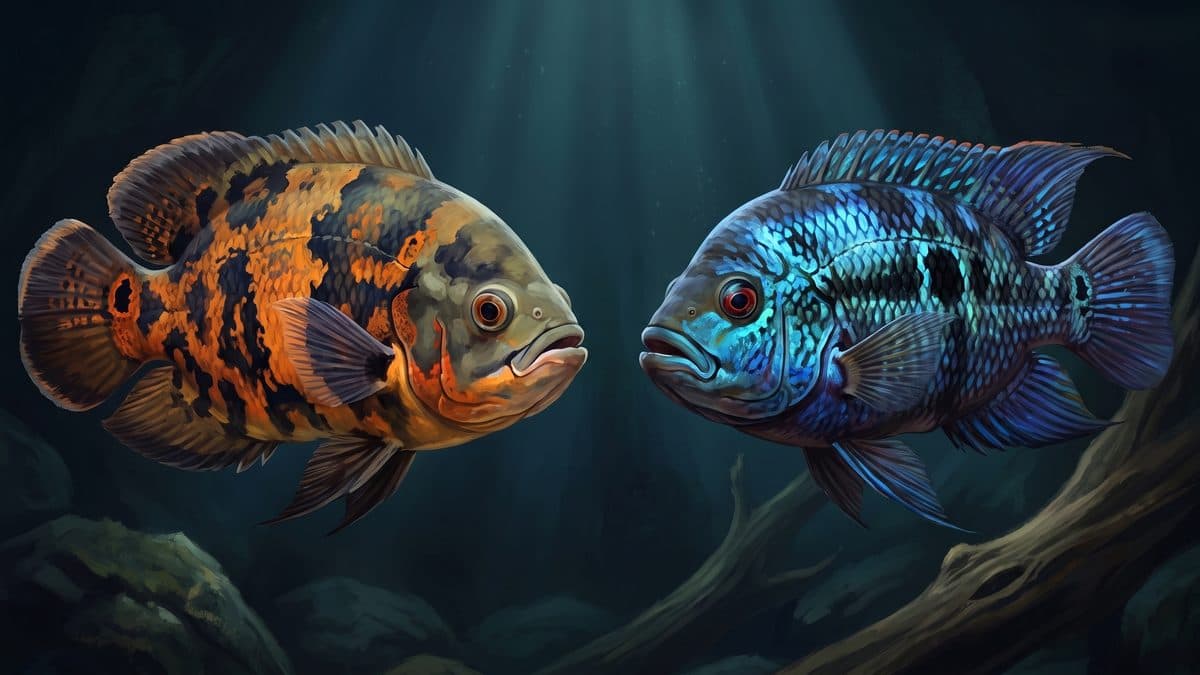
Oscar vs Jack Dempsey: New World Cichlid Showdown
The Oscar and the Jack Dempsey are two of the most iconic New World cichlids in the aquarium hobby. Both hail from Central and South America, both develop remarkable intelligence and personality, and both are popular choices for hobbyists stepping beyond community fish into the world of large, interactive cichlids. Yet they differ significantly in size, temperament, and care demands.
This comparison covers everything you need to know to choose between these two legendary cichlids — or decide whether your tank can handle both.
Oscar Overview
The Oscar (Astronotus ocellatus) is native to the slow-moving rivers and floodplain lakes of the Amazon Basin in Peru, Colombia, Brazil, and French Guiana. It is one of the most intelligent and interactive aquarium fish available — Oscars recognise their owners, beg for food, rearrange their tank décor, and have been trained to perform tricks. This dog-like personality is the primary reason hobbyists tolerate the species' substantial downsides: massive adult size, prodigious waste production, and a tendency to destroy aquascaping.
Adult Oscars reach 30–40 cm (12–16 inches) and weigh up to 1.5 kg in aquarium conditions. They grow rapidly — a 2.5 cm juvenile can reach 25 cm within its first year if well-fed. Popular varieties include Tiger Oscar (wild-type with orange and black markings), Red Oscar (predominantly red-orange), Albino Oscar, and Lemon Oscar. Long-finned and "Veil Tail" variants exist but are less common.
Oscars are opportunistic predators in the wild, feeding on smaller fish, crustaceans, insects, and fruit. In captivity, they thrive on high-quality cichlid pellets (Hikari Cichlid Gold, Northfin Cichlid Formula) supplemented with frozen shrimp, earthworms, and crickets. Avoid feeder fish — they carry parasites and provide poor nutrition.
Jack Dempsey Overview
The Jack Dempsey (Rocio octofasciata) is a Central American cichlid found in slow-moving waters from southern Mexico through Guatemala, Belize, and Honduras. Named after the famously aggressive 1920s boxer Jack Dempsey, this species earned its moniker through its aggressive territoriality and powerful jaw — it can crack snail shells and rearrange substrate with ease.
Adults reach 20–25 cm (8–10 inches) — considerably smaller than Oscars. The wild-type colouration is stunning: a dark base overlaid with iridescent blue, green, and gold spangles that intensify with age and mood. Dominant males develop a pronounced nuchal hump (forehead bump) and their spangling becomes electric blue. Females are smaller and less intensely coloured.
The Electric Blue Jack Dempsey (EBJD) is a selectively bred variant that displays an all-over electric blue colouration from juvenile stage. It is one of the most visually striking freshwater fish available. However, EBJDs are genetically weaker than standard Jack Dempseys — they are smaller (15–20 cm), more susceptible to disease, less aggressive, and more sensitive to water quality fluctuations. EBJDs carry a recessive gene, and breeding two EBJDs produces high fry mortality.
Key Differences
Size and Growth Rate
Oscars are 50–60 % larger than Jack Dempseys at maturity. An Oscar at 35 cm has roughly three times the body mass of a 22 cm Jack Dempsey. This size difference has enormous implications for tank size, filtration requirements, and food costs. Oscars also grow faster — reaching near-adult size within 12–18 months, while Jack Dempseys take 2–3 years to mature fully.
Aggression Profile
Despite the Jack Dempsey's pugilistic namesake, Oscars and Jack Dempseys display different aggression profiles. Jack Dempseys are more consistently territorial — they claim a defined area and aggressively defend it against all intruders. Their aggression is focused and persistent. Oscars are more variable: they can be surprisingly docile with tank mates in large tanks, but when they do turn aggressive, their size makes them dangerous. Oscar aggression tends to be situational (breeding, feeding, stress) rather than constant territorial defence.
Personality and Intelligence
Oscars are widely considered the most intelligent freshwater aquarium fish after certain species of pufferfish and cichlids like the Midas. They watch their environment actively, respond to their owner's presence, and display complex behaviours (playing dead, rearranging décor, sulking after tank changes). Jack Dempseys are intelligent for cichlids but do not match Oscars for interactive personality. They are more reclusive, spending time in caves and territories rather than patrolling the front glass looking for attention.
Quick Comparison Table
| Factor | Oscar (Astronotus ocellatus) | Jack Dempsey (Rocio octofasciata) |
|---|---|---|
| Adult Size | 30–40 cm (12–16 in) | 20–25 cm (8–10 in); EBJD: 15–20 cm |
| Lifespan | 10–15 years | 10–15 years |
| Minimum Tank Size | 75 gal (single); 125+ gal (pair) | 55 gal (single); 75+ gal (pair) |
| Temperature | 23–28 °C (73–82 °F) | 22–28 °C (72–82 °F) |
| pH | 6.0–8.0 | 6.5–8.0 |
| Aggression Level | Moderate-High (situational) | High (territorial, persistent) |
| Personality | Extremely interactive, "dog-like" | Territorial, reclusive, assertive |
| Bioload | Very heavy | Moderate-heavy |
| Cost | $10–$30 (standard); $30–$80 (rare morph) | $8–$20 (standard); $30–$80 (EBJD) |
| Difficulty | Moderate | Moderate |
Tank Requirements Comparison
Oscar tank setup: A single Oscar requires a minimum of 75 gallons, but 90–125 gallons is strongly recommended to accommodate their adult size and heavy bioload. A pair needs 125+ gallons. Filtration must be oversized — canister filters rated for 2–3 times the tank volume, or a sump system. Oscars produce enormous amounts of waste, and ammonia spikes are the leading killer in Oscar tanks. Weekly 30–40 % water changes are essential, not optional.
Décor should be minimal and heavy — Oscars will uproot plants, move rocks, and rearrange driftwood. Use large river rocks, heavy driftwood secured with silicone, and sand or fine gravel substrate. Live plants are pointless unless potted in weighted containers or limited to hardy species like Anubias attached to heavy wood. A sturdy, tight-fitting lid is essential — Oscars jump, especially when startled.
Jack Dempsey tank setup: A single Jack Dempsey does well in a 55-gallon tank, with 75+ gallons recommended for a pair or community. Filtration requirements are less extreme than Oscars but should still be robust — a canister filter rated for 1.5–2 times the tank volume is ideal. Weekly 25–30 % water changes maintain water quality.
Jack Dempseys appreciate caves and territories more than Oscars. Provide rock caves, driftwood overhangs, and clay pots for territory establishment. They dig enthusiastically but are less destructive than Oscars overall. A sand substrate is ideal (allows natural digging behaviour). Plants are possible — hardy species like Java Fern and Anubias attached to hardscape can survive, though some individuals will uproot anything within their territory.
Which Should You Choose?
Choose an Oscar if:
- You want the most interactive, personality-driven freshwater fish available
- You have a 75+ gallon tank with heavy-duty filtration
- You do not mind frequent, large water changes and a messy eater
- You want a fish that recognises you and "greets" you at the glass
- You are comfortable with a fish that will rearrange (and likely destroy) your aquascape
Choose a Jack Dempsey if:
- You have a 55–75 gallon tank and want a bold, beautiful cichlid
- You prefer stunning natural colouration (or the electric blue variant)
- You want a cichlid that is challenging but not as space- and maintenance-intensive as an Oscar
- You plan a Central American cichlid community with other robust species
- You appreciate territorial behaviour and the drama of cichlid hierarchy
Our recommendation: For pure personality and interaction, the Oscar is unmatched — it is the closest thing to a "pet" in the freshwater fish world. For a visually stunning, moderately sized cichlid that fits a wider range of tank sizes, the Jack Dempsey — especially the Electric Blue variant — is hard to beat. Both are excellent choices for intermediate hobbyists ready for the rewarding challenge of large cichlid keeping.