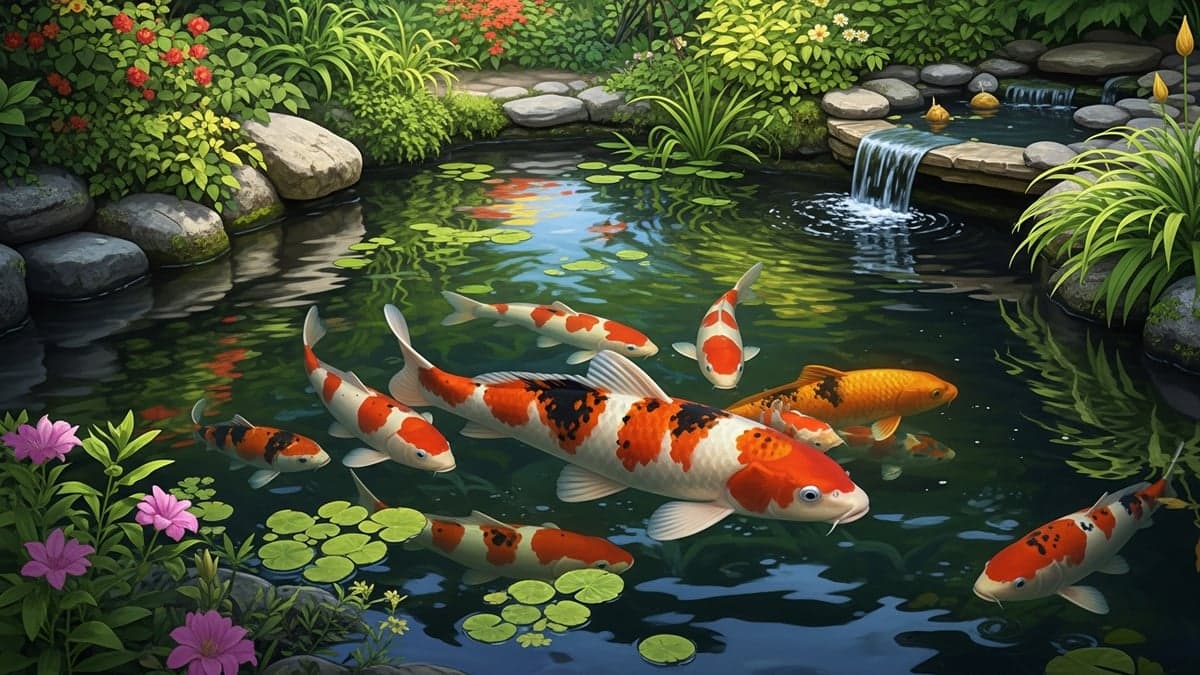
Why Koi Are Rewarding for Beginners
Koi (Cyprinus rubrofuscus) are ornamental carp bred in Japan for over 200 years, prized for their vivid colours, impressive size (60–90 cm), and remarkable longevity — healthy Koi routinely live 25–35 years, with exceptional specimens exceeding 50 years. Unlike most aquarium fish, Koi recognise their keepers, learn to hand-feed, and develop genuine pet-like bonds.
Koi are fundamentally pond fish — they need outdoor or large indoor ponds of 1,000+ gallons to thrive. They cannot live permanently in standard aquariums. This is the most important fact for beginners to understand: Koi keeping is pond keeping. If you have the outdoor space, Koi are among the most rewarding and beginner-friendly fish in the hobby due to their hardiness and adaptability.
The varieties below were selected for their genetic robustness, wide availability, reasonable price point, and ability to thrive in new ponds where water chemistry may fluctuate as the biological filter matures.
Top 7 Koi Varieties for Beginners
1. Kohaku (White Body, Red Pattern)
Kohaku is the most iconic Koi variety — a pure white body with vibrant red (hi) markings. It is considered the foundation of Koi keeping: the Japanese saying goes, "Koi keeping begins and ends with Kohaku." For beginners, Kohaku offers classic beauty, wide availability, and reasonable pricing ($10–$50 for pond-grade; $100–$5,000+ for show-quality).
Kohaku are hardy and adapt well to new ponds. Look for specimens with bright, well-defined red markings on a clean white base — the cleaner the white, the more striking the fish. Kohaku improve with age as their patterns develop and colours deepen over 2–3 years.
2. Ogon (Solid Metallic Gold/Platinum)
The Ogon is a solid-coloured metallic Koi — most commonly bright gold (Yamabuki Ogon) or gleaming platinum white (Platinum Ogon). Ogons are the easiest Koi to appreciate because their beauty is immediately obvious: a single, uniform metallic sheen across the entire body with no pattern complexity to evaluate.
Ogons are among the hardiest Koi varieties and the most forgiving for beginners. They are widely available and affordable ($10–$40 for pond-grade). Their reflective scales make them highly visible in murky or deep ponds, which is a practical advantage. Yamabuki Ogon is the most popular colour and an excellent first Koi.
3. Showa (Red, White, and Black)
Showa Sanshoku — commonly called Showa — features a black (sumi) base colour with red (hi) and white markings. Along with Kohaku and Sanke, it forms the "Big Three" (Gosanke) of Koi varieties. Showa are dramatic, high-contrast fish that look spectacular in ponds.
Showa are hardy and grow quickly. Their appearance changes significantly as they mature — juvenile Showa often look muddy or unfinished, but their patterns develop beautifully over 2–4 years as the sumi (black) deepens and stabilises. Price: $15–$60 pond-grade; $200–$10,000+ show-quality. A rewarding choice for patient beginners.
4. Chagoi (Olive/Brown — The Friendliest Koi)
The Chagoi is the variety every Koi keeper should own. Olive-green to brown in colour, it is not the flashiest fish in the pond — but Chagoi are universally recognised as the friendliest, most docile Koi variety. They are typically the first fish to approach for hand-feeding and their calm behaviour encourages other, more skittish varieties to come forward.
Chagoi grow large (often the biggest fish in the pond), are extremely hardy, and eat voraciously. They are widely available and inexpensive ($10–$30). Adding a Chagoi to a new pond is the single best way to make all your Koi more tame and interactive. Many experienced keepers consider them indispensable.
5. Sanke (White with Red and Black Accents)
Taisho Sanshoku — called Sanke — features a white base with red and black markings. The key difference from Showa: Sanke has a white base with black accents on the body (not the head), while Showa has a black base with red and white overlaid. Sanke tend to look cleaner and more elegant.
Sanke are hardy, grow well, and their patterns develop beautifully with age. Price: $15–$50 pond-grade; $200–$8,000+ show-quality. For beginners, Sanke offer the visual complexity of three colours with the reliability of the Gosanke lineage. They pair beautifully with Kohaku in a pond.
6. Butterfly Koi (Long-Finned)
Butterfly Koi — also called Dragon Koi — are any Koi variety with elongated, flowing fins and barbels. Originally bred from crosses between standard Koi and Indonesian longfin carp, they are divisive among purists (not recognised in Japanese shows) but beloved by beginners for their graceful, ethereal appearance.
Butterfly Koi are exceptionally hardy — many keepers report they are tougher than standard Koi. They are widely available in all colour patterns and very affordable ($8–$30 pond-grade). Their long fins develop further with age, becoming more dramatic each year. An excellent choice for beginners who prioritise visual beauty over show competition.
7. Bekko (Solid Colour with Black Spots)
Bekko Koi feature a solid base colour — white (Shiro Bekko), red (Aka Bekko), or yellow (Ki Bekko) — with scattered black (sumi) markings. Shiro Bekko (white with black) is the most common and popular. The simple two-colour pattern makes Bekko easy to appreciate and evaluate.
Bekko are hardy, widely available, and affordable ($10–$35 pond-grade). They provide excellent visual contrast in a pond and pair well with solid-coloured Ogon or bright Kohaku. A good choice for beginners building a diverse, visually balanced pond collection.
What to Look For When Buying Koi
- Body shape: A healthy Koi has a torpedo-shaped, symmetrical body. Avoid fish with bent spines, sunken bellies, or asymmetrical body shapes.
- Skin quality: The skin should be smooth, glossy, and free of ulcers, raised scales, or reddened areas. Healthy Koi have a natural sheen.
- Active swimming: Koi should swim smoothly and respond to stimuli. Avoid fish that sit on the bottom, gasp at the surface, or swim erratically.
- Clear eyes: Both eyes should be clear and equal-sized. Cloudy or sunken eyes indicate illness or poor conditions.
- Quarantine availability: Buy from dealers who quarantine their fish for 2–4 weeks before sale. Introducing unquarantined Koi to your pond risks devastating disease outbreaks (KHV, Aeromonas).
Common Mistakes with Beginner Koi
- Pond too small: Koi need at least 1,000 gallons (250 per fish as a minimum), with 250+ gallons per Koi at adult size. A 500-gallon pond is too small for even two adult Koi. Plan for adult size from the start.
- Inadequate filtration: Koi produce enormous waste. A pond filter must be rated for at least 1.5x your pond volume and include both mechanical and biological filtration. Underfiltering is the number one cause of Koi health problems.
- No predator protection: Herons, raccoons, cats, and osprey all prey on Koi. Install netting, motion-activated sprinklers, or pond depth of 4+ feet (herons cannot wade in deep water).
- Overstocking: Start with 3–5 Koi and resist adding more until your filter is fully mature (3–6 months). Koi grow rapidly and overstocked ponds crash quickly.
- Feeding in cold water: Stop feeding when water temperature drops below 10 °C. Koi cannot digest food in cold water, and undigested food causes potentially fatal intestinal problems.
Getting Started Equipment
- Pond: 1,000 gallons minimum (1,500–3,000 recommended). Preformed, liner, or concrete. Minimum depth of 3 feet (4+ in areas with herons or harsh winters).
- Filter system: Pressurised or gravity-fed pond filter rated for your pond volume. Include both mechanical (pads/brushes) and biological (moving bed, lava rock) stages.
- Pump: Pond pump that circulates the entire volume once per hour minimum. Redundancy (two smaller pumps) is wise for reliability.
- UV clarifier: Inline UV steriliser (25–40 watts for 1,000–2,000 gallons) to control green water algae and reduce waterborne pathogens.
- Aeration: Air pump with airstones or diffusers for supplemental oxygen, especially in warm summer months when oxygen levels drop.
- Net or cover: Predator netting or pond cover to protect fish from herons and raccoons.
- Test kit: Pond water test kit for ammonia, nitrite, nitrate, pH, and KH (carbonate hardness).
- Food: High-quality Koi pellets (Hikari Gold, Saki-Hikari, Blue Ridge) sized for your fish. Wheat germ formula for spring and autumn feeding.
Budget $2,000–$8,000 for a complete 1,500-gallon Koi pond including excavation, liner, filtration, and initial fish. See our equipment guide for details.