Overview
The Panther Grouper is a paradox of the marine aquarium hobby: it is one of the most widely sold marine fish, yet one of the least suitable for the average marine tank. Juveniles — typically sold at 5–8 cm (2–3 in) — are charming, affordable (often under £30), and display an endearing swimming style where they hover head-down at 45-degree angles. What retailers often fail to communicate is that this cute juvenile will grow into a 70 cm (28 in) apex predator that requires a tank larger than most hobbyists can accommodate.
For those with the space, however, the Panther Grouper is a genuinely rewarding aquarium fish. It is hardy, disease-resistant, interactive, and strikingly beautiful at every stage of growth. The key is going in with realistic expectations about size and tank requirements.
Appearance
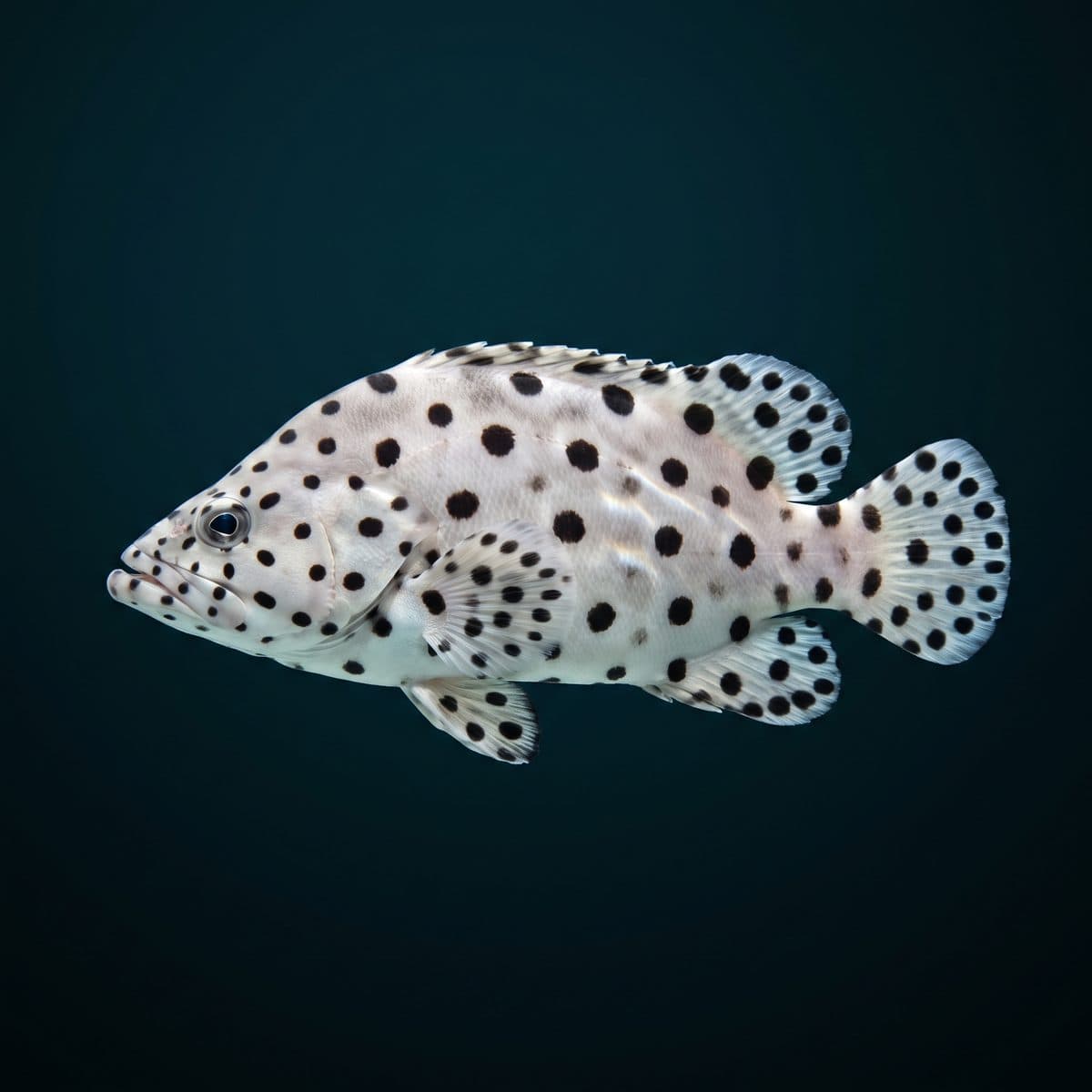
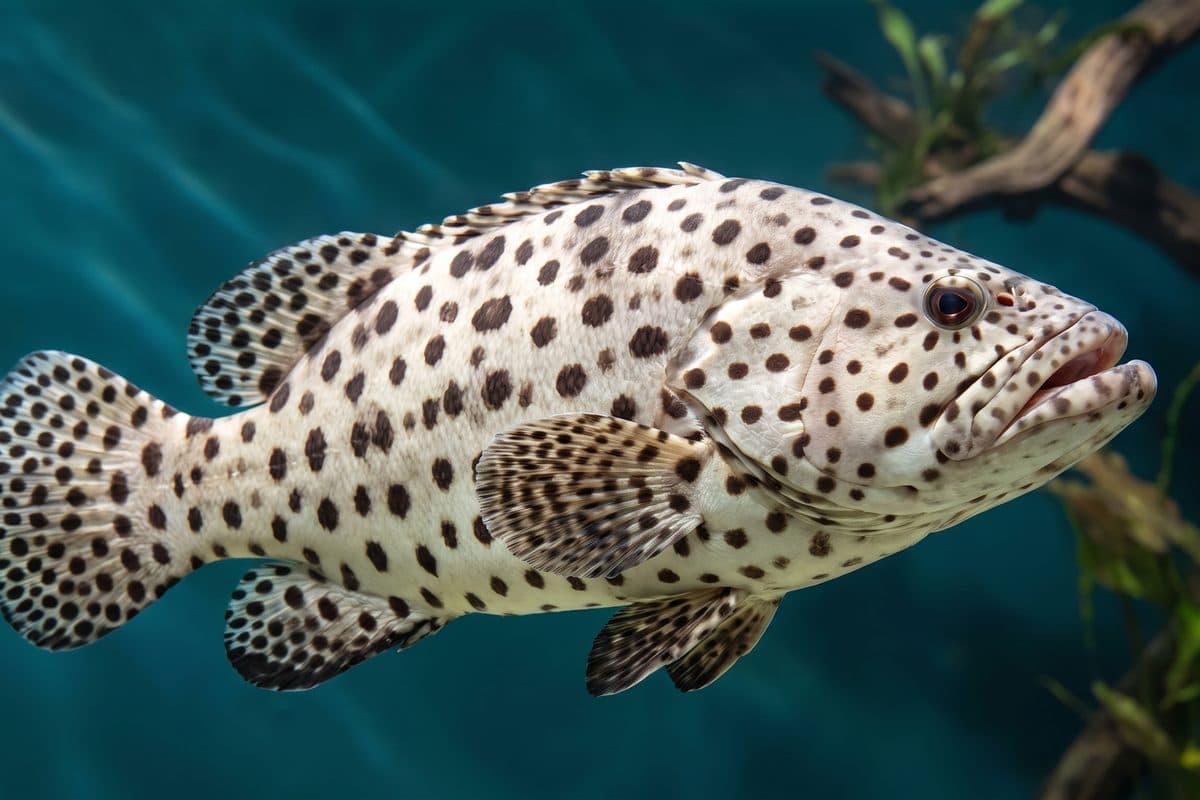
The Panther Grouper's appearance is unmistakable:
- Body colour: White to pale cream base colour.
- Pattern: Bold, round black spots distributed across the entire body, fins, and head — the "polka dot" or "panther" pattern. Spots are proportionally larger in juveniles relative to body size and become more numerous (and relatively smaller) as the fish grows.
- Head profile: Distinctively humped or concave above the eyes, giving the fish its alternative common name "Humpback Grouper." This profile becomes more pronounced with age.
- Body shape: Deep-bodied and laterally compressed — more so than most grouper species.
Tank Requirements
- Juvenile (under 15 cm): 75-gallon minimum — but only as temporary housing. Plan your upgrade path before purchasing.
- Sub-adult (15–40 cm): 180–240 gallons.
- Adult (40+ cm): 300 gallons (1,135 L) minimum; 500+ gallons preferred.
Filtration: Robust protein skimming is essential — Panther Groupers are messy, carnivorous feeders that produce significant waste. A large sump with protein skimmer, biological media, and mechanical filtration is the recommended approach. Target water turnover of 6–10× the tank volume per hour.
Aquascape: Provide rocky caves and overhangs — the fish will claim a cave as its home base. Open swimming space in the centre is important, as the fish becomes increasingly active and territorial with age.
Water Parameters
- Temperature: 76–82 °F (24–28 °C).
- pH: 8.1–8.4.
- Salinity: 1.024–1.026 SG.
- Ammonia/Nitrite: 0 ppm.
- Nitrate: Below 20 ppm (Panther Groupers are moderately nitrate-tolerant but thrive in cleaner water).
Diet & Feeding
Panther Groupers are voracious carnivores with no interest in vegetable matter:
- Staple: Frozen silversides, frozen shrimp (shell-on for adults), frozen squid, and frozen krill.
- Supplementary: High-quality marine pellets (New Life Spectrum Marine, Hikari Mega Marine).
- Treats: Live ghost shrimp, live crayfish (occasionally).
- Feeding frequency: Daily for juveniles; every 2–3 days for adults.
Be cautious about overfeeding — Panther Groupers are enthusiastic eaters that will gorge if given the opportunity. Moderate portions fed on a regular schedule are healthier than large, infrequent meals.
Behaviour & Tank Mates
Juveniles are relatively peaceful and spend much of their time hovering at angles near rockwork. As they grow, they become increasingly bold and territorial. Adult Panther Groupers are ambush predators that will eat any fish or invertebrate they can fit in their surprisingly large mouths.
Suitable tank mates for adult Panther Groupers include:
- Large tangs (Sohal, Vlamingi, Naso)
- Large angelfish (Emperor, Queen, French)
- Large wrasses (Napoleon, Harlequin Tuskfish)
- Moray eels
- Other similarly sized groupers (in 500+ gallon systems)
Avoid all small fish, invertebrates (crabs, shrimp, lobsters), and anything that could fit in the grouper's mouth.
Growth Rate
Panther Groupers grow rapidly when well-fed. Expect:
- Year 1: From 5 cm (2 in) to 15–20 cm (6–8 in).
- Year 2: 20–30 cm (8–12 in).
- Year 3–5: 30–50 cm (12–20 in).
- Year 5+: Gradual growth to 60–70 cm (24–28 in).
This growth rate means your tank upgrade timeline is measured in months, not years. Many aquarists who purchase a juvenile Panther Grouper for a 75-gallon tank find themselves needing a 180-gallon upgrade within 12 months.
Natural Habitat & Range
Wild Panther Groupers range across the Indo-Pacific, from the Nicobar Islands and southern Japan down through Indonesia, the Philippines, Papua New Guinea, and the Great Barrier Reef. Juveniles live in shallow, sheltered water — seagrass beds, rubble zones, and lagoon patch reefs at depths of just 2–20 metres — where their bold spotting breaks up their outline against dappled sand. Adults move onto deeper coral slopes and outer-reef drop-offs, hunting small fish and crustaceans from the cover of ledges and caves.
Understanding this background helps you set the tank up properly. These are ambush predators from structurally complex reefs, not open-water swimmers, so they want rockwork to patrol and a cave to call home. It also explains their temperament: a juvenile that hovers head-down among branching coral in the wild is doing exactly what yours does in the aquarium, using that odd posture as camouflage and a hunting stance.
It's worth knowing the conservation angle too. Cromileptes altivelis is heavily targeted in the live reef food-fish trade across Southeast Asia, where large adults fetch high prices as a delicacy. Wild numbers have declined in several regions, which is one reason the species is now farmed on a commercial scale — and why most aquarium specimens you'll see are tank-raised rather than wild-caught. Captive-bred juveniles adapt faster to aquarium life and frozen foods, so they're the ones to look for.
Acclimation & Quarantine
Panther Groupers are hardy once settled, but the settling-in period is where problems start. Always quarantine a new grouper in a separate 40–75 gallon bare-bottom tank for at least 3–4 weeks before adding it to your display. This lets you watch for disease, get the fish feeding confidently, and treat problems without medicating your main system or exposing established fish.
Acclimate slowly — marine fish are sensitive to swings in salinity, pH, and temperature. Drip-acclimate over 45–60 minutes, matching the specific gravity and temperature of your quarantine tank to the bag water gradually. A stressed grouper will sulk in a corner for a day or two; that's normal. Keep the lights dim, offer a piece of rockwork or a length of PVC pipe for cover, and don't crowd it with tank mates during this period.
Feeding response is your best health indicator. Most Panther Groupers eat within 24–48 hours; a small piece of fresh or thawed silverside offered on feeding tongs usually triggers a strike. If a fish refuses food for more than four or five days, check your water parameters first, then look for signs of parasites. Once it's eating steadily, holding weight, and showing clear eyes and unmarked skin, it's ready for the display tank.
Health & Common Problems
Panther Groupers are among the more disease-resistant marine fish, but no fish is bulletproof. The problems you're most likely to meet are the standard marine parasites plus a couple of husbandry-driven issues:
- Marine ich (Cryptocaryon irritans): White salt-grain spots on the body and fins, flashing against rocks, rapid breathing. Groupers are large-bodied and can carry a parasite load for a while before crashing, so act early. Treat in quarantine with copper or the tank-transfer method — never in a reef display.
- Marine velvet (Amyloodinium): Faster and deadlier than ich, causing a dusty sheen and heavy breathing. Quarantine and prevention are your only reliable defences.
- Head and lateral line erosion (HLLE): Pitting around the head and along the lateral line, usually linked to poor diet, stray electrical current, or chronic nitrate. Fix the underlying cause and improve dietary variety with vitamin-soaked foods.
- Overfeeding and fatty liver: The most common self-inflicted problem. These enthusiastic eaters will gorge, and keepers oblige — leading to obesity and a shortened lifespan. Feed measured portions on a schedule, not whenever the fish begs at the glass.
The single best preventive is stable water and a varied diet. A well-quarantined grouper in a mature system with clean water rarely gets sick — most health problems trace back to skipping quarantine or overfeeding.
Breeding & Aquaculture
Panther Groupers won't breed in a home aquarium — they're large, need open water to spawn, and like many groupers they're protogynous hermaphrodites (individuals mature first as females, and some later become males). Spawning is a broadcast event in open water, with pelagic eggs and larvae that drift for weeks. None of that is reproducible in a living-room tank.
Commercially, though, the species is bred at scale. Hatcheries across Indonesia, Taiwan, and Thailand raise Panther Groupers for both the food trade and the aquarium market, using hormone-induced spawning of conditioned broodstock and painstaking larval rearing on rotifers and enriched brine shrimp. The larvae are notoriously delicate — grouper aquaculture is considered one of the harder marine finfish to raise — but the industry has matured to the point where tank-raised juveniles are widely available.
For you as a keeper, that's good news on two fronts: it takes collection pressure off wild reefs, and captive-bred fish are simply better aquarium candidates. They arrive already accustomed to captive conditions and prepared foods, they ship better, and they adapt to your tank with far less drama than a wild-caught fish. When you buy, ask whether the fish is aquacultured — it's worth seeking out.
Is a Panther Grouper Right for You?
Let's be honest, because this is the question that matters most with this species. A Panther Grouper is a wonderful fish for the right keeper and a mistake for everyone else — and the deciding factor is almost entirely about space and long-term planning.
A Panther Grouper is a good fit if you:
- Already own or can commit to a 300+ gallon system within 2–3 years.
- Want a hardy, interactive, long-lived centrepiece and are happy with a fish-only-with-live-rock (FOWLR) setup rather than a reef.
- Understand it will eat any fish or invertebrate small enough to swallow.
- Are prepared to feed a messy carnivore and run the filtration to match.
Look elsewhere if you:
- Have a tank under 180 gallons and no upgrade path — the cute 8 cm juvenile becomes a 70 cm adult faster than you'd think.
- Want a reef tank with shrimp, crabs, and small fish.
- Are new to marine keeping and want something low-commitment.
Bought with clear eyes, a Panther Grouper will greet you at the glass, take food from tongs, and live 15–20 years. Bought on impulse from a shop tank without a plan for its adult size, it becomes the fish people rehome — or worse, can't. Go in knowing which keeper you are.