Why Water Testing Matters
Water testing is to fishkeeping what blood tests are to medicine — it reveals problems invisible to the naked eye before they become emergencies. Fish can appear healthy for days while ammonia slowly rises to toxic levels. By the time you see symptoms (gasping, lethargy, clamped fins), organ damage is already underway. Regular testing catches parameter shifts early, when a simple water change solves the problem, rather than after fish are sick or dying.
Testing is especially critical during three periods: the initial cycling of a new tank (daily testing), the first three months after stocking (weekly testing), and whenever anything unusual occurs — a fish death, behaviour change, new addition, or equipment failure. Experienced aquarists who have maintained a tank for years can reduce testing frequency, but even they test monthly to confirm the stability their routine provides.
Liquid Kits vs. Test Strips
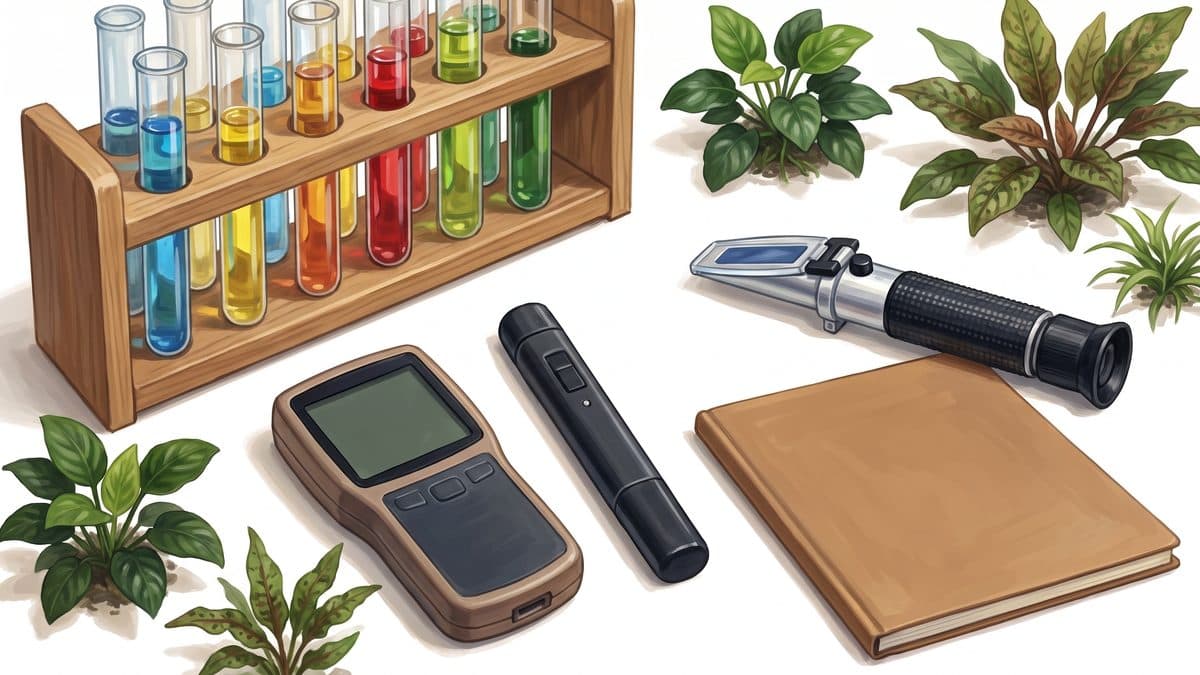
Liquid reagent kits (API Freshwater Master Kit, Salifert, Hanna Instruments) are the standard. They are more accurate, more consistent between batches, and more cost-effective per test than strips. The API Freshwater Master Kit costs approximately $25–30 and provides about 800 tests — roughly $0.03 per test. Each test involves filling a glass vial with tank water, adding a precise number of reagent drops, shaking, waiting a specified development time, and comparing the resulting colour against a reference card.
Test strips (API 5-in-1, Tetra EasyStrips) are convenient — dip and read. However, they are less accurate (especially for ammonia and nitrite at low concentrations), have wider margins of error, and cost more per test. They expire faster once the container is opened due to moisture exposure. Strips are acceptable for quick checks between liquid tests but should not be your primary testing tool.
Digital testers (Hanna Instruments colorimeters) provide the highest accuracy and eliminate subjective colour reading. They are expensive ($40–70 per parameter) but worth the investment for advanced keepers maintaining sensitive species (Discus, stingrays, marine reef tanks).
Core Parameters to Test
Ammonia (NH₃/NH₄⁺)
Ammonia is the most critical parameter to monitor. Target: 0 ppm at all times. Any detectable ammonia in a cycled tank indicates a problem — overfeeding, dead fish, filter failure, or an overwhelmed nitrogen cycle.
The API ammonia test uses a Nessler reagent that produces a yellow-to-green colour scale. Read the result after exactly 5 minutes of development time. Under-timing produces false low readings; over-timing produces false high readings. Shake Bottle #2 vigorously for 30 seconds — the reagent separates during storage, and inadequate mixing is the most common cause of inaccurate ammonia results.
Important: Some dechlorinators (Seachem Prime) bind ammonia into a non-toxic form (ammonium) that still registers on most test kits. If you test within 24 hours of adding Prime, a positive ammonia reading may be harmless. Retest 48 hours after the last Prime dose for a true reading.
Nitrite (NO₂⁻)
Target: 0 ppm at all times. Nitrite is toxic at very low concentrations — above 0.25 ppm causes stress; above 1 ppm can be lethal. The API nitrite test produces a blue-to-purple colour scale. Read after 5 minutes.
Detectable nitrite in a cycled tank usually indicates the cycle is struggling — either the filter is undersized, too much media was replaced at once, or the bioload increased too quickly (too many new fish added at once).
Nitrate (NO₃⁻)
Target: below 20 ppm (below 40 ppm is acceptable for hardy species). Nitrate is the end product of the nitrogen cycle and accumulates between water changes. It is far less toxic than ammonia or nitrite but causes harm at chronic elevated levels — stunted growth, reduced colour, weakened immunity, and algae blooms.
The API nitrate test is the most error-prone test in the kit. Shake Bottle #2 vigorously for at least 30 seconds, then shake the sealed test vial for 60 seconds. The reagent contains precipitated crystite that settles in the bottle — without vigorous shaking, results read falsely low. Many aquarists who think their nitrate is 0 ppm actually have high nitrate masked by an under-shaken reagent.
pH
Target: stable within the species' preferred range. Most freshwater tropical fish thrive at pH 6.5–7.5. Stability is more important than hitting an exact number — a stable pH of 7.8 is healthier than a pH swinging between 6.5 and 7.0 due to chemical adjustments.
The API kit includes two pH tests: standard range (6.0–7.6) and high range (7.4–8.8). Start with the standard range test. If the result reads the maximum (7.6), switch to the high range test for an accurate reading.
Test pH at the same time of day consistently — pH naturally fluctuates in planted tanks (higher during the day due to CO₂ uptake, lower at night). Testing at a consistent time reveals true trends rather than diurnal variation.
Advanced Parameters
GH, KH, and TDS
These parameters describe the mineral content of your water:
- GH (General Hardness): Measures dissolved calcium and magnesium. Expressed in degrees (dGH) or ppm. Soft water: 0–4 dGH; moderate: 4–12 dGH; hard: 12+ dGH. Softwater species (Discus, cardinal tetras, Bettas) prefer 2–8 dGH; hardwater species (African cichlids, livebearers) prefer 10–20 dGH.
- KH (Carbonate Hardness): Measures carbonate and bicarbonate ions — the buffering capacity of the water. Higher KH resists pH changes; low KH allows pH to crash. A KH below 2 dKH puts you at risk for dangerous pH drops, especially in planted tanks with CO₂ injection.
- TDS (Total Dissolved Solids): Measured with an electronic TDS meter. Indicates overall mineral and solute concentration. Useful for monitoring RO water remineralisation and detecting gradual mineral accumulation between water changes. Most freshwater fish thrive at 100–400 ppm TDS.
Test GH and KH with a liquid drop test (API GH/KH Test Kit). Add drops one at a time to a water sample until the colour changes — the number of drops equals the dGH or dKH value. For comprehensive water chemistry understanding, see our water chemistry guide.
Recommended Testing Schedule
- During cycling: Test ammonia and nitrite daily. Test nitrate weekly.
- First 3 months after stocking: Test ammonia, nitrite, nitrate, and pH weekly.
- Established tanks (3+ months): Test all four core parameters weekly. Reduce to biweekly once consistency is established over several months.
- After any event (fish death, new fish added, medication, equipment failure, missed water change): Test immediately, then daily for 3–5 days.
- GH, KH: Monthly, or after switching water sources or adding mineral supplements.
- Tap water baseline: Test your tap water for ammonia, pH, GH, and KH once when you set up the tank and again if your water utility issues a quality notice. Tap water parameters vary seasonally in some regions.
Interpreting Results and Taking Action
- Ammonia above 0 ppm: Perform an immediate 50 % water change. Investigate cause — dead fish, overfeeding, filter failure, cycle crash. Dose Seachem Prime to detoxify remaining ammonia. Test daily until stable at 0.
- Nitrite above 0 ppm: Same emergency response as ammonia. Check that filter media has not been recently replaced or washed in tap water.
- Nitrate above 40 ppm: Perform a 50 % water change immediately. Increase water change frequency and/or volume going forward. Check for overfeeding, overstocking, or clogged filter media trapping detritus.
- pH drop below 6.0: Check KH — if KH is below 2, the buffering capacity is exhausted. Add crushed coral to the filter or perform a water change with higher-KH water. Do not chase pH with chemicals unless you understand the underlying cause.
- Persistent high nitrate despite water changes: Test your tap water for nitrate — in some agricultural areas, tap water itself contains 20–40 ppm nitrate. If so, consider using RO or RO/DI water for water changes.
Water testing is not a chore — it is information. Every test result tells you something about the health of your system. The 5 minutes spent testing weekly saves the hours of emergency treatment, fish loss, and frustration that come from flying blind. For guidance on adjusting water parameters, see our comprehensive water chemistry guide.