Understanding the Dragon Goby
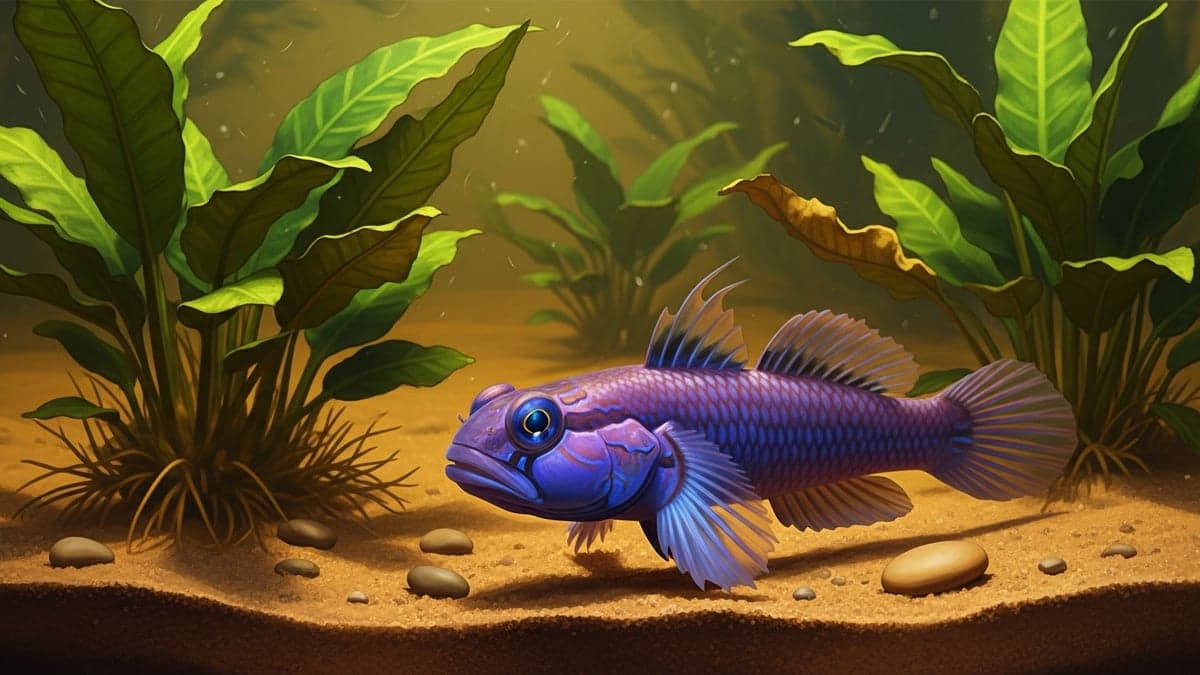
The Dragon Goby (Gobioides broussonnetii), also called the Violet Goby, is one of the most misunderstood fish in the aquarium hobby. Its appearance — an elongated, eel-like body up to 60 cm long, tiny vestigial eyes, enormous gaping mouth lined with small teeth, and iridescent purple-blue scales — suggests a fearsome predator. In reality, it is a gentle, nearly blind filter-feeder that sifts sand for microorganisms and organic detritus. The contrast between appearance and behaviour is what makes this species so fascinating.
Dragon Gobies are brackish water fish native to estuaries and coastal lagoons from the southeastern United States through the Caribbean and down to Brazil. They are frequently sold in freshwater sections of pet stores with no salinity guidance — one of the primary reasons for poor survival rates in captivity. With proper brackish conditions, a sandy substrate, and appropriate feeding, Dragon Gobies are hardy fish that can live 8–10 years.
Brackish Tank Setup
Salinity Management
Dragon Gobies require brackish water — a mix of freshwater and marine salt water. Target specific gravity of 1.005–1.015 (approximately 8–20 ppt salinity). Use marine salt mix (Instant Ocean, Red Sea, or similar reef-grade salt), not freshwater aquarium salt or table salt. Dissolve the salt in the replacement water before adding to the tank — never add dry salt directly.
A refractometer or digital salinity meter is essential for accurate measurement. Hydrometer-style swing-arm testers are less accurate and prone to mineral buildup affecting readings.
Dragon Gobies can survive in freshwater temporarily but will not thrive long-term. Chronic freshwater exposure suppresses immune function, reduces activity, and shortens lifespan significantly. Conversely, full marine conditions (SG 1.024+) are too saline — Dragon Gobies inhabit the brackish transition zone, not open ocean.
Substrate Requirements
Fine sand is mandatory. Dragon Gobies feed by scooping mouthfuls of sand, filtering out edible particles, and expelling the sand through their gill openings. They also burrow, creating tunnels and hiding under sand banks. Without fine sand, they cannot feed naturally and lose their primary stress-relief behaviour.
Use pool filter sand, play sand, or fine aragonite sand. Grain size should be 0.5–2 mm — fine enough to pass through the gills without damage. Depth of 5–8 cm (2–3 inches) allows burrowing. Avoid gravel, crushed coral (too coarse), and bare bottoms.
Water Parameters
- Temperature: 24–28 °C (75–82 °F)
- Salinity: SG 1.005–1.015
- pH: 7.5–8.5 (naturally buffered by marine salt mix)
- Ammonia/Nitrite: 0 ppm
- Nitrate: Below 20 ppm
The marine salt mix provides natural pH buffering, making brackish tanks inherently more stable than pure freshwater. Weekly 25–30 % water changes with pre-mixed brackish replacement water maintain salinity and water quality. Always match salinity of replacement water to the tank — salinity fluctuations stress Dragon Gobies and their tank mates.
Filtration should be rated for the tank volume with media that tolerates brackish conditions. Standard canister filters and HOB filters work well. Avoid copper-based medications in brackish systems with invertebrates.
Feeding the Dragon Goby
This is where most Dragon Goby keepers fail. Despite their enormous mouth, Dragon Gobies cannot eat large food items. They are filter-feeders and micro-predators that consume tiny organisms sifted from sand, detritus, and biofilm. In captivity, food must be small, sinking, and delivered where the goby can find it — remember, Dragon Gobies are nearly blind and locate food by scent and vibration.
Best foods:
- Sinking pellets: Small, slow-sinking granules (Hikari Sinking Wafers, NLS Small Fish Formula). Crush pellets to 1–2 mm particle size if they are too large.
- Frozen bloodworm: Sinks to the substrate where Dragon Gobies feed. Cut frozen cubes into smaller portions to prevent waste.
- Frozen brine shrimp: Small particles that settle into the sand for natural sifting behaviour.
- Algae wafers: Broken into small pieces. Dragon Gobies are omnivorous and consume algal matter.
- Repashy gel foods: Spread thinly on rocks or the tank bottom for slow grazing. Soilent Green and Community Plus are well-suited.
Feeding method: Feed after lights-out or during dim lighting, when Dragon Gobies are most active. Target-feed by placing food directly on the substrate near the goby's hiding spot using a turkey baster or pipette. Dragon Gobies are slow feeders — if housed with faster fish, they will starve unless target-fed.
Feed daily. Dragon Gobies have high metabolisms relative to their apparent inactivity and lose condition quickly if underfed.
Tank Mates
Dragon Goby tank mate selection is critical because of the goby's passive feeding behaviour. Any aggressive or fast-feeding tank mate will outcompete the goby for food, leading to starvation.
Compatible species (brackish-tolerant):
- Mollies: The ideal Dragon Goby companion. Mollies thrive in brackish water, are peaceful, and occupy the mid-to-upper water column — a different feeding zone than the bottom-dwelling goby.
- Bumblebee Gobies: Small, peaceful brackish gobies that occupy a different niche (they are micro-predators hunting tiny prey near rock surfaces).
- Knight Gobies: Brackish-tolerant and generally peaceful.
- Brackish-tolerant livebearers: Guppies and Endler's (at low brackish levels), Swordtails.
- Nerite Snails: Excellent algae control, fully brackish-tolerant.
Avoid: Aggressive cichlids, large predatory fish (Dragon Gobies are prey, not predators despite their appearance), and any fast-feeding species that will intercept food before it reaches the substrate.
Health and Common Issues
- Starvation: The most common cause of Dragon Goby death. Owners assume the goby is feeding when it is not. Monitor body condition — a healthy Dragon Goby has a rounded belly. A thin, concave belly indicates starvation. Target-feed daily.
- Freshwater syndrome: Dragon Gobies kept in freshwater develop suppressed immunity, lethargy, fin deterioration, and shortened lifespan. If you purchased a Dragon Goby from a freshwater tank, acclimate it to brackish over 1–2 weeks by gradually raising salinity.
- Skin abrasion: Caused by coarse substrate (gravel, crushed coral). Switch to fine sand immediately if abrasion is observed.
- Bacterial infections: Usually secondary to poor water quality or stress. Maintain clean brackish conditions and address stressors.
Common Mistakes
- Keeping in freshwater. Dragon Gobies need brackish water (SG 1.005–1.015) to thrive. Freshwater keeps them alive temporarily but shortens their life dramatically.
- Using gravel substrate. Dragon Gobies need fine sand for feeding and burrowing. Gravel prevents natural behaviour and can damage their gills during sand-sifting attempts.
- Assuming they are predators. Despite the fearsome appearance, Dragon Gobies are gentle filter-feeders that cannot eat large food items. Do not house with aggressive fish or expect predatory behaviour.
- Not target-feeding. In any community tank, Dragon Gobies will be outcompeted for food unless food is placed directly on the substrate near them during low-light periods.
- Tank too small. Dragon Gobies reach 35–60 cm. A 75-gallon tank is the minimum for a single adult. They are more active than their occasional burrowed-in-sand appearance suggests.
With proper brackish conditions, sandy substrate, and attentive feeding, the Dragon Goby is a fascinating, long-lived species that defies first impressions. Their bizarre appearance, gentle nature, and unique behaviour make them unlike anything else in the aquarium hobby. Browse The Fish Collection's exotic fish collection for current availability.