Why Tank Size Matters for Discus
Tank size affects every aspect of Discus health. In an undersized tank, waste accumulates faster, temperature and pH fluctuate more sharply between water changes, and social stress intensifies as dominant fish have no escape from subordinates — and subordinates have no escape from bullies. The result is stunted growth, chronic disease susceptibility, washed-out colour, and shortened lifespan.
Discus are not small fish. Adults reach 15–20 cm (6–8 inches) in diameter — a full-grown Discus is roughly the size of a saucer. A group of six adults in a 40-gallon tank is visibly overcrowded, and the water quality consequences are immediate. Proper sizing from the start avoids expensive, disruptive upgrades later.
Minimum Tank Sizes by Group
Six Discus — 75 Gallons
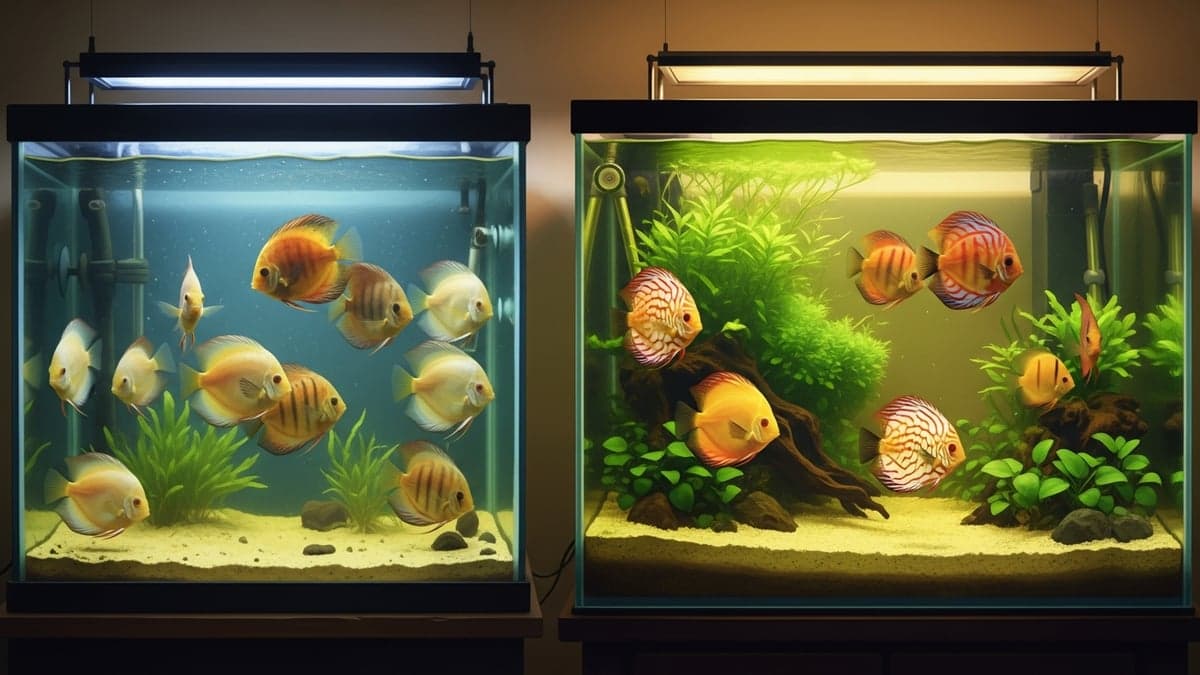
The baseline setup for most Discus keepers. A standard 75-gallon tank (48 × 18 × 21 inches / 122 × 46 × 53 cm) provides adequate space for six adult Discus with room for a small school of compatible tank mates (Cardinal Tetras, Rummy-nose Tetras). The 10-gallons-per-Discus rule gives six fish exactly 75 gallons, but the real advantage of this volume is water stability — 285 litres buffers temperature and chemistry fluctuations far better than smaller tanks.
A 55-gallon tank can temporarily house six juvenile Discus but will need upgrading as they approach adult size. If budget permits, start with 75 gallons to avoid the disruption and cost of a mid-growth upgrade.
Eight to Ten Discus — 100–125 Gallons
The ideal range for a serious Discus display. Larger groups (8–10 fish) distribute aggression more evenly, display more natural schooling behaviour, and produce a more visually impressive tank. A 125-gallon tank (72 × 18 × 22 inches) is the gold standard — the 6-foot length provides excellent swimming space and allows for a planted aquascape with driftwood territories.
At this volume, water stability is excellent. Temperature swings are dampened, pH drift between water changes is minimised, and nitrate accumulation is slower per fish. Maintenance effort per fish actually decreases with larger volumes.
Twelve+ Discus — 150+ Gallons
Show-level Discus displays with 12 or more fish require 150–200 gallon tanks or larger. At this scale, you are creating a genuine Amazonian biotope — a wall of shimmering Discus moving through driftwood and plant cover is one of the most impressive sights in freshwater fishkeeping.
Tanks of this size typically use sump filtration (adding 30–50 % water volume), automated water change systems, and dedicated electrical circuits for heaters and lighting. The investment is substantial but the result is extraordinary.
Tank Dimensions and Shape
Height Requirements
Tank height matters more for Discus than for most species. Their tall, laterally compressed body profile means they utilise vertical space actively — Discus swim at all levels and need height to display naturally. A tank shorter than 45 cm (18 inches) cramps their vertical swimming pattern.
Standard tank dimensions work well: a 75-gallon (48 × 18 × 21 inches) provides 53 cm height, and a 125-gallon (72 × 18 × 22 inches) provides 56 cm. Avoid long, shallow tanks (like 40-gallon breeders at only 40 cm tall) for Discus display — they are fine for breeding pairs but inadequate for display groups.
Width (front-to-back) of at least 45 cm (18 inches) allows Discus to turn comfortably and provides depth for aquascaping.
Breeding Pair Tanks
Breeding Discus pairs are typically separated into dedicated tanks: 40–55 gallons, bare-bottomed for hygiene, with a vertical spawning surface (slate, spawning cone, or PVC pipe). Height should be at least 45 cm to accommodate spawning behaviour — Discus deposit eggs on vertical surfaces and fan them with their pectoral fins.
Breeding tanks prioritise water quality control over aesthetics. Bare bottom with a sponge filter (to avoid fry being sucked into intake tubes) and a heater is sufficient. For the full breeding protocol, see our Discus breeding guide.
Grow-Out Tanks for Juveniles
Juvenile Discus (under 8 cm) are grown out in dedicated tanks optimised for feeding and water change frequency. Typical grow-out setup: 40–75 gallons, bare bottom, sponge filtration, heated to 30–31 °C (higher than adult display temperature to maximise growth rate). Stocking density is higher than display tanks — up to 1 Discus per 5 gallons — but only if water changes are performed twice daily (a standard practice in professional Discus grow-out).
The reason for higher density in grow-out tanks is that it distributes juvenile aggression — in small groups, dominant juveniles bully subordinates into starvation. In larger, denser groups, aggression is spread across many targets and no single fish is consistently harassed.
Volume and Water Stability
The relationship between tank volume and water parameter stability is the strongest argument for larger Discus tanks:
- Temperature: A 75-gallon tank with a quality heater holds temperature within ±0.5 °C. A 30-gallon tank can swing ±1.5 °C between day and night — a range that stresses Discus.
- pH: Larger water volume contains more KH buffer, resisting pH drops from biological acidification. In a 40-gallon tank, pH can drop 0.3–0.5 units between weekly water changes; in a 125-gallon tank, the same bioload causes a drop of only 0.1–0.2 units.
- Nitrate: More water dilutes waste products. A group of six Discus produces the same waste in a 55-gallon tank and a 125-gallon tank — but nitrate concentration between water changes is 2× higher in the smaller tank.
The mathematical reality is simple: larger tanks are easier to maintain at the stable conditions Discus require. The upfront cost of a larger tank saves money and effort in the long run. For water parameter targets, see our Discus water parameters guide.
Common Sizing Mistakes
- Starting with a 20-gallon "trial" tank. A 20-gallon tank cannot support even two adult Discus. Water quality deteriorates within hours of feeding, and social dynamics collapse with fewer than six fish. If the budget does not accommodate a 75-gallon setup, wait until it does.
- Counting juveniles, not adults. Six 5 cm juvenile Discus look lost in a 75-gallon tank. They will not stay small. Within 12–18 months, they will be 15 cm adults that fill the same space appropriately. Size your tank for adult fish, not the juveniles you buy.
- Ignoring the water change equation. A smaller tank does not save time — it requires more frequent water changes to maintain the same quality. A 55-gallon Discus tank may need water changes every 3 days; a 125-gallon tank can go a full week. The net maintenance time is similar, but the larger tank provides a larger safety margin.
- Upgrading mid-growth. Moving growing Discus from a small tank to a large tank is stressful. The cycle disruption, parameter changes, and physical stress of netting and transfer set back growth. Get the right tank from the start.
For the complete guide to Discus keeping, including tank mates, feeding, and disease prevention, see our Discus beginner's guide. Browse our Discus species profiles for available varieties.