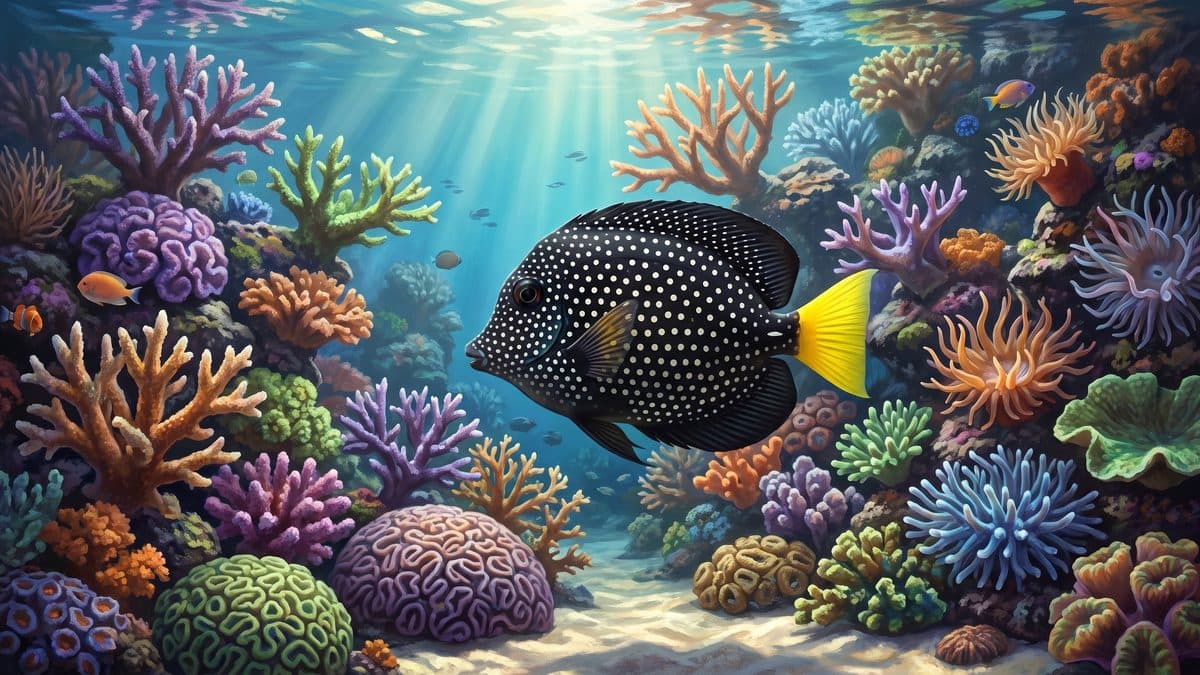
What Is the Gem Tang?
The Gem Tang (Zebrasoma gemmatum) is a marine surgeonfish in the family Acanthuridae, closely related to the popular Yellow Tang (Z. flavescens) and Purple Tang (Z. xanthurum). What sets the Gem Tang apart is its extraordinary appearance: a jet-black body densely covered in bright white polka dots, with a blue-tipped caudal fin and yellow accents on the pectoral fins. It is widely regarded as the most beautiful tang species and one of the most visually striking marine fish in the aquarium hobby.
Gem Tangs reach approximately 20–22 cm (8–9 inches) in captivity. They are herbivorous grazers requiring ample algae and vegetable matter in their diet, and they thrive in mature reef aquariums with stable parameters and adequate swimming space. Their rarity, visual impact, and relative hardiness (once properly acclimated) make them the ultimate "grail fish" for reef hobbyists.
Gem Tang Pricing and Availability
Why the Gem Tang Is So Expensive
The Gem Tang's price — typically $800–$3,000, with exceptional specimens reaching $5,000 — is driven by geographic restriction and collection logistics, not biological rarity per se. Gem Tangs are found across the western Indian Ocean, primarily around Mauritius, Reunion Island, and Madagascar, with sporadic records from Mozambique and South Africa. Unlike the Yellow Tang (historically collected by the hundreds of thousands in Hawaii), Gem Tang collection is limited to a small number of divers working in remote locations with minimal export infrastructure.
Additional factors include:
- Limited collection permits: Madagascar and Mauritius regulate marine collection through permit systems that cap the number of specimens exported annually.
- Shipping logistics: Specimens must transit from remote Indian Ocean islands through international freight hubs, adding cost and transit time. Mortality during extended shipping reduces the number reaching end consumers.
- Demand outpacing supply: The Gem Tang has become a status symbol in the reef hobby. Every serious reef keeper wants one, and annual supply is measured in hundreds — not thousands.
For context on pricing across all rare marine species, see our guide to the most expensive aquarium fish in the world.
Price Trends (2020–2026)
Gem Tang prices have fluctuated significantly over the past six years. During 2020–2021, pandemic-related shipping disruptions reduced supply and pushed prices above $4,000 for standard specimens. As shipping normalised in 2022–2023, prices settled to $1,200–$2,500. By 2025–2026, increased collection from Madagascar has further stabilised supply, with healthy sub-adult specimens typically available at $800–$1,500 and large adults at $1,500–$3,000.
Prices are lowest in summer (June–September) when collection conditions are optimal in the Southern Hemisphere. Winter months (November–February) see reduced supply and higher prices.
Reef Tank Requirements
Tank Size
A 180-gallon (680-litre) reef tank is the recommended minimum for a Gem Tang. Like all Zebrasoma species, Gem Tangs are active swimmers that patrol the reef constantly, grazing on algae-covered surfaces. A 6-foot (180 cm) tank length provides adequate swimming distance. Smaller tanks (120 gallons) can house a juvenile temporarily, but adult Gem Tangs in undersized tanks develop stress-related behaviour including excessive aggression and repetitive pacing.
Provide substantial live rock structure with overhangs, caves, and through-passages. Gem Tangs sleep in rock crevices at night and retreat to cover when startled. Open swimming space in the front and sides, combined with complex rockwork in the rear, creates the ideal layout.
Water Parameters
Gem Tangs require the stable, high-quality water expected of any reef inhabitant:
- Temperature: 24–26 °C (75–79 °F)
- Salinity: 1.024–1.026 SG (33–35 ppt)
- pH: 8.1–8.4
- Alkalinity: 7–11 dKH
- Calcium: 380–450 ppm
- Magnesium: 1,250–1,350 ppm
- Nitrate: Below 10 ppm; below 5 ppm is ideal
- Phosphate: Below 0.03 ppm
Stability matters more than hitting exact numbers. A Gem Tang acclimated to a stable pH of 8.0 will perform better than one in a system that oscillates between 8.1 and 8.4. Invest in an ATO (auto top-off) system and dose alkalinity and calcium consistently — either manually on a strict schedule or via a dosing pump.
Lighting and Flow
Gem Tangs inhabit reef slopes at moderate depths (10–30 metres). Standard reef lighting (full-spectrum LEDs at PAR 200–350 across the rockwork) is appropriate. They do not require intense light and may be stressed by excessively bright lighting with no shaded retreat areas — ensure the rockwork provides some lower-light zones.
Flow should be moderate to strong (20–40× total tank volume per hour from powerheads and return pump combined). Gem Tangs are strong swimmers that appreciate current. Randomised flow patterns (achieved with programmable wavemakers) are preferred over constant laminar flow.
Feeding the Gem Tang
Gem Tangs are herbivorous grazers that spend the majority of their day picking at algae-covered surfaces. In captivity, providing sufficient vegetable matter is the key nutritional challenge:
- Nori (dried seaweed): The staple food. Clip a sheet of nori to the tank glass or a magnetic feeding clip daily. Gem Tangs will graze on it continuously. Use unseasoned, unroasted nori from Asian grocery stores — it is identical to aquarium-branded seaweed sheets at a fraction of the cost.
- Frozen herbivore preparations: Spirulina-enriched brine shrimp, mysis shrimp, and formula foods (Ocean Nutrition Formula Two, LRS Herbivore Frenzy) provide supplementary nutrition.
- Pellets: New Life Spectrum Marine, Hikari Marine S — high-quality pellets with algae and spirulina content are readily accepted.
- Live macroalgae: Chaetomorpha and Ulva in a refugium provide natural grazing opportunities, and refugium-grown pods enter the display tank as additional nutrition.
Feed at least twice daily. Tangs that are not fed frequently enough develop "pinched belly" — a visible concavity of the abdomen that indicates chronic malnutrition. A fat, well-fed Gem Tang should have a smoothly convex belly profile.
Compatibility and Tank Mates
Gem Tangs are moderately aggressive — typical of Zebrasoma species — but their aggression is primarily directed at other tangs and surgeonfish. In a 180+ gallon reef:
- Compatible: Clownfish, Anthias, Wrasses, Dwarf Angelfish, Blennies, Gobies, and most non-tang reef fish.
- Caution: Other Zebrasoma species. Gem Tangs and Purple Tangs or Yellow Tangs can coexist in 200+ gallon tanks if introduced simultaneously, but aggression is possible. Adding a Gem Tang to a tank with an established tang requires careful monitoring.
- Avoid: Other Gem Tangs (unless the tank is 300+ gallons with extensive rockwork), Powder Blue Tangs (highly aggressive combination), and any fish known to bully tangs.
If adding a Gem Tang to a tank with existing tangs, introduce the Gem Tang last — as the newest arrival, it is least likely to display territorial aggression. Use a quarantine period of at least 30 days before introduction, both for health and to break any territorial patterns in the display tank.
Collection and Trade Dynamics
Understanding the Gem Tang trade helps buyers assess pricing and sourcing legitimacy. The primary collection points are:
- Madagascar: The largest source of Gem Tangs for the international market. Collection is regulated through government permits, and fish are typically shipped through Antananarivo to European and US wholesalers.
- Mauritius: A secondary source with more limited collection. Mauritius-sourced specimens sometimes command a premium due to perceived quality.
- Reunion Island: Occasional specimens, but collection is heavily restricted due to the island's marine reserve designations.
Transit from collection to retailer typically takes 3–7 days, including holding at the export facility, international flight, and wholesale quarantine. Each transit point adds mortality risk, which is factored into the final retail price. For an overview of how the exotic fish trade works, see our guide to buying exotic fish online.
Buying a Gem Tang
When purchasing a Gem Tang, prioritise:
- Condition: The fish should be alert, actively swimming, and eating in the dealer's tank. Request feeding video. A Gem Tang that is hiding, refusing food, or displaying faded colouration may be stressed or sick.
- Body weight: Look for a convex belly profile, not pinched or concave. Underweight tangs have a much higher mortality rate post-shipping.
- Skin condition: No HLLE (Head and Lateral Line Erosion), no white spots (Ich), no frayed fins, and no cloudy eyes.
- Quarantine history: Buy from dealers who quarantine for at least 2–4 weeks. A Gem Tang shipped directly from import is a gamble — parasites (particularly Marine Ich and Marine Velvet) can be present but asymptomatic during the stress of transport, only manifesting after introduction to your display tank.
At $800–$3,000 per fish, the investment in a properly quarantined, feeding specimen from a reputable source is dramatically better value than saving $200 on a recently imported fish that dies within a week. Browse The Fish Collection's marine fish collection for quarantined, feeding Gem Tang specimens when available.