Overview
The Denison Barb burst onto the international aquarium scene in the late 1990s and quickly became one of the most sought-after freshwater species in the hobby. Its combination of vivid colouration, torpedo-shaped body, active swimming behaviour, and peaceful temperament made it an instant classic. The fish is marketed under several common names — Roseline Shark (a misnomer, as it is a cyprinid, not a shark), Red-Lined Torpedo Barb, and Miss Kerala — but Sahyadria denisonii is the accepted scientific name following the genus' separation from Puntius in 2012.
The species' rapid rise in popularity had a darker side: massive overcollection from wild populations in India's Western Ghats led to significant population declines, resulting in an IUCN Red List classification of Endangered. Today, responsible aquarists source captive-bred specimens, and Indian authorities have implemented collection quotas and seasonal bans to protect remaining wild populations.
Natural Habitat & Conservation
Denison Barbs are endemic to the rivers and hill streams of the Western Ghats mountain range in Kerala and Karnataka, southern India. They inhabit clear, fast-flowing, well-oxygenated streams with rocky substrates, typically at elevations of 100–1,000 metres. Water temperatures in these habitats are notably cooler than tropical lowland rivers — typically 18–25 °C — which is an important consideration for captive care.
The Western Ghats is a UNESCO World Heritage Site and one of the world's 36 biodiversity hotspots. Denison Barbs share their habitat with several other endemic species, and the ecosystem is under pressure from deforestation, agriculture, dam construction, and — historically — the ornamental fish trade.
Conservation status: IUCN Red List — Endangered (EN). Export of wild-caught specimens from India is now regulated under the Wildlife Protection Act. Captive breeding programmes in Southeast Asia and Europe have significantly reduced collection pressure, and the majority of Denison Barbs in the aquarium trade today are farm-bred. When purchasing, always confirm that your specimens are captive-bred.
Appearance
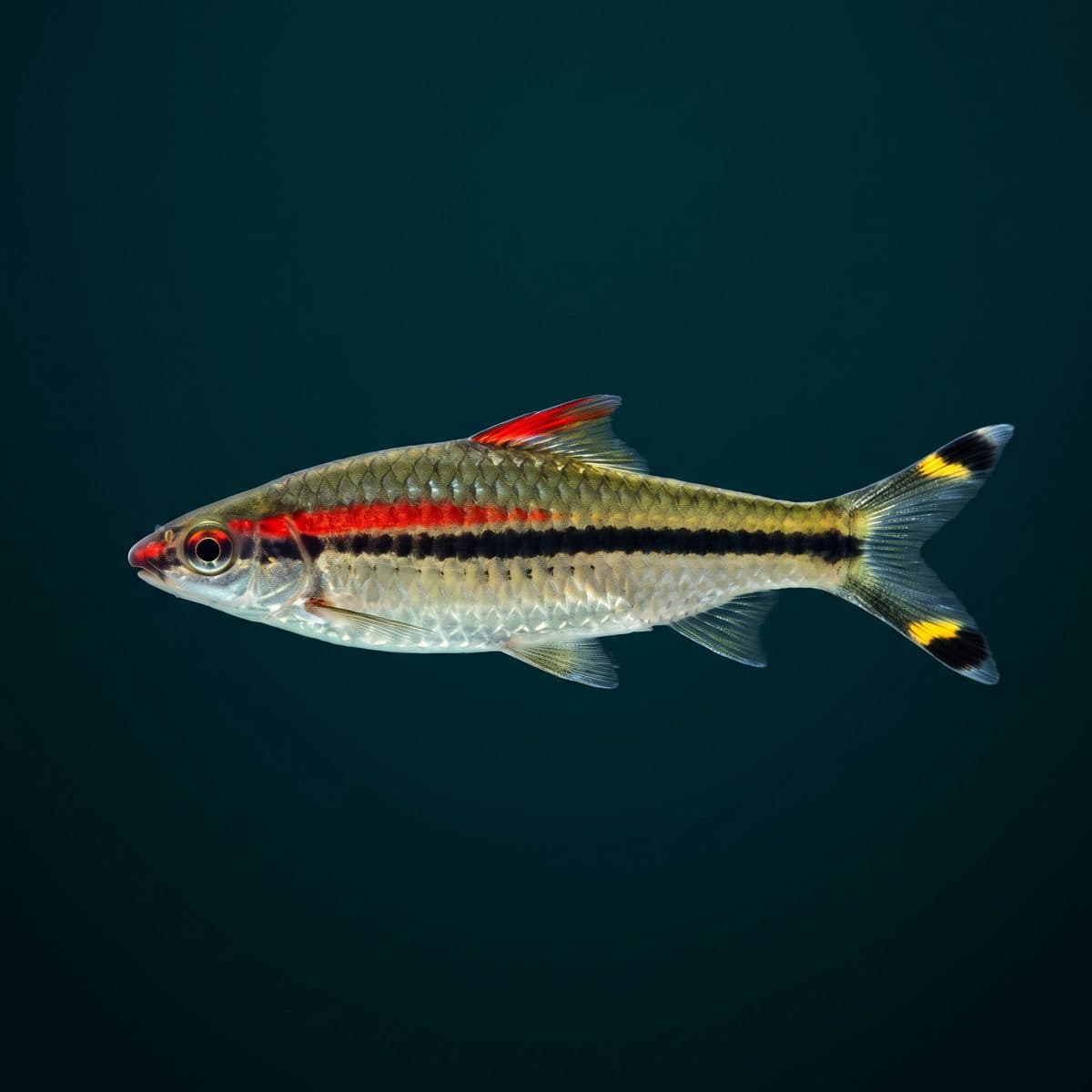
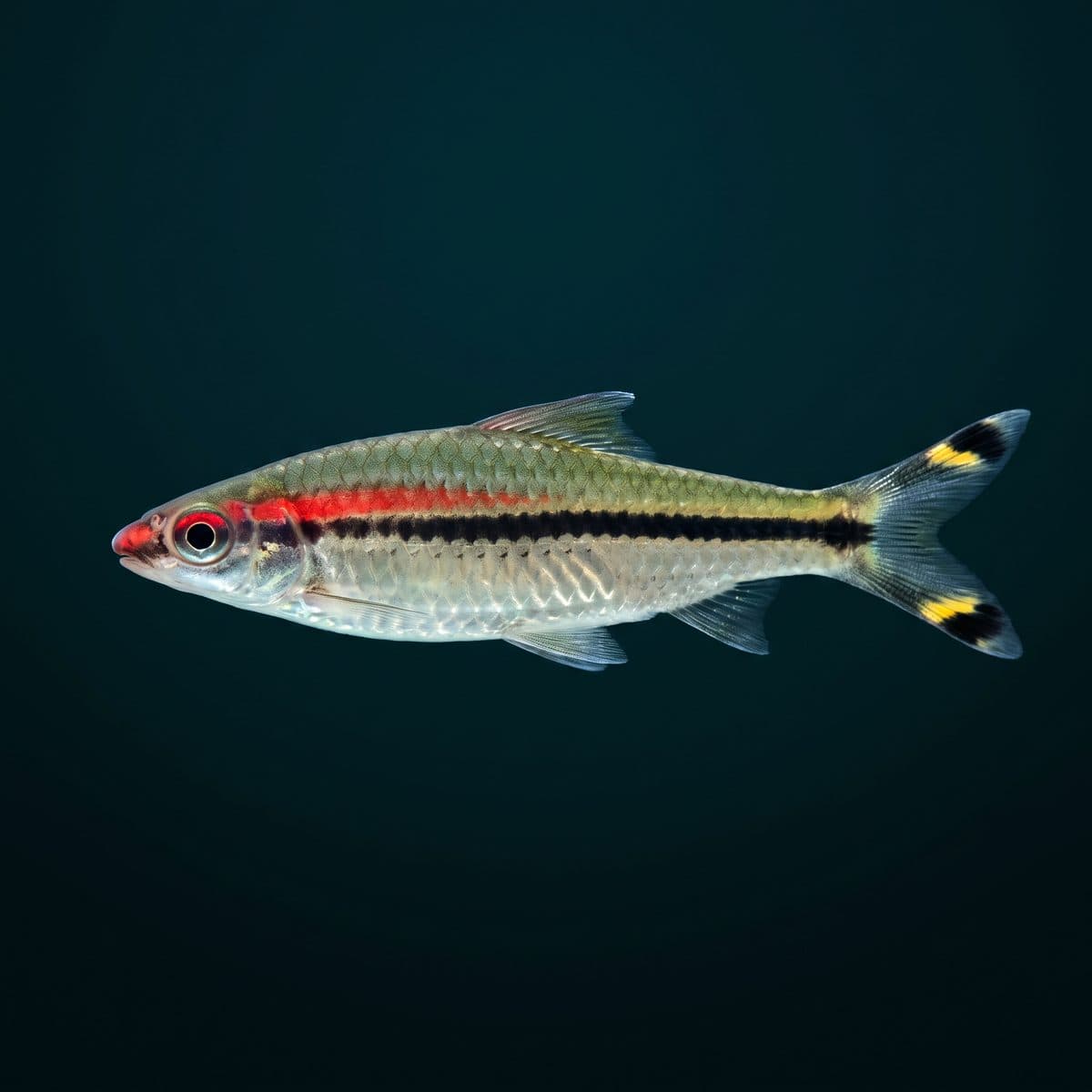
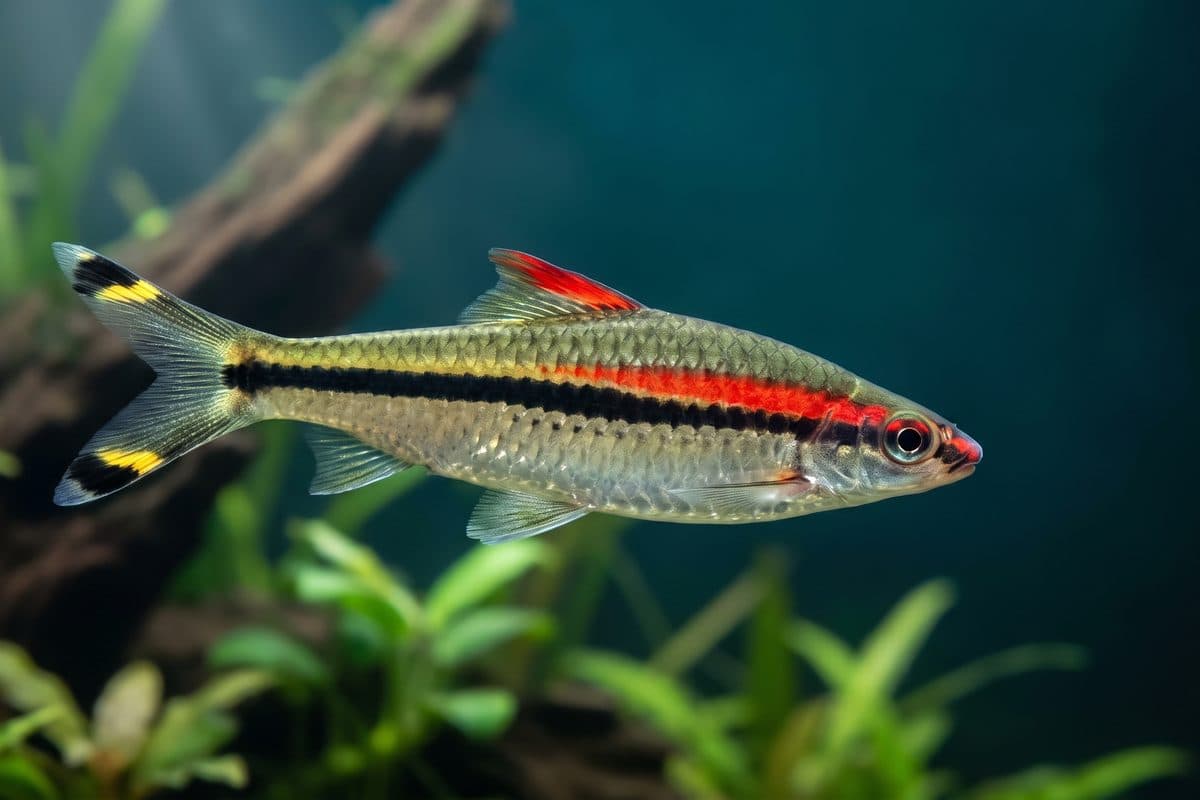
The Denison Barb's appearance is distinctive and unmistakable:
- Body shape: Elongated, torpedo-shaped, laterally compressed — built for strong currents.
- Base colour: Silver with a golden-olive tinge along the dorsal surface.
- Lateral markings: A bold black horizontal stripe runs from the snout through the eye to the caudal peduncle. Above this, a vivid red stripe extends from the tip of the snout to approximately the midpoint of the body (often reaching the dorsal fin origin). The red stripe is the species' signature feature.
- Caudal fin: Forked, with bold black and yellow-green bands on the upper and lower lobes.
- Dorsal fin: Bears a red leading edge in well-conditioned specimens.
Males and females are nearly identical in appearance, though mature females tend to be slightly deeper-bodied when in spawning condition. Colour intensity is influenced by diet, water quality, and stress level — well-maintained fish in a school display significantly more vivid red and sharper contrast than stressed or isolated individuals.
Tank Requirements
Denison Barbs are active, fast-swimming fish that need space to school and exercise:
- Minimum tank size: 55 gallons (208 L) for a school of 6; 75 gallons (284 L) preferred; 100+ gallons for schools of 10+.
- Tank dimensions: Length is more important than height — choose the longest tank available. A 48-inch (120 cm) minimum length is recommended.
- Water flow: Moderate to strong. Denison Barbs come from fast-flowing streams and thrive with a powerhead or wavemaker creating directional current. They will actively swim into the flow.
- Oxygenation: Excellent gas exchange is essential. Surface agitation from the filter return and/or a separate air stone ensures high dissolved oxygen levels.
- Substrate: Fine gravel or sand, mimicking their natural rocky stream habitat. Rounded river pebbles and smooth stones add authenticity.
- Plants: Hardy species that tolerate current — Anubias, Java Fern, Vallisneria, and Cryptocoryne are excellent choices. Dense planting along the sides and back provides visual barriers that reduce stress.
Water Parameters
The critical detail that many keepers miss is temperature — Denison Barbs are subtropical, not tropical:
- Temperature: 65–77 °F (18–25 °C). They tolerate the lower end of this range well and may be stressed by sustained temperatures above 80 °F (27 °C). A heater set to 72–74 °F (22–23 °C) is ideal for most setups.
- pH: 6.5–7.8.
- GH: 5–15 dGH.
- Ammonia/Nitrite: 0 ppm.
- Nitrate: Below 20 ppm.
These fish are sensitive to poor water quality — particularly elevated nitrate and low oxygen. Weekly 30% water changes and diligent filter maintenance are essential. In warmer climates, consider using a chiller or positioning the tank in the coolest room of the house.
Diet & Feeding
Denison Barbs are omnivores that accept a wide range of foods:
- Staple: High-quality flake or small pellet food with a protein content of 40%+.
- Frozen: Bloodworms, brine shrimp, daphnia, and mysis shrimp — offered 3–4 times per week.
- Live: Small insects, daphnia, and baby brine shrimp are eagerly consumed and promote natural foraging behaviour.
- Vegetable: Blanched spinach, spirulina flakes, and algae wafers. In the wild, they graze on algae and biofilm — vegetable matter should compose 20–30% of the diet.
Feed 2–3 times daily in amounts consumed within 2 minutes. The fast current in their tank means food disperses quickly, so ensure all fish in the school have access.
Behaviour & Schooling
Denison Barbs are obligate schooling fish — they must be kept in groups of at least 6, with 8–12 being ideal. In smaller numbers, they become skittish, lose colour, and hide excessively. In a proper school, they display their full behavioural repertoire: synchronised swimming, playful chasing, and bold exploration of the entire tank.
Despite their active nature, Denison Barbs are peaceful community fish. They do not nip fins, harass tank mates, or show significant territorial behaviour. Occasional in-group chasing is normal social behaviour and not a cause for concern — it establishes a loose hierarchy within the school.
Compatible Tank Mates
Their peaceful disposition and preference for cooler water make them compatible with:
- Other subtropical cyprinids: White Cloud Mountain Minnows, Cherry Barbs, Gold Barbs.
- Loaches: Clown Loach, Yoyo Loach, Zebra Loach (all appreciate similar current and temperature).
- Corydoras catfish: Bottom-dwellers that stay out of the barbs' mid-water territory.
- Rainbowfish: Active, similarly sized, and colourful — an excellent pairing.
- Bristlenose Pleco: Peaceful algae control that tolerates the moderate current.
Avoid very small fish that might be outcompeted at feeding time, slow-moving long-finned species, and aggressive cichlids.
Breeding
Breeding Denison Barbs in captivity is uncommon and considered moderately difficult. Most commercial captive breeding occurs on farms in Southeast Asia using hormone induction.
Natural spawning has been reported in large, well-established aquariums (100+ gallons) with the following conditions: a group of at least 10 fish, cool-water conditioning at 65–68 °F (18–20 °C) for several weeks followed by a gradual temperature increase to 77 °F (25 °C) simulating the monsoon season, a diet rich in live foods, and dense fine-leaved plants (Java Moss, Hornwort) for egg deposition.
Eggs are scattered among plants and are not guarded. Adults will eat eggs if given the opportunity, so either remove adults after spawning or use a separate breeding tank with a mesh bottom that allows eggs to fall through. Eggs hatch in 24–48 hours, and fry become free-swimming within 3–4 days. Start fry on infusoria, transitioning to baby brine shrimp and micro-worms as they grow.
Aquascaping a Denison Barb Biotope
Denison Barbs look their absolute best in a tank built to echo their native Western Ghats streams, and the good news is that this kind of setup also happens to keep them healthiest. Think fast, clear, rocky hill-stream: a long tank with open swimming lanes down the middle, smooth river rocks and rounded pebbles over a sand or fine-gravel bed, and a few pieces of driftwood for structure.
Because these are active, current-loving fish, aim the flow to create a definite direction they can swim into — a spray bar along the back or a powerhead at one end works well, and the barbs will happily school against it. Keep the hardscape and planting toward the sides and back so the central swimming channel stays clear; a cramped, cluttered tank cuts against everything these torpedo-shaped fish are built to do.
For plants, choose hardy species that tolerate strong flow and won't be uprooted: Anubias and Java Fern tied to wood and rock, Vallisneria and Cryptocoryne along the back, and tougher stem plants if you want more green. Denison Barbs don't eat healthy plants, so a well-planted tank is entirely compatible with them. Finish with a tight lid — like many stream fish, they're capable jumpers, especially when startled — and good surface agitation to keep oxygen levels high, which these fish demand.
Health & Common Problems
Denison Barbs are reasonably hardy once settled, but they're sensitive to two things in particular — poor water quality and low oxygen — and they can be delicate as new imports. Watch for:
- Ich (white spot): The classic stress-triggered parasite, common in newly imported or chilled fish. Raise the temperature and treat promptly; a stressed, freshly shipped school is especially vulnerable.
- Sensitivity to nitrate and low oxygen: These stream fish expect clean, highly oxygenated water. Sustained high nitrate or poor gas exchange leads to laboured breathing, faded colour, and general decline. Regular water changes and strong surface agitation are the fix.
- Bacterial and fungal infections: Usually secondary to stress or injury, showing as ulcers, fin rot, or fungus. Clean water and prompt treatment resolve most cases.
- Colour loss: Not a disease as such, but a reliable warning sign. A Denison Barb that's lost its vivid red stripe is telling you something's wrong — too small a group, poor water, or an overly warm tank.
Prevention comes down to the essentials: quarantine new arrivals for a few weeks (their wild-caught history makes this doubly important), keep the water cool, clean, and oxygen-rich, and maintain a proper school. Do that, and Denison Barbs are robust, active fish that live 5–8 years.
Choosing & Acclimating Denison Barbs
Buying Denison Barbs well starts before you even look at an individual fish. First, ask whether they're captive-bred — with the species listed as Endangered in the wild, farm-raised stock is both the ethical choice and usually the healthier, better-adapted one. Then watch the shop's school for a few minutes: healthy Denison Barbs are active, swimming mid-water, with bright, sharply defined red and black stripes.
Pick fish with full, rounded bellies, undamaged fins, and no signs of disease — avoid any that are hanging near the surface gasping, sitting listlessly on the bottom, looking pale, or showing white spots or frayed fins. Because these fish are so social, the condition of the whole group matters; if several fish in a tank look poor, be cautious about any of them, since they share the same water.
Buy the whole school at once wherever possible. Denison Barbs are obligate schoolers that settle far better added together than drip-fed into a tank over weeks, and a group of six or more spreads out the stress of a new environment. Acclimate them slowly and gently — they don't love abrupt change — into a mature, well-oxygenated, cool tank, and keep the lights dim for the first day. Expect some shyness and faded colour at first; within a week or two in a proper school and clean water, that vivid red stripe returns and they'll be cruising the tank confidently.