What Is Ich?
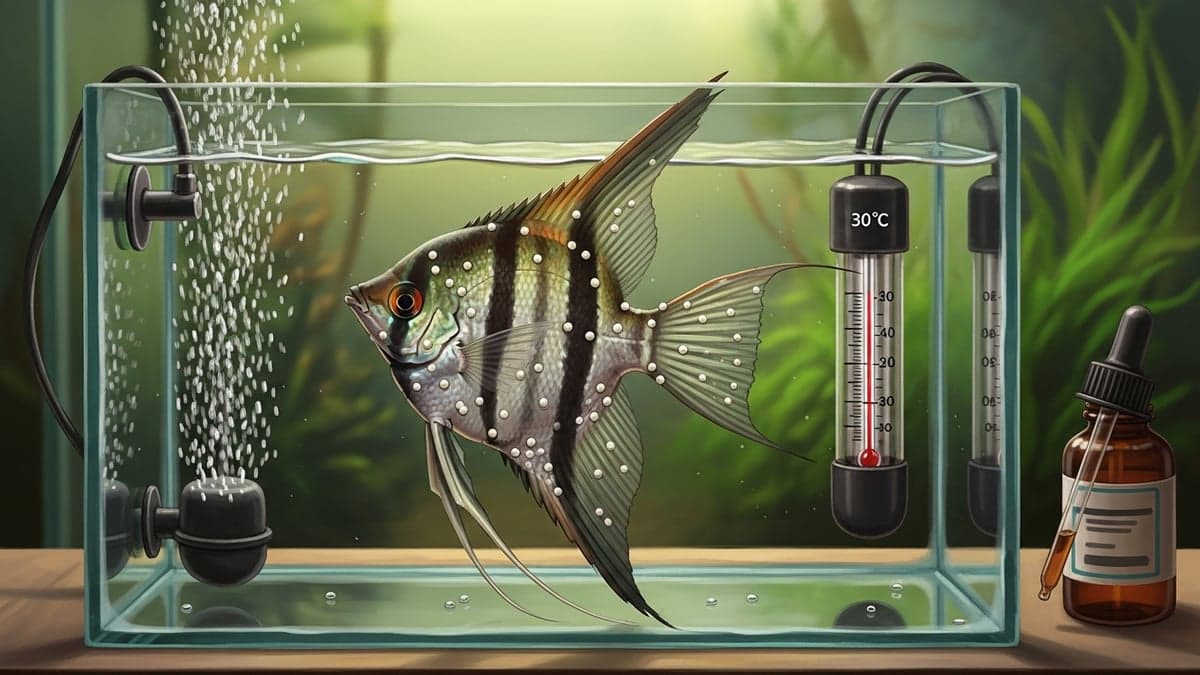
Ich — short for Ichthyophthirius multifiliis — is the most common parasitic disease in freshwater aquariums worldwide. It presents as small white spots (0.5–1.5 mm diameter) scattered across the fish's body, fins, and gills, giving the appearance of grains of salt or sugar sprinkled on the fish. Left untreated, Ich is fatal. The parasite destroys gill tissue, causing respiratory failure, and opens the skin to secondary bacterial and fungal infections.
Every aquarist will encounter Ich eventually. The parasite is ubiquitous — present in most water systems and carried asymptomatically by healthy fish with robust immune systems. Outbreaks are triggered by stress: temperature drops, poor water quality, overcrowding, transport, or the introduction of new fish. Understanding the parasite's life cycle is the key to effective treatment, because only one stage of the life cycle is vulnerable to medication.
The Ich Life Cycle
Ich has a three-stage life cycle that takes 4–14 days to complete depending on water temperature. Understanding each stage explains why treatment must continue long after visible spots disappear.
Trophont (Feeding Stage)
The trophont is the visible white spot on the fish. It is a parasite burrowed beneath the fish's epithelium (outer skin layer), feeding on cells and fluids. The trophont is completely protected from medication by the fish's own tissue — no chemical you add to the water can reach it at this stage. Each trophont feeds for 3–7 days before detaching from the fish and dropping to the substrate.
Tomont (Reproductive Stage)
After detaching, the trophont becomes a tomont — a reproductive cyst that attaches to substrate, plants, decorations, or filter media. Inside the cyst, the parasite divides repeatedly, producing up to 1,000 daughter cells called theronts. This process takes 6–72 hours depending on temperature. The cyst wall protects the dividing parasites from medication. At lower temperatures (below 70 °F / 21 °C), tomonts can remain dormant for weeks before rupturing.
Theront (Free-Swimming Stage)
When the cyst ruptures, hundreds of free-swimming theronts are released into the water column. These microscopic parasites actively seek a fish host. This is the only stage vulnerable to medication and salt. Theronts must find a host within 24–48 hours or they die. Once they penetrate a fish's skin, the cycle begins again.
The critical implication: you cannot kill Ich on the fish. You must wait for trophonts to detach, and kill theronts before they reinfect. Treatment must continue long enough to eliminate every generation — a minimum of 14 days at elevated temperature.
Diagnosing Ich
Ich is usually straightforward to identify:
- White spots: Distinct, raised, salt-grain-sized white dots on the body, fins, and tail. Unlike fungal infections (which appear cottony) or Lymphocystis (which forms irregular cauliflower-like growths), Ich spots are uniform, round, and clearly defined.
- Flashing: Fish rubbing or scratching against substrate, rocks, or decorations — an attempt to dislodge the irritating parasites.
- Clamped fins: Fins held tight against the body rather than extended normally.
- Lethargy and appetite loss: Infected fish become increasingly listless as gill damage progresses.
- Rapid breathing: Gill infestation impairs oxygen exchange. Fish may gasp at the surface.
If spots appear only on fins and are accompanied by ragged edges, consider fin rot instead. If the coating looks like fine gold dust rather than white spots, suspect velvet disease.
Heat Treatment Method
Raising temperature is the cornerstone of Ich treatment. Heat accelerates the parasite's life cycle, forcing trophonts off the fish faster and shortening the tomont encystment period — which means theronts are exposed to treatment sooner and more predictably.
- Raise temperature to 86 °F (30 °C) gradually over 24 hours (no more than 2 °F per hour). This temperature is lethal to many Ich strains on its own and accelerates the life cycle from 14 days to 4–5 days.
- Increase aeration. Warmer water holds less dissolved oxygen. Add an airstone or increase surface agitation to compensate.
- Maintain 86 °F for a minimum of 14 days after the last visible spot disappears from any fish. This ensures all tomont cysts have ruptured and all theronts have been killed.
- Lower temperature gradually back to normal over 48 hours once treatment is complete.
Heat alone can cure mild Ich outbreaks in heat-tolerant species (Discus, Rams, Bettas, most tetras). For severe infestations or species that cannot tolerate 86 °F, combine heat with medication or salt.
Medication Treatment
The most effective Ich medications contain malachite green and/or formalin:
- Hikari Ich-X: The gold standard. Contains malachite green and formalin in a pre-mixed, safe concentration. Dose per label instructions (5 mL per 10 gallons). Perform a 33 % water change before each re-dose. Treat every 24 hours for a minimum of 3 days after the last spot disappears, plus an additional 7 days at elevated temperature.
- Kordon Rid-Ich Plus: Another malachite green/formalin combination. Effective but slightly harsher on sensitive species than Ich-X.
- Seachem ParaGuard: An aldehyde-based alternative for malachite-green-sensitive species. Less potent but safer for scaleless fish.
Critical rules:
- Remove activated carbon from the filter before medicating — carbon adsorbs medications and renders them ineffective.
- Half-dose for scaleless fish (loaches, catfish, stingrays) and Tetras, which are sensitive to malachite green. Alternatively, use the salt method for these species.
- Never combine medications unless specifically directed by the manufacturer. Malachite green + copper, for instance, is synergistically toxic.
- Treat the entire tank, not just the visibly infected fish. Ich is in the water column and on every surface — isolating one fish does not eliminate the parasite from the display tank.
Aquarium Salt Treatment
Aquarium salt (sodium chloride, NaCl) kills Ich theronts through osmotic stress and is the safest treatment for sensitive species:
- Dissolve 1 tablespoon of aquarium salt per 5 gallons of tank water in a cup of tank water before adding.
- Add the dissolved salt solution gradually over 2–3 hours to avoid osmotic shock.
- Raise temperature to 82–86 °F simultaneously.
- Maintain salt concentration for 14 days after the last visible spot. When performing water changes, add replacement salt proportional to the volume of water removed.
- After treatment, gradually remove salt through successive water changes without salt replacement.
Caution: Some species are salt-sensitive. Corydoras, Otocinclus, most Plecos, and many plant species do not tolerate sustained salt exposure. For planted tanks, medication is usually preferable to salt. For tanks with salt-sensitive fish, use half the salt dose combined with heat.
Treating Sensitive Species
Scaleless fish and certain species require modified treatment protocols:
- Loaches and catfish: Half-dose malachite green medications. Prefer heat + half-salt or heat + Seachem ParaGuard.
- Bettas: Tolerate heat well (86 °F is within their upper comfort range). Heat + aquarium salt is effective and gentle. Ich-X at full dose is also well tolerated by Bettas.
- Goldfish and cold-water species: Cannot tolerate 86 °F. Use 80 °F maximum combined with full-dose Ich-X. Treatment duration extends to 21 days at lower temperatures due to the slower parasite life cycle.
- Stingrays: Extremely medication-sensitive. Heat alone (86 °F) is the safest approach. If medication is necessary, use ParaGuard at quarter dose under close observation.
Prevention Strategies
- Quarantine all new fish for 30 days in a separate heated, filtered tank before adding to the display. This is the single most effective Ich prevention measure. See our quarantine guide for setup details.
- Maintain stable temperature. Temperature drops of 3 °F or more suppress the immune system and trigger Ich outbreaks. Use a reliable, adjustable heater and verify with a separate thermometer.
- Keep water quality pristine. Ammonia and nitrite at 0 ppm, nitrate below 20 ppm. Stressed fish in poor water are Ich magnets.
- Avoid overcrowding. Overcrowded tanks concentrate parasites and increase transmission rates.
- Do not share nets, siphons, or equipment between tanks without disinfecting. Theronts and tomonts travel on wet surfaces.
Ich is treatable and preventable. The keys are understanding the life cycle, treating long enough, and maintaining the conditions that keep fish immune systems strong. For broader disease prevention, see our disease prevention guide.